Solar Financing Model
CAPEX vs RESCO: Which Solar Financing Is Best?
2026-02-20T00:00:00.000Z•8
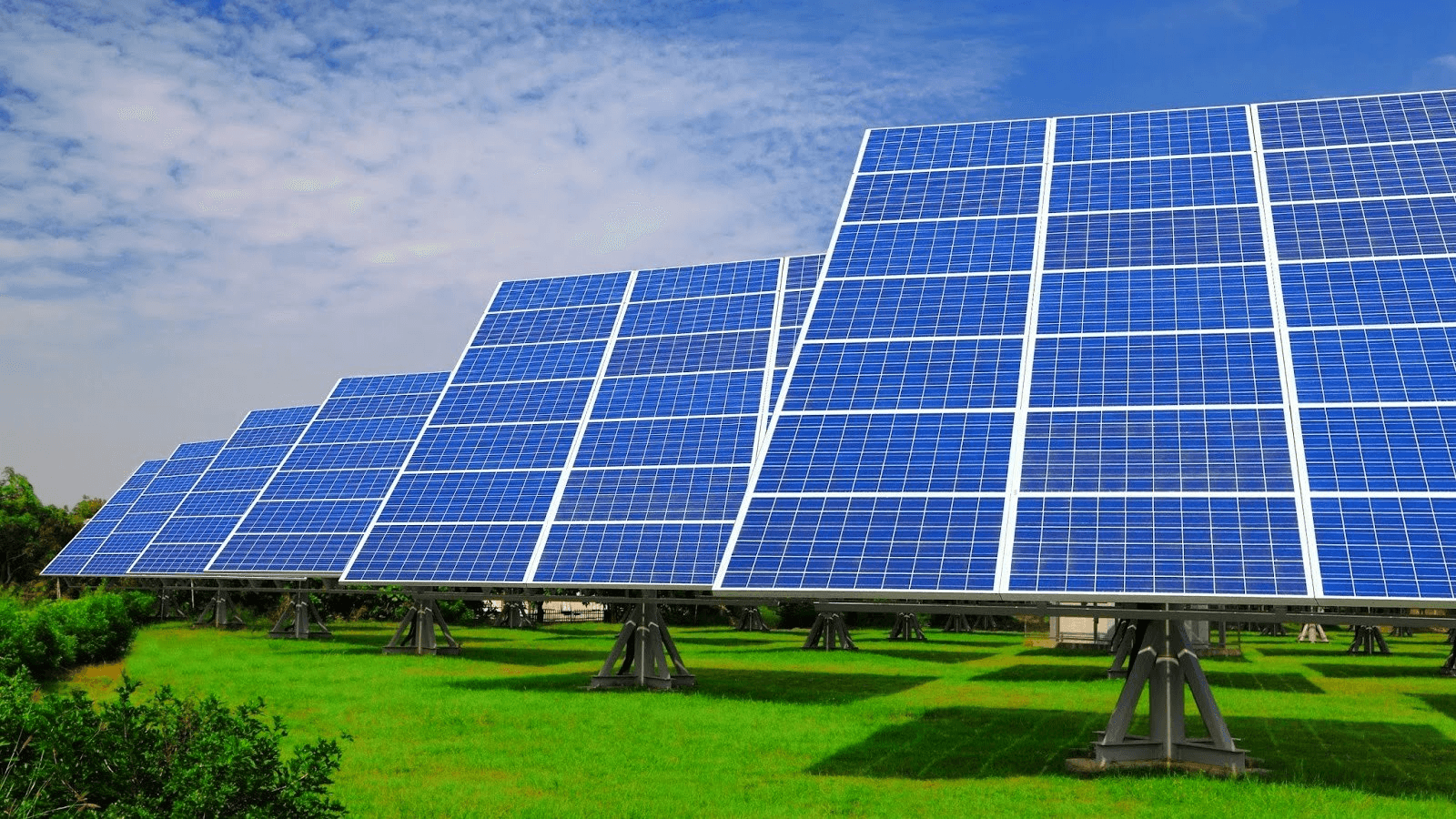
Choosing between CAPEX and RESCO solar financing determines whether you invest upfront to own the system or pay only for the power you consume with zero capital investment.
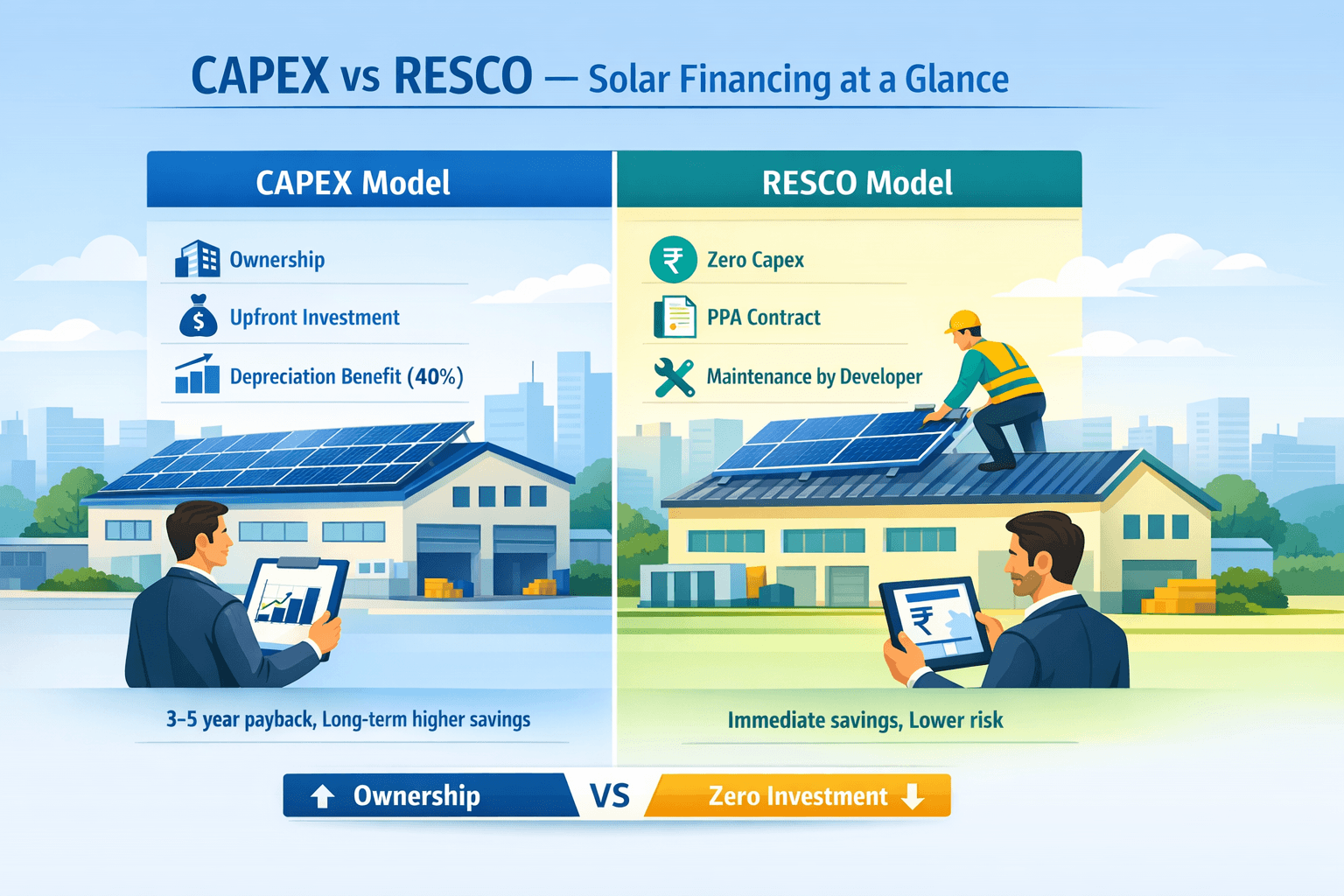
CAPEX model
: You own the solar system outright with high upfront investment but enjoy 40% accelerated depreciation and 3-5 year payback period
RESCO model
: Third-party owns and maintains the system while you pay only for electricity consumed at rates 20-50% cheaper than grid tariffs
CAPEX suits profitable businesses with available capital and tax appetite, while RESCO works for SMEs with limited cash flow
CAPEX delivers higher long-term savings (up to 70% reduction in electricity costs), but RESCO provides immediate savings from day one
Decision factors include upfront capital availability, tax liability, maintenance capacity, and long-term business goals
This analysis is backed by
Earthwave Solar's hands-on experience
executing commercial solar projects across manufacturing and industrial facilities in Gujarat and Madhya Pradesh
Our EPC team has guided businesses through both CAPEX and RESCO decisions, with real financial data from installations ranging from 50 kW to multi-MW capacities completed in 2024-2025.
Solar adoption has moved beyond environmental goals to become a strategic financial decision for Indian businesses facing electricity costs ranging from ₹8 to ₹16 per unit.
Commercial solar installations now deliver measurable ROI, making them essential for cost-conscious businesses across manufacturing, retail, and industrial sectors.
CAPEX (Capital Expenditure) means your business purchases and owns the entire solar power system outright.
You engage a solar EPC company for complete installation, then take full ownership of the asset.
Key characteristics:
Complete ownership and control of solar assets
Full responsibility for upfront investment (₹4-5 crore per MW)
You manage or contract annual operations and maintenance
Eligible for 40% accelerated depreciation under Section 32 of Income Tax Act
All electricity savings and surplus power sale revenue belongs to you
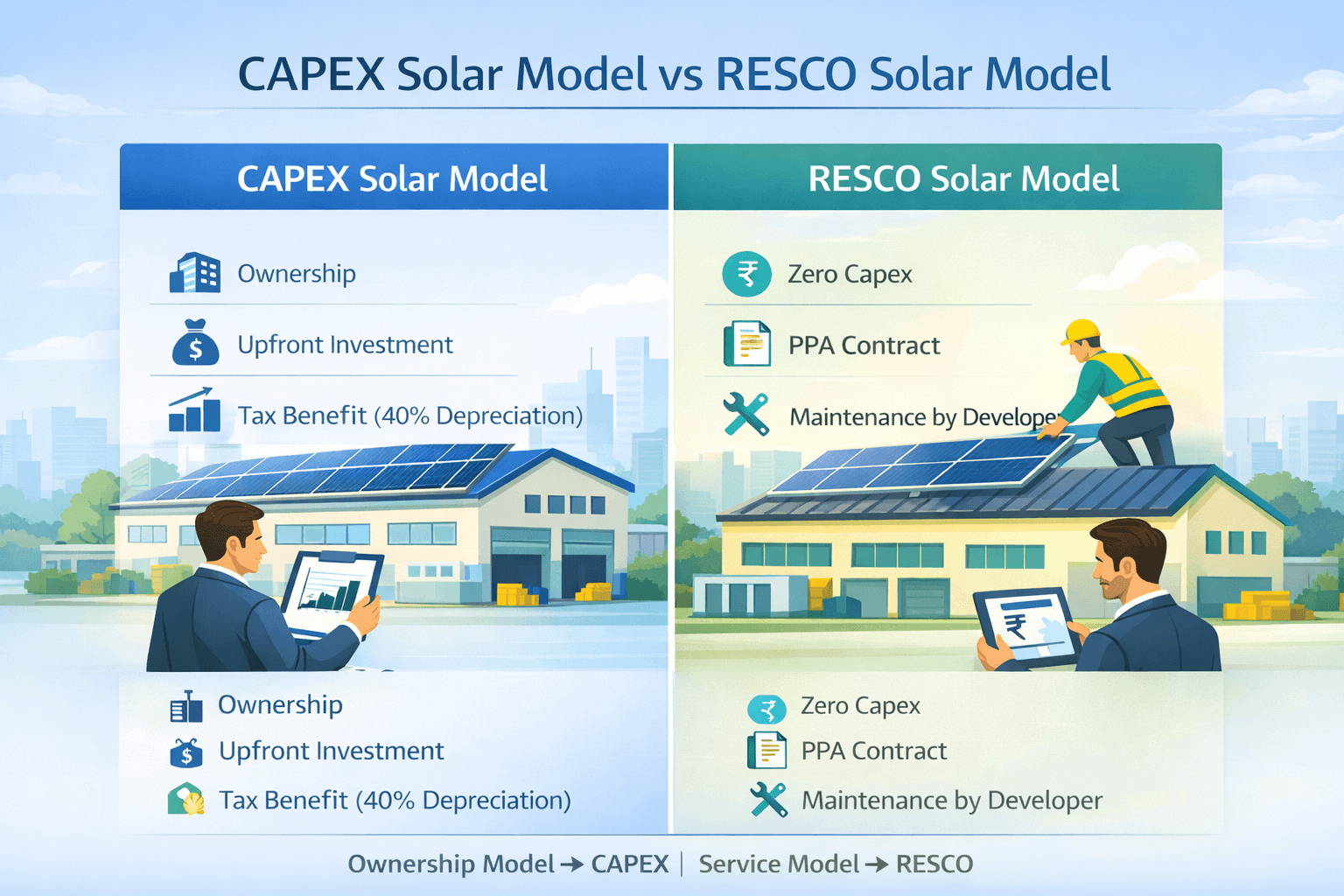
RESCO is a third-party ownership model where a solar developer installs, owns, operates, and maintains the system on your commercial rooftop or industrial facility.
You simply pay for the solar electricity you consume through a Power Purchase Agreement (PPA) typically spanning 10-25 years.
Key characteristics:
Zero upfront capital investment from your business
RESCO developer handles all installation, maintenance, and performance risks
You pay a fixed per-unit tariff (typically 20-50% lower than grid rates)
Agreement duration ranges from 10-25 years with various end-of-term options
Developer may transfer asset ownership after agreement period
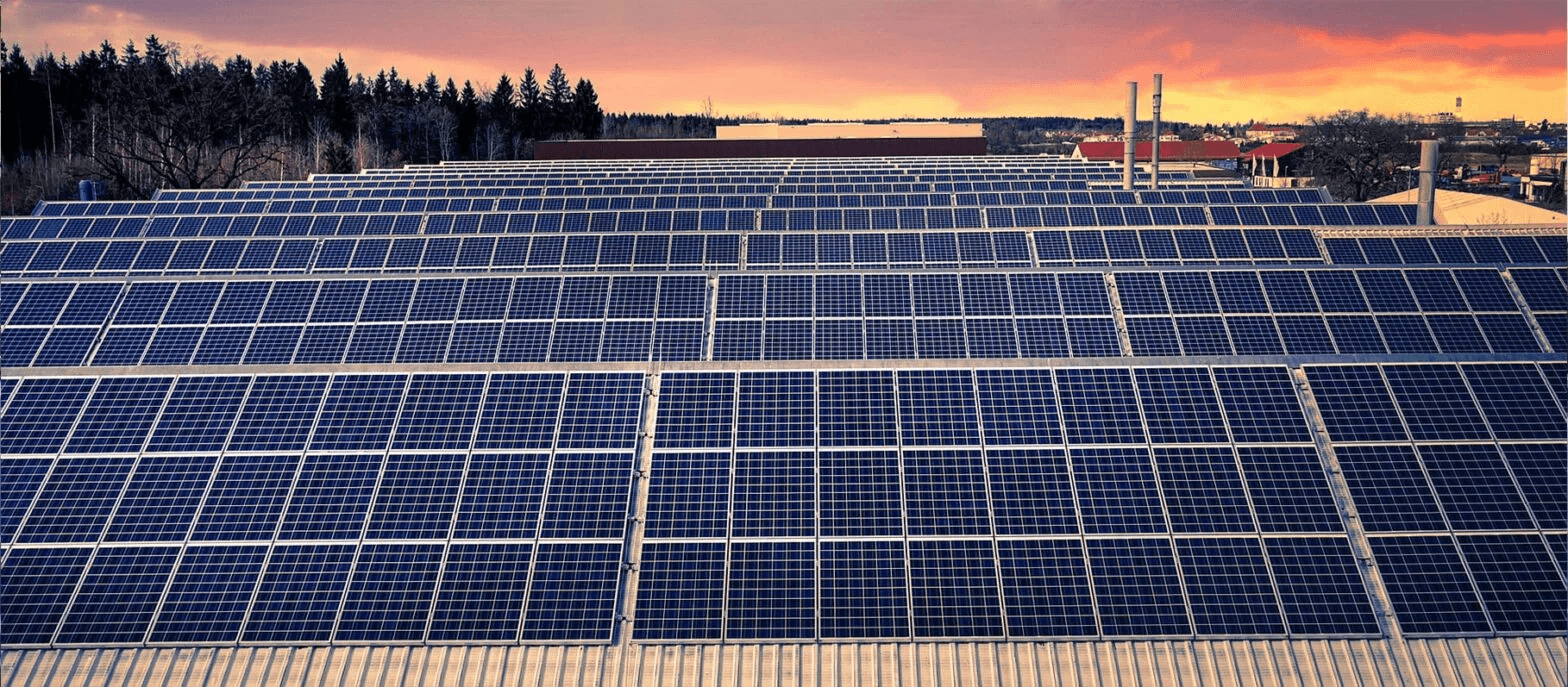
With CAPEX, you gain complete control over your energy asset and all associated benefits.
The solar system appears on your balance sheet as a tangible asset, increasing property value and demonstrating commitment to sustainability.
Upfront costs for 1 MW system:
Solar panels: ₹2.5-3.5 crore
Inverters: ₹70 lakh-₹1 crore
Mounting structures: ₹50-80 lakh
Civil works and electrical: ₹40-60 lakh
Grid connection and approvals: ₹50 lakh-₹2 crore
Total investment typically ranges from ₹4-5 crore per MW depending on system configuration and site requirements.
CAPEX model offers substantial tax advantages for profitable businesses.
Accelerated depreciation benefit:
Claim 40% depreciation on solar asset cost in first year
Reduces taxable income immediately, improving cash flow
Must be operational for more than 180 days in fiscal year to claim full benefit
Only available to businesses with taxable income against which depreciation can be offset
Learn how to maximize solar tax benefits and accelerated depreciation benefits with detailed calculations and eligibility criteria.
Financial performance metrics:
Payback period: 3-5 years for commercial installations
Annual ROI: 15-25% depending on consumption patterns
Internal Rate of Return (IRR): Often exceeds 20%
Post-payback energy costs: Less than ₹0.50 per unit for 20+ years
Manufacturing facilities can see even higher returns, discover how factories cut power costs by 40% through strategic solar deployment.
You assume full responsibility for system performance and maintenance.
Ongoing obligations:
Quarterly panel cleaning
Annual system diagnostics
Equipment repairs and replacements
Performance monitoring and optimization
Annual O&M costs: ₹5-8 lakh per MW
Many businesses contract the original EPC provider for annual maintenance at mutually agreed rates.
RESCO eliminates upfront investment entirely. The developer funds, installs, owns, and maintains the entire system while you simply pay for the solar power you consume.
Your only commitment: Sign a Power Purchase Agreement (PPA) and start saving from day one.
You buy solar electricity at a fixed rate significantly below grid tariffs.
Standard PPA terms:
Duration
: 10-25 years
Tariff
: ₹4-₹7 per unit (vs. ₹8-₹16 grid rates)
Escalation
: 3-5% annually or fixed throughout
Performance guarantee
: Developer ensures minimum generation
Monthly billing
: Pay only for units consumed
Real Savings: A business consuming 1 lakh units monthly saves ₹1.5-3 lakhs per month from the first bill itself.
The RESCO provider manages everything technical, transferring all operational risk away from your business:
24/7 remote system monitoring
Regular cleaning, inspections, and maintenance
All equipment repairs and replacements
Insurance and performance guarantees
Compliance with grid regulations
You focus on your business. The developer ensures your solar system performs.
After the PPA term, you typically have four options:
Purchase
the system at depreciated residual value (usually 10-20% of original cost)
Extend
the PPA at renegotiated lower rates
Transfer
ownership automatically (some agreements include this)
Remove
system if no longer needed (developer's responsibility)
Many RESCO agreements transfer full ownership after 5-10 years, giving you free electricity for 15-20 additional years.
Factor | CAPEX Model | RESCO Model |
Upfront Investment | ₹4-5 crore per MW | Zero |
Ownership | Business owns the asset | Developer owns during PPA |
Tax Benefits | 40% accelerated depreciation | Not available to business |
Maintenance | Business responsibility | Developer responsibility |
Savings Timeline | After 3-5 year payback | Immediate from day one |
Annual ROI | 15-25% | Not applicable (operational savings only) |
Long-term Savings | Up to 70% over 25 years | 20-50% during PPA period |
Risk Profile | Performance and maintenance risk | Risks transferred to developer |
Balance Sheet Impact | Creates capital asset | Operational expense only |
Contract Duration | Permanent ownership | 10-25 years |
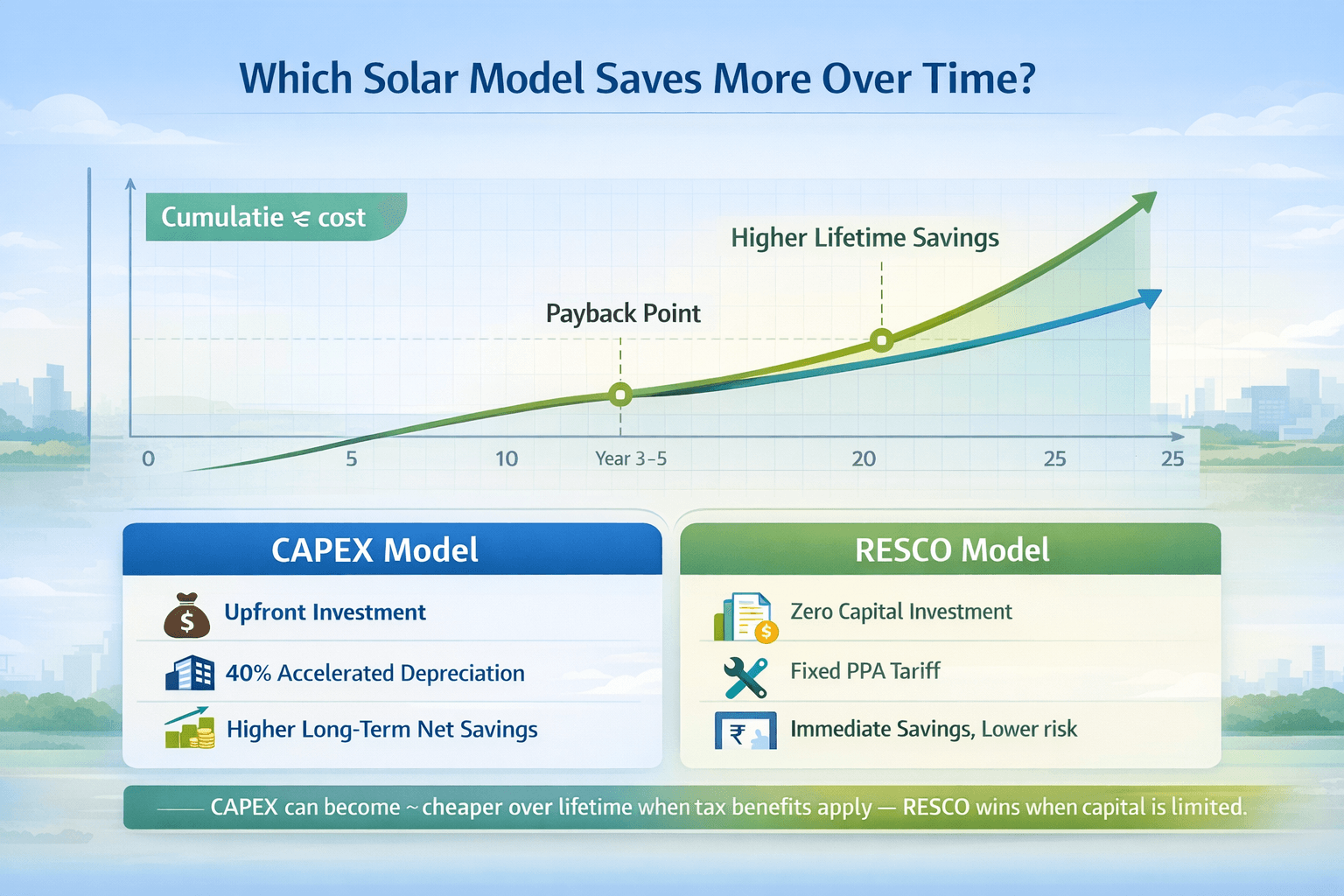
Research indicates CAPEX with accelerated depreciation benefit is approximately 14% cheaper than RESCO over the system lifetime.
25-year financial projection (100 kW system example):
Initial investment: ₹40-50 lakhs
Tax savings (Year 1): ₹16-20 lakhs (40% depreciation benefit)
Annual electricity savings: ₹8-12 lakhs
Total 25-year savings: ₹2-3 crore
Net return after investment: ₹1.5-2.5 crore
The accelerated depreciation benefit is the primary driver making CAPEX more financially attractive for profitable businesses.
RESCO provides consistent savings throughout the agreement period without upfront investment.
25-year financial projection (100 kW system, 10-year PPA example):
Initial investment: Zero
Monthly savings: 20-50% on solar consumption
Years 1-10: Pay PPA tariff to developer
Years 11-25: Free electricity if ownership transfers
Total savings: Lower than CAPEX due to PPA payments during initial period
RESCO makes sense when capital availability is constrained or when the business cannot utilize tax depreciation benefits.
The 40% first-year depreciation fundamentally changes CAPEX economics.
Without this tax benefit, both models deliver similar net present value to the business. For companies with insufficient tax liability, this advantage disappears, making RESCO more attractive.
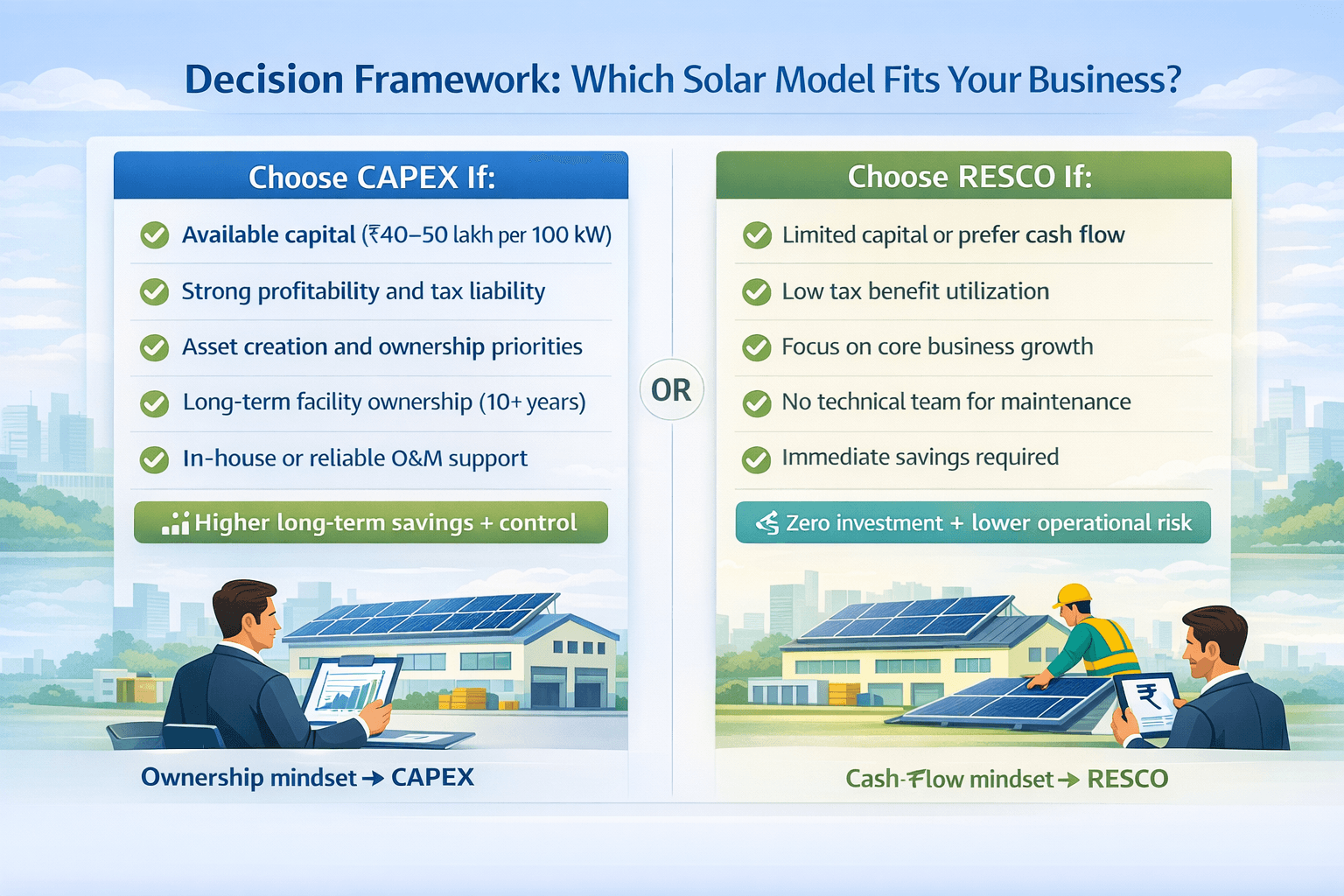
Financial position:
You have access to ₹40-50 lakhs per 100 kW capacity
Strong profitability with substantial tax liability to offset
Seeking capital asset creation for balance sheet strength
Operational factors:
Long-term facility ownership (10+ years planned)
In-house maintenance capability or established vendor relationships
Desire maximum long-term savings and full system control
Business profile:
Large manufacturing units with high power consumption
benefit most from CAPEX ownership with accelerated depreciation advantages.
Established enterprises with available capital reserves
Companies prioritizing asset ownership and balance sheet optimization
Financial position:
Limited capital availability or prefer to preserve cash flow
Insufficient tax liability to benefit from accelerated depreciation
Need to deploy capital toward core business growth instead
Operational factors:
Limited technical expertise for solar system management
Preference for outsourced maintenance and performance risk
Require immediate cost savings without waiting for payback
Business profile:
Small and medium enterprises with capital constraints
Commercial complexes and retail facilities
Businesses in leased premises with uncertain long-term tenure
Companies seeking solar benefits without operational burden
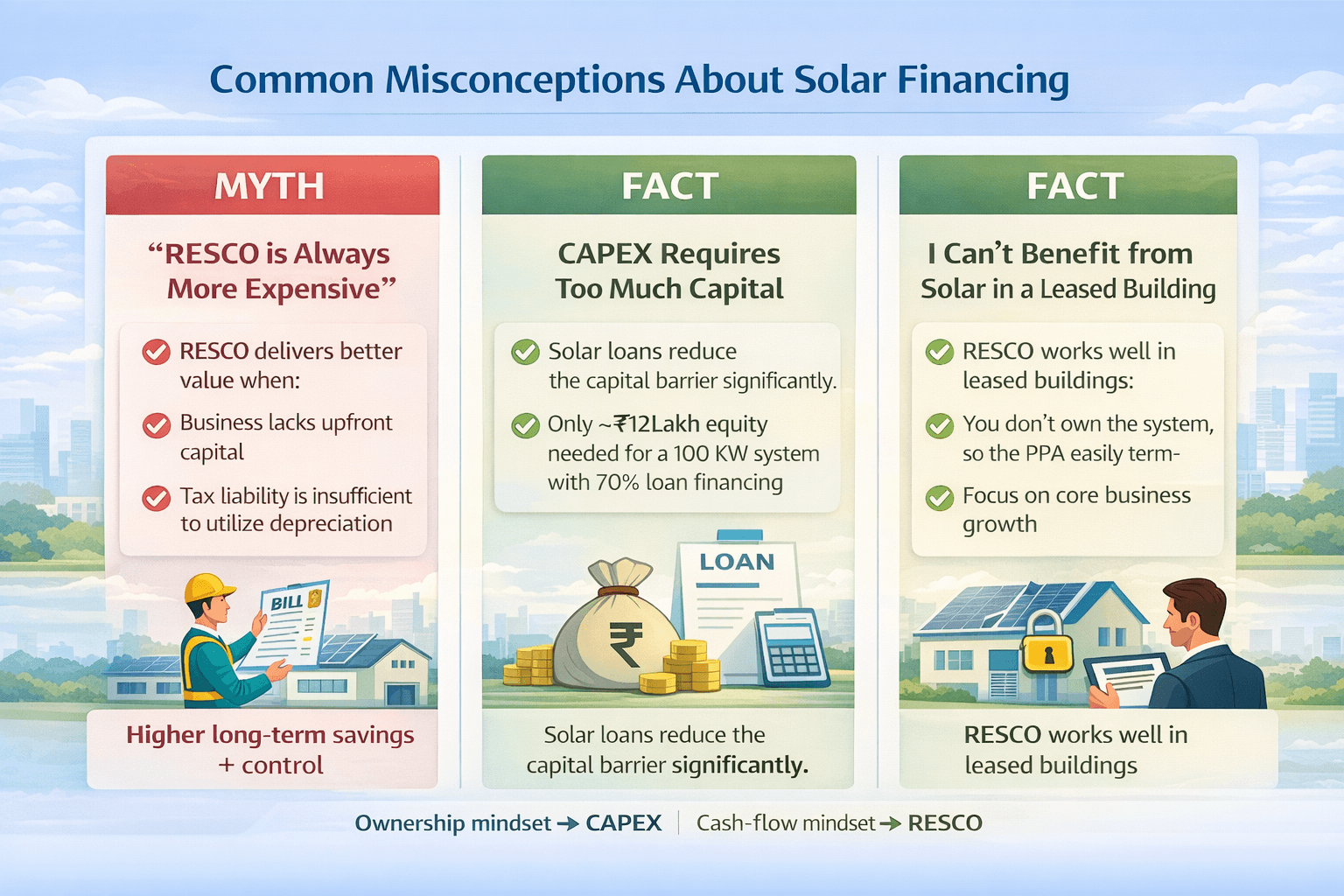
While RESCO costs more over 25 years compared to CAPEX for profitable businesses, it delivers better value when:
Business lacks capital for upfront investment
Tax liability is insufficient to utilize depreciation
Technical expertise for system management is unavailable
For these scenarios, RESCO's immediate savings outweigh CAPEX's long-term advantage.
Solar loans and financing options reduce the capital barrier significantly.
With 70% loan financing, a 100 kW system requiring ₹40 lakhs total investment needs only ₹12 lakhs equity. The remaining amount is financed through commercial debt.
RESCO model specifically addresses this situation.
Since you don't own the system, there's no asset stranded when relocating. The PPA simply terminates, or transfers to the new tenant with landlord approval.
The optimal choice between CAPEX and RESCO depends on your specific business context rather than a universal "best" model.
Understanding how to calculate your solar energy savings helps you make data-driven comparisons between both financing models.
Critical evaluation questions:
What is your current annual electricity expenditure?
Do you have available capital or prefer to preserve cash flow?
What is your effective tax rate and ability to utilize 40% depreciation?
Do you plan to occupy this facility for 10+ years?
Does your team have bandwidth for system maintenance oversight?
What is your risk tolerance for operational performance?
Answer these honestly to align your solar financing choice with business realities.
Whether you choose CAPEX for maximum long-term returns or RESCO for immediate savings with zero investment, solar power delivers verified financial benefits for Indian businesses.
The right financing model amplifies these benefits based on your unique business situation.
Ready to evaluate solar for your facility?
Schedule a free consultation with Earthwave Solar's EPC experts to receive a customized feasibility report comparing CAPEX and RESCO models for your specific facility. Our team analyzes your energy consumption, roof characteristics, and financial position to recommend the optimal solar strategy.
Contact us today for a detailed assessment including system design, financial projections, and implementation roadmap tailored to your business.
The payback period for CAPEX solar installations typically ranges from 3-5 years for commercial and industrial facilities, depending on electricity tariff rates, solar irradiance, and available tax benefits like 40% accelerated depreciation.
Yes, most RESCO agreements include a buyout option allowing you to purchase the system at residual value after a specified period (typically 5-10 years), effectively converting from RESCO to ownership model.
Commercial and industrial solar installations do not qualify for direct subsidies in India. However, CAPEX model businesses can claim 40% accelerated depreciation benefit, which significantly reduces effective system cost through tax savings.
Quality RESCO agreements include provisions for asset transfer or assignment to another qualified developer. Verify the financial stability and track record of the RESCO provider before signing agreements to minimize this risk.
Yes, both models work for small installations starting from 10-20 kW capacity. RESCO particularly suits smaller businesses as it eliminates the capital barrier, while smaller CAPEX investments (₹4-8 lakhs) become manageable for businesses with moderate capital availability.
FAQS
Can't find the answer you're looking for? Our team is here to help.
SUBSCRIBE NEWSLETTER
Switching to solar is easier than you think. Let us guide you to cleaner, more affordable energy.
