EPC vs Non-EPC Solar
EPC vs Non-EPC Solar Contractors: Key Differences
2026-06-25T00:00:00.000Z•8
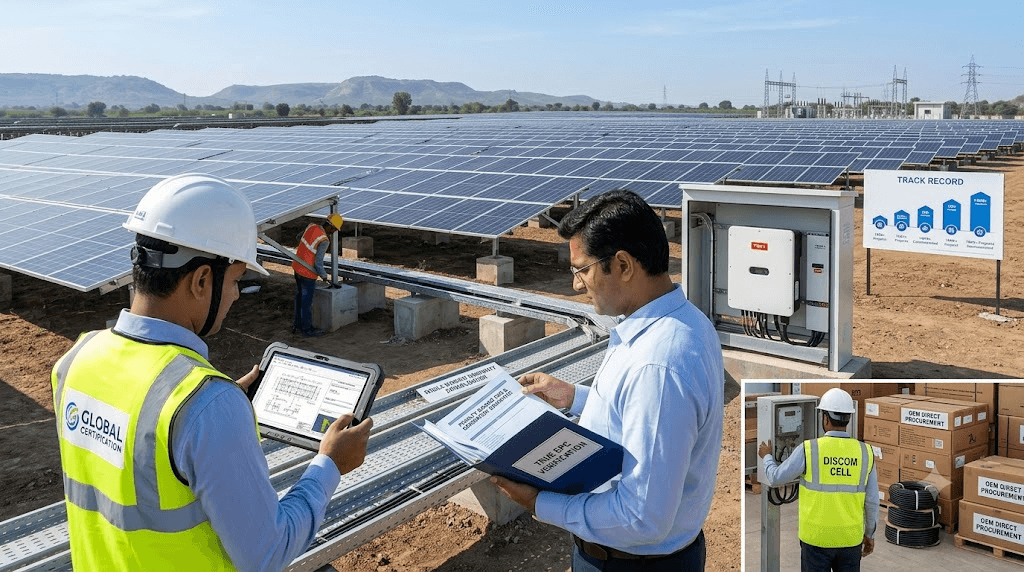
An EPC solar contractor takes full responsibility for engineering, procurement, construction, approvals, warranty, and generation, while a non-EPC contractor (reseller, installer, integrator, or local electrician) owns only one or two of those layers.
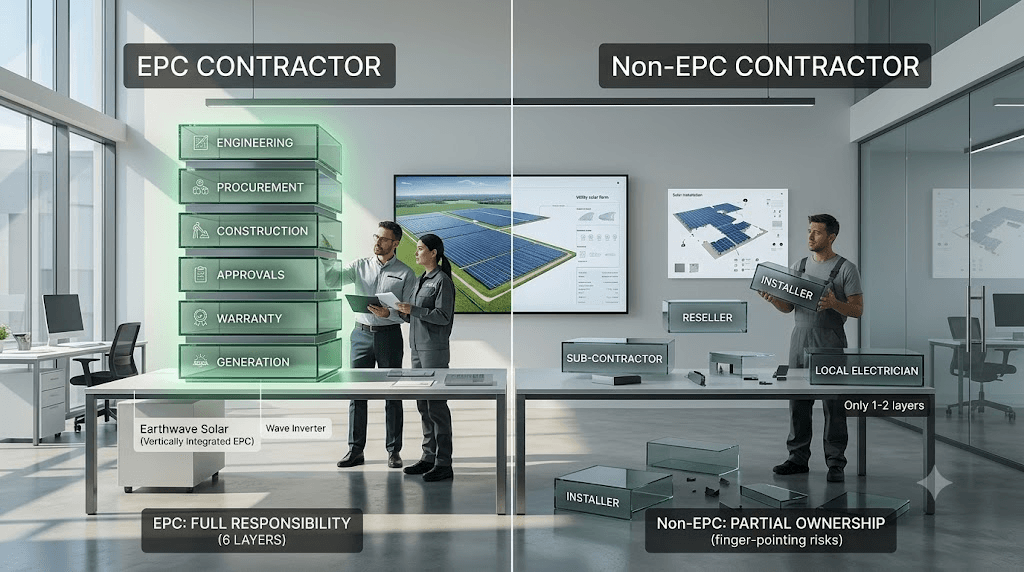
The real difference is not price. It is who owns the project when something fails.
For the broader buying framework, read our solar EPC company checklist for India.
An EPC owns 6 layers: engineering, procurement, construction, approvals, warranty, generation.
A non-EPC contractor (reseller, installer, integrator, sub-contractor) owns 1 to 2 layers only.
EPC quotes look 8% to 15% higher but cut 5-year total cost of ownership by 12% to 20%.
DISCOM, CEIG, and net-metering rejections are the #1 reason non-EPC projects fail.
Earthwave Solar is a vertically integrated EPC with in-house Wave inverter and module manufacturing.
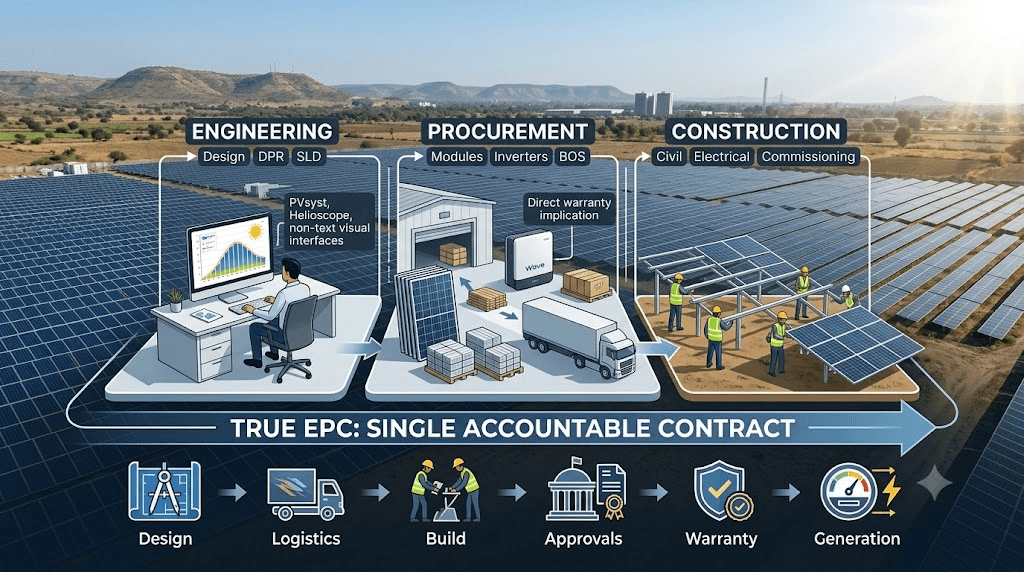
EPC in solar means a single contractor owns Engineering, Procurement, and Construction under one accountable contract. Anything less than this is not EPC, even if the vendor calls themselves one.
Engineering:
Design, DPR, SLD, generation modelling (PVsyst, Helioscope).
Procurement:
Modules, inverters, MMS, cables, transformers, BOS.
Construction:
Civil, electrical, commissioning, handover.
Bankable engineering and DPR
Procurement and BOM ownership
Civil and electrical construction
DISCOM, CEIG, GPCB, net-metering approvals
Single-window warranty consolidation
Generation and performance guarantee
Many resellers and integrators claim "turnkey" but only sub-contract civil, approvals, and O&M. A real EPC owns the contract clauses, the LD exposure, and the COD.
Read the solar EPC process in Gujarat for the full execution flow.

A non-EPC solar contractor is any vendor who takes responsibility for only part of the project. Most "solar companies" in India fall into one of 5 non-EPC categories.
Solar reseller (channel partner):
Sells modules and inverters of a parent brand. No engineering, no warranty ownership.
Solar installer or local electrician:
Handles wiring and panel mounting. No DISCOM coordination, no DPR.
Solar integrator:
Buys components, installs them. Does not own civil, approvals, or generation guarantee.
Solar sub-contractor:
Works under a larger EPC. Has no direct contract with the project owner.
Solar supply-only vendor:
Sells the BOM only. Installation and approvals are the owner's job.
Each has a place. None is a substitute for a turnkey EPC on a serious project.
The cleanest way to read a solar quote is to compare scope, not price. Use this 12-point comparison to classify your vendors before signing anything.
Dimension | EPC Contractor | Non-EPC Contractor |
Engineering & design | In-house, bankable DPR | Outsourced or skipped |
BOM selection & procurement | OEM-direct, locked BOM | Open-market sourcing |
Civil & structural | In-house or accountable | Owner's responsibility |
Installation & commissioning | Single team | Multiple vendors |
DISCOM, net-metering, CEIG | In-house cell | Owner's job |
Warranty consolidation | Single window | 6 to 10 separate vendors |
Generation guarantee | Contractual | Verbal at best |
Liquidated damages | Capped LD clauses | Rarely signed |
Single accountability | One contract owner | Diffused |
O&M and after-sales | Bundled or optional AMC | Walk away after handover |
COD timeline commitment | Penalty-backed | Estimate only |
Bankability for lenders | Strong | Weak to none |
Use this alongside our solar EPC red flags in Gujarat guide to catch fake EPCs.
Non-EPC contractors usually deliver fine on day 1. The problems show up between month 3 and year 3.
A small factory hires a local electrician who installs panels in 3 weeks. Net-metering paperwork is never filed. The plant runs without DISCOM approval and faces disconnection notices in month 4.
A 100 kW C&I rooftop drops 18% in year 2. The reseller blames the inverter OEM. The OEM blames the installer. The owner is stuck without a generation guarantee.
An integrator commissions a 500 kW plant. By year 3, the module supplier changes hands, the inverter brand exits India, and the integrator has wound down. The owner self-funds repairs.
A sub-contractor uses non-galvanised mounting structures to save cost. The first Gujarat monsoon causes rusting and panel detachment. Re-installation costs 22% of original CAPEX.
These scenarios are why we wrote our solar plant maintenance checklist.
Non-EPC contracts look cheaper on paper but cost more across the 25-year asset life. The cost is rarely visible at the quotation stage.
Warranty fragmentation:
Coordinating 6 to 10 vendors during a single failure event.
No accountability for generation shortfall:
A 10% under-generation costs ₹50,000+ per year per 100 kW.
Post-installation patch-ups:
Drainage, earthing, and cable rework cost 5% to 8% extra.
DISCOM and CEIG rejection delays:
30 to 90 days of lost generation.
Insurance and lender problems:
Most lenders refuse to finance non-EPC contracts.
Compare these losses against expected solar energy savings in India.
A non-EPC contractor is not always wrong. There are 4 narrow situations where hiring one is a reasonable choice.
Residential systems under 3 kW:
Where complexity is low and DISCOM is straightforward.
Supply-only deals with in-house engineering:
Large corporates with their own design team.
Retrofits or minor expansions:
Where the original EPC is unavailable.
Hard-capped budgets with conscious risk:
Where the owner accepts warranty and generation risk.
Outside these cases, hiring a non-EPC contractor is a cost-saving illusion.
Use this 10-point checklist to separate a real EPC from a vendor pretending to be one.
In-house engineering and design team with named engineers.
OEM-direct procurement, not open-market sourcing.
Civil and structural capability (in-house or accountable sub-contractors).
Dedicated DISCOM, CEIG, and net-metering cell.
Single-window warranty consolidation for 10 to 25 years.
Penalty-backed COD and generation guarantee in writing.
Bankable DPR with PVsyst or Helioscope modelling.
Track record of projects above 100 kW (ideally above 1 MW).
Tier-1 module and Tier-1 inverter empanelment.
Transparent CAPEX with itemised BOM, not lump-sum quotes.
For inverter benchmarks, read our best solar inverter brands in India guide.
Six red flags tell you a vendor is non-EPC, even if the proposal says EPC on the cover page.
Quotation arrives within 24 hours of a 10-minute call with no site visit.
No engineering or design team named in the proposal.
BOM uses generic terms like "branded module" or "leading inverter."
No mention of CEIG, DISCOM, or GPCB in the scope of work.
Vendor refuses to sign LD or generation guarantee clauses.
Warranty handled "through the manufacturer directly," not the EPC.
If 2 or more of these show up, classify the vendor as non-EPC immediately.
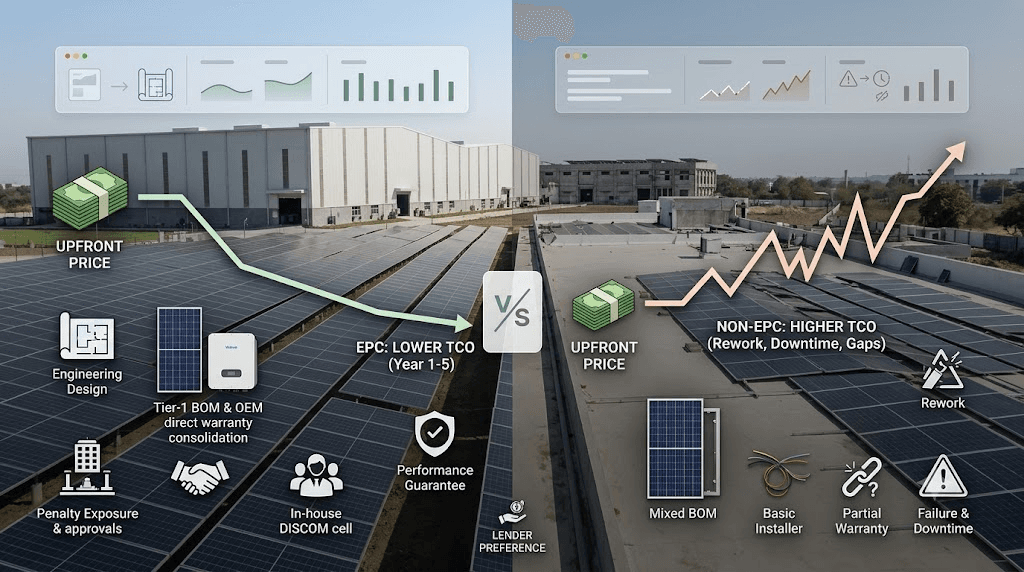
EPC quotes look 8% to 15% higher than non-EPC quotes, but deliver lower total cost of ownership across 5 years.
Bankable engineering and design effort
Tier-1 BOM and Tier-1 inverter pricing
Full warranty consolidation cost
Penalty exposure (LD and generation guarantee)
In-house DISCOM and CEIG team overhead
EPC:
Lower failure rate, fewer warranty claims, higher generation.
Non-EPC:
Lower upfront price, but 12% to 20% higher 5-year TCO due to rework, downtime, and generation gaps.
Banks and NBFCs financing solar above ₹1 Cr usually insist on an EPC contract structure for lendability. Read CAPEX vs RESCO solar financing for the funding angle and solar payback period India 2026 for ROI math.
A vertically integrated EPC owns more BOM layers in-house and removes vendor handoffs from the project. This is the most resilient EPC model in India today.
The EPC manufactures or owns one or more of the major BOM lines: solar modules, inverters, or mounting structures. Procurement risk drops, warranty becomes single-window, and COD compresses.
Faster COD because module and inverter inventory is internal.
Lower supply chain risk during ALMM, BCD, or container disruptions.
Single warranty across the BOM (modules + inverters + civil).
Better generation guarantee economics.
Read our deep dive on the Wave on-grid inverter for India.
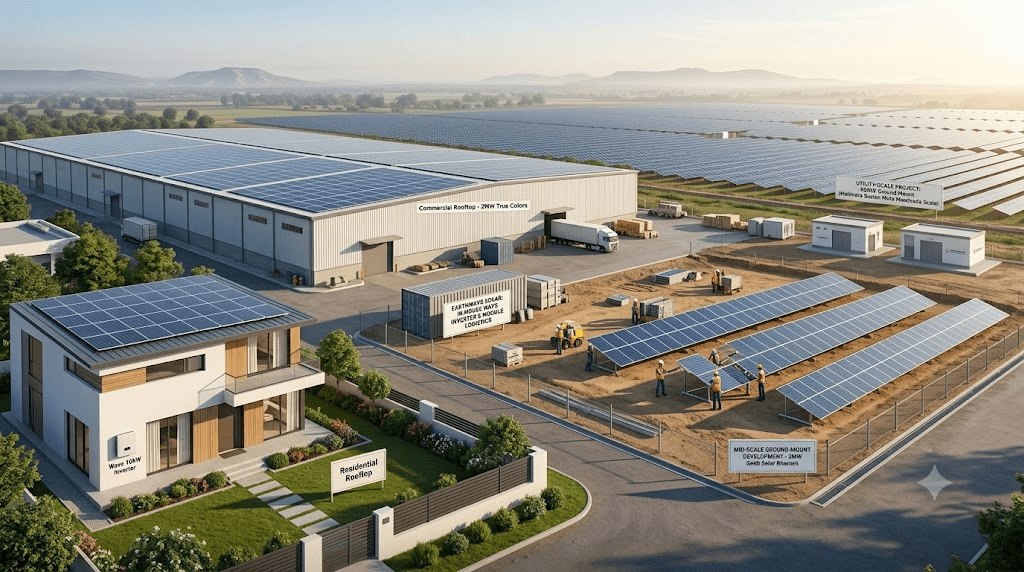
Earthwave Solar is a vertically integrated EPC delivering rooftop, residential, commercial, ground-mount, and Wave hybrid projects across India.
80 MW ground-mount for Mahindra Susten
at Mota Mandvada, Bagasra.
2 MW Goldi Solar ground-mount
at Amod, Bharuch.
170 kW Pari Textile rooftop
at Diamond Nagar.
2 MW True Colors industrial rooftop
at Palsana.
4 MW Zudvadli ground-mount
under execution.
Browse the full project portfolio.
Wave inverter manufacturing in-house since 2024.
Solar module manufacturing from 2025.
Dedicated DISCOM, CEIG, and GPCB approval cell.
Civil, drainage, and fencing teams for ground-mount.
Transparent CAPEX, locked BOM, penalty-backed COD.
Earthwave's full service stack covers rooftop, residential, commercial, ground-mount, and Wave hybrid projects.
Most buyers stay stuck between quotes because they compare prices, not scope. A 5-step decision framework fixes this in one afternoon.
Classify each vendor
as EPC or non-EPC using the 12-point comparison.
Compare scope, not price.
Strip every quote down to the 6 EPC layers.
Run the 10-point EPC verification checklist
on the top 3 vendors.
Demand LD and generation guarantee in writing.
Vendors who refuse drop off the shortlist.
Shortlist 2 EPCs and run a final site visit
with engineering, civil, and electrical leads present.
Cross-reference your CAPEX numbers with solar EPC cost in Gujarat factories and use accelerated depreciation tax benefits to model your final IRR.
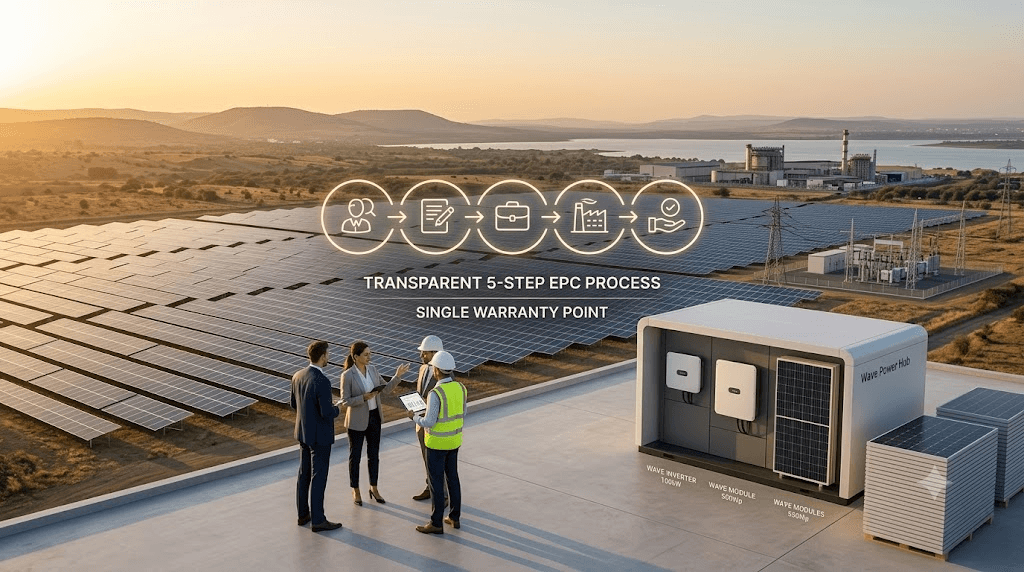
Earthwave Solar is a Surat-based vertically integrated EPC with operations in Bhopal and project delivery across Gujarat, Madhya Pradesh, and multiple Indian states. Established in 2018, the company scaled from 100 kW to 80 MW utility-scale execution, launched Wave inverter manufacturing in 2024, and added solar module manufacturing in 2025.
True full-scope EPC across engineering, procurement, construction, approvals, warranty, and generation.
In-house Wave inverter and module manufacturing for supply chain certainty.
Trusted by Goldi Solar, Mahindra Susten, GUVNL, Torrent Power, Solnce, Deon Energy, True Colors, and Rajesh Power Services.
Transparent 5-step process from consultation to handover.
Single warranty point across the BOM.
Meet the Earthwave leadership team who structure each project.
An EPC owns engineering, procurement, construction, approvals, warranty, and generation under one contract. A non-EPC contractor owns only 1 or 2 of these layers, leaving the rest to the owner.
EPC quotes look 8% to 15% higher upfront but deliver 12% to 20% lower total cost of ownership across 5 years due to better generation, single-window warranty, and fewer post-installation reworks.
Technically yes, practically no. A 100 kW plant needs structural sign-off, DISCOM net-metering, CEIG inspection, generation modelling, and warranty management. Local electricians rarely handle these layers.
With a true EPC, the EPC is your single accountable point for module, inverter, civil, and generation issues. With a non-EPC contractor, you coordinate 6 to 10 separate vendors yourself.
Earthwave Solar is a vertically integrated EPC. It owns engineering, procurement, construction, approvals, warranty, and generation in-house, plus manufactures its own Wave inverters and solar modules.
FAQS
Can't find the answer you're looking for? Our team is here to help.
SUBSCRIBE NEWSLETTER
Switching to solar is easier than you think. Let us guide you to cleaner, more affordable energy.
