Ground-Mounted Solar Gujarat
Ground-Mounted Solar Plant in Gujarat: Full Guide
2026-06-25T00:00:00.000Z•9
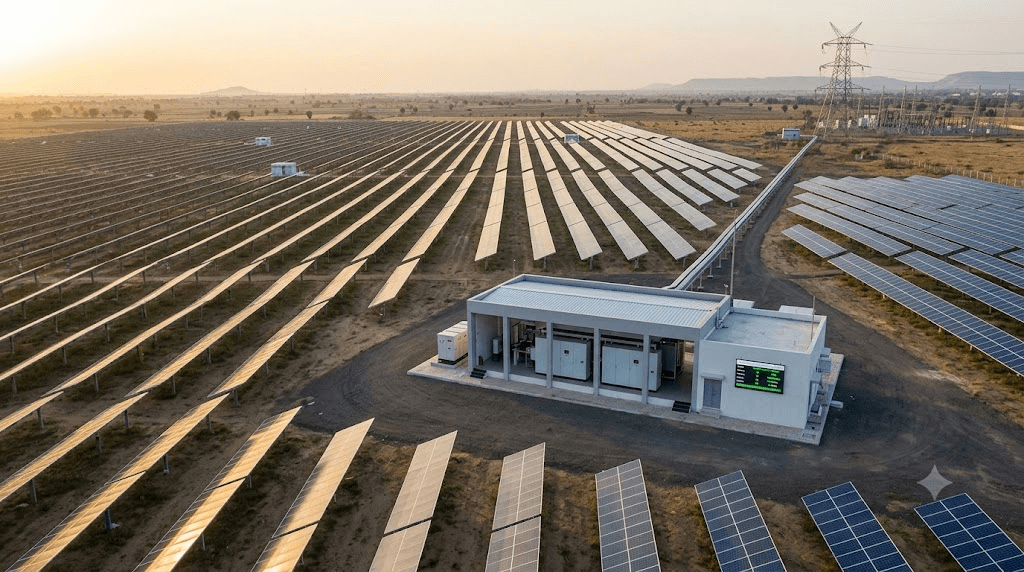
A ground-mounted solar plant in Gujarat needs 12 to 18 mandatory approvals across GEDA, GETCO, the local DISCOM, CEIG Gujarat, GPCB, and the revenue department, plus 3 to 6 weeks of land preparation.
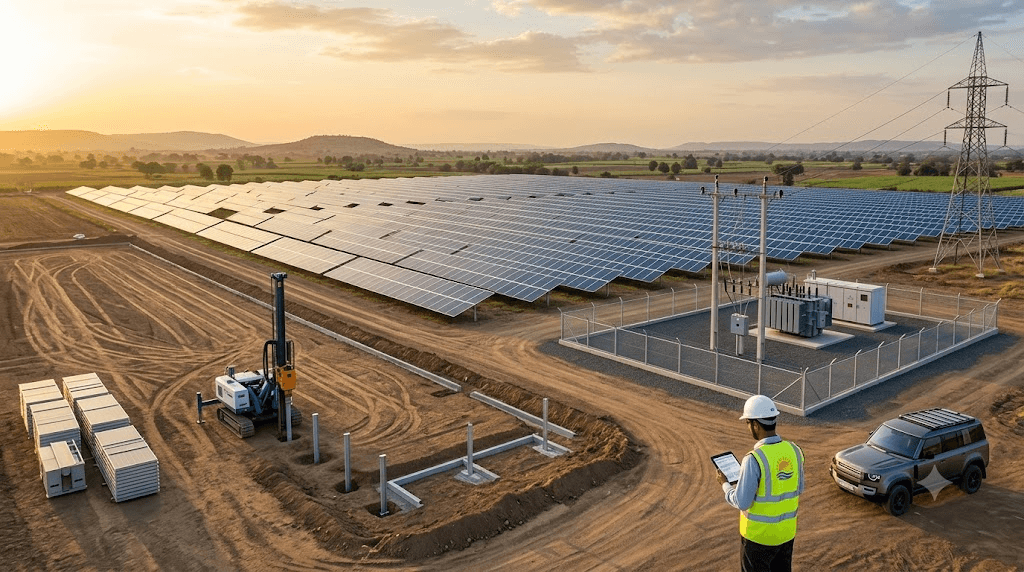
With a turnkey EPC running procurement, civil, and approvals in parallel, the realistic Commercial Operation Date (COD) lands between 5 and 8 months from PO.
For the broader execution map, read our guide on the solar EPC process in Gujarat.
1 MW needs roughly 4 to 5 acres of land and 12 to 18 statutory approvals.
Core permits:
GEDA, GETCO, DGVCL/PGVCL/MGVCL/UGVCL, CEIG Gujarat, GPCB, 63AA NA, revenue NOC.
Realistic COD
: 5 to 8 months with a parallel-track EPC, 10 to 14 months with sequential execution.
CAPEX for ground-mount in Gujarat:
₹3.5 to ₹4.2 Cr per MW depending on land, transformer, and evacuation.
Earthwave Solar
handles permits, land prep, civil, and commissioning in-house, with 80 MW already delivered for Mahindra Susten at Mota Mandvada.
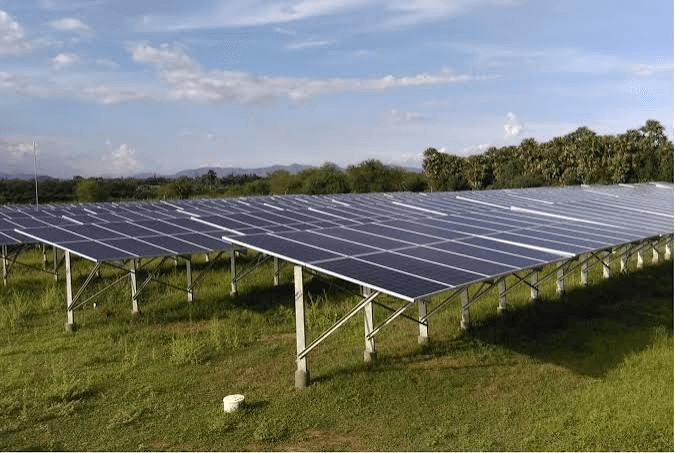
Gujarat is the fastest-scaling ground-mount solar state in India because of high irradiance, mature DISCOM infrastructure, and the dedicated Solar Power Policy 2021 with extensions into 2026.
High Global Horizontal Irradiance (GHI) of 5.5 to 6.2 kWh per sq.m per day.
Strong GETCO transmission backbone across solar zones.
Active GUVNL and GERC tariff orders for captive and open access.
Banaskantha:
Highest irradiance, large flat land parcels.
Kutch:
Solar park clusters, 33 kV and 66 kV evacuation ready.
Patan, Surendranagar, Bharuch, Bhavnagar:
Strong DISCOM and PGVCL/UGVCL coverage.
KUSUM Component A:
500 kW to 2 MW farmer-aggregator plants.
Captive C&I:
1 MW to 10 MW for textile, chemical, and pharma units.
Open access:
5 MW to 50 MW.
IPP and GUVNL bids:
50 MW and above.

A turnkey ground-mount EPC in Gujarat covers everything from land feasibility to COD, not just module supply. Without this scope, owners end up coordinating 7 to 10 vendors themselves.
Land feasibility, DPR, and bankable generation report
All statutory approvals (GEDA, GETCO, DISCOM, CEIG, GPCB, revenue)
Land preparation, civil, foundation, MMS erection
Supply of modules, inverters, transformers, HT panels, BOS
DC and AC cabling, earthing, lightning protection, SCADA
Pre-commissioning, CEIG inspection, DISCOM synchronisation, handover
Supply-only vendor:
Sells modules and inverters, no permit help.
Turnkey EPC:
Owns COD, paperwork, civil, and warranty.
For deeper context, compare with rooftop vs ground-mounted solar for industrial sites.
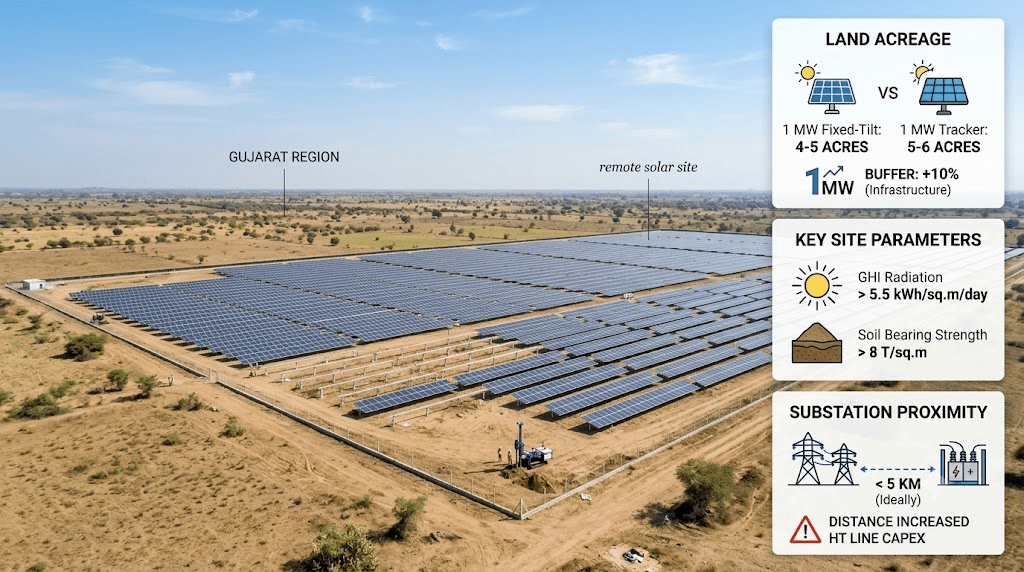
Land selection decides 70% of your project economics, so this step belongs before land purchase, not after.
Rule of thumb:
4 to 5 acres per MW for fixed-tilt structures.
Tracker plants:
5 to 6 acres per MW.
Add buffer:
10% extra for inverter rooms, internal roads, and drainage.
Irradiance:
GHI above 5.5 kWh per sq.m per day.
Soil:
Bearing capacity above 8 t per sq.m for driven piles.
Grid proximity:
Within 5 km of a 11 kV or 33 kV substation.
Agricultural land:
Needs 63AA NA conversion or specific solar carve-out.
NA land:
Ready for industrial and solar use.
Solar park land:
Pre-approved and pre-evacuated, lower paperwork.
Every extra km of HT line adds ₹8 to ₹15 lakhs in CAPEX. Owners often discover this only after buying remote, cheap land.
For owner-side civil planning, also read the land and civil engineering checklist for ground-mounted projects in Gujarat.
A ground-mounted solar plant in Gujarat needs 12 to 18 approvals, and missing even one blocks COD. The good news: most can be filed in parallel, not sequence.
GEDA:
Project registration and empanelment.
GERC:
Tariff and policy compliance.
GETCO:
Connectivity approval for HT and 33 kV plus.
DGVCL, PGVCL, MGVCL, UGVCL:
Net-metering and feasibility for the relevant zone. Read
net-metering solar income in Gujarat
for the income side of this approval.
CEIG Gujarat:
Electrical safety inspection and energisation approval.
GPCB:
Consent to Establish (CTE) and Consent to Operate (CTO).
63AA NA permission:
Land use conversion from agriculture to solar.
Revenue department NOC:
7/12 extract verification and clearance.
Forest NOC:
Required if the parcel touches forest land.
Gram panchayat NOC:
Required in many talukas.
KUSUM Component A and C2:
Through GEDA portal for farmer-aggregator plants.
Open access and wheeling agreement:
For off-site captive plants.
Captive Solar Policy Gujarat 2026:
Required for group captive structures.
For paperwork-heavy buyers, our Gujarat rooftop solar policy 2026 and Gujarat solar subsidy 2026 guides give the policy backbone.
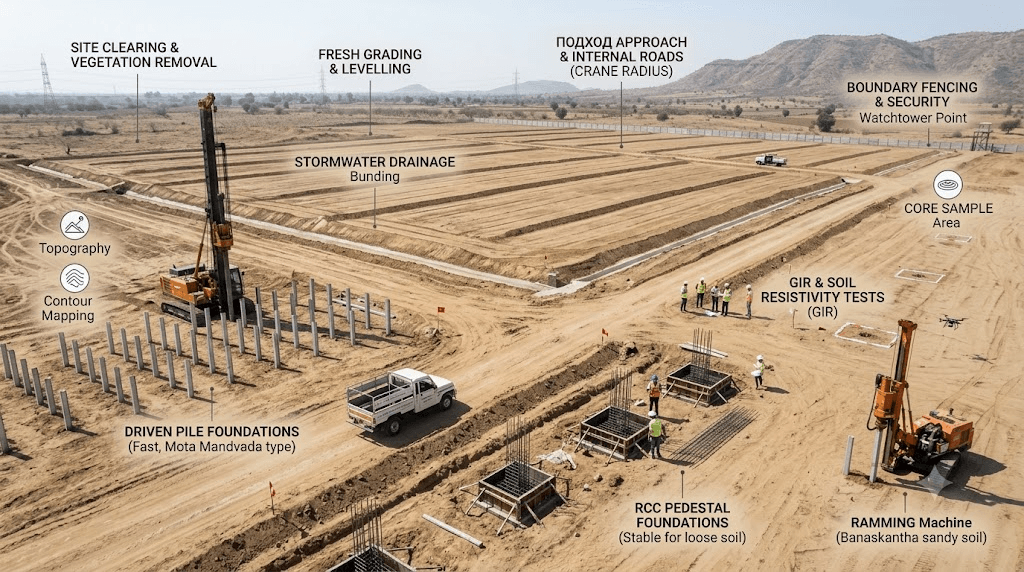
Land preparation in Gujarat takes 3 to 6 weeks and decides whether your plant survives 25 years or fails in the first monsoon.
Drone topography and contour mapping.
Soil bearing capacity test (target above 8 t per sq.m).
Soil resistivity test for earthing design.
Full geotechnical investigation report (GIR).
Land levelling, grading, and contour correction.
Bunding and stormwater drainage design.
Site clearing, vegetation removal, snake and wildlife management.
Approach road and internal roads with crane turning radius.
Boundary fencing, watchtower, and security planning.
Driven pile:
Fast, ideal for stable soil, used at 80 MW Mota Mandvada.
RCC pedestal:
For loose or filled soil.
Ramming:
Quickest for sandy soil in Kutch and Banaskantha.
Pair this with our guide on choosing the right solar mounting structure.
A ground-mount solar EPC in Gujarat hits COD in 5 to 8 months when GEDA, GETCO, DISCOM, CEIG, GPCB, civil, and procurement run in parallel.
Month | Key Activities |
Month 1 | DPR, land due diligence, GEDA registration, irradiance and soil studies |
Month 2 | GETCO and DISCOM application, GPCB CTE, CEIG filing, BOM lock |
Month 3 | Land prep, geotechnical, levelling, drainage, internal roads |
Month 4 | Civil foundations, MMS erection, inverter room construction |
Month 5 | Module installation, DC cabling, string formation |
Month 6 | HT panel, transformer, switchyard, AC cabling, earthing |
Month 7 | Pre-commissioning, CEIG inspection, DISCOM synchronisation |
Month 8 | COD, handover, SCADA activation, O&M handoff |
Monsoon (June to September): 4 to 8 weeks of civil downtime.
DISCOM synchronisation: Add 2 to 4 weeks buffer.
CEIG inspection: Add 1 to 2 weeks.
Compare against the broader ground-mounted solar plant India guide for non-Gujarat geographies.
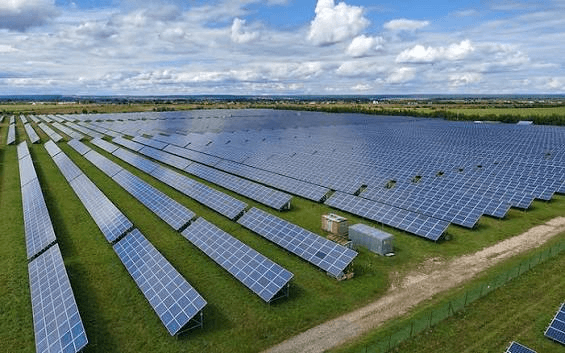
CAPEX for ground-mounted solar in Gujarat ranges from ₹3.5 to ₹4.2 Cr per MW depending on land, transformer rating, and evacuation distance.
1 MW:
₹3.9 to ₹4.2 Cr per MW.
5 MW:
₹3.7 to ₹4.0 Cr per MW.
25 MW and above:
₹3.4 to ₹3.7 Cr per MW.
Component | Share of CAPEX |
Solar modules | 38% to 42% |
Inverters and SCADA | 9% to 11% |
Mounting structures (MMS) | 8% to 10% |
DC and AC cables, BOS | 8% to 10% |
Civil, foundation, drainage | 10% to 12% |
Transformer, HT panel, switchyard | 10% to 12% |
Approvals, GETCO charges, GPCB | 4% to 6% |
Project management and contingency | 3% to 5% |
Drainage and bunding (₹6 to ₹12 lakhs per MW).
Boundary fencing and watchtower.
Approach road and gram panchayat NOC fees.
GETCO connectivity and bay charges.
For deeper cost intelligence, see ground-mounted solar plant cost in India and the solar EPC cost guide for Gujarat factories.
CAPEX:
Best for buyers who can use
.
RESCO:
No upfront cost, pay per unit.
OPEX:
Hybrid lease model.
Read CAPEX vs RESCO solar financing for the decision framework.
The best ground-mounted solar EPC in Gujarat is the one that owns permits, land development, and commissioning in-house, not a vendor that subcontracts the hard parts.
In-house module or inverter manufacturing capability.
Track record of at least 10 MW ground-mount in Gujarat.
Dedicated GETCO and DISCOM liaison team.
Empanelled with GEDA for ground-mount.
Land development team (survey, soil, drainage, fencing).
Dual-vendor BOM lock policy.
Penalty-backed COD commitment.
Real-time project dashboard for client and lender.
Strong references from Goldi Solar, Mahindra Susten, Torrent Power, GUVNL.
Transparent CAPEX breakup, no lump-sum quotes.
Cross-verify using our broader solar EPC company checklist for India and solar EPC red flags in Gujarat.
DISCOM relationships across DGVCL, PGVCL, MGVCL, UGVCL.
CEIG Gujarat process fluency.
Local civil and crane vendor network.
Faster monsoon recovery and labour mobilisation.
Earthwave Solar has executed ground-mount projects from 2 MW to 80 MW across Bagasra, Amod, and Zudvadli, making it a Gujarat-native, vertically integrated EPC.
80 MW Mota Mandvada, Bagasra:
Delivered for Mahindra Susten in 2021.
2 MW Goldi Solar, Amod, Bharuch:
Completed industrial ground-mount.
4 MW Zudvadli:
Under execution with full in-house permit and civil ownership.
Browse the full project portfolio and meet the leadership team behind these deliveries.
Wave inverter manufacturing since 2024.
Solar module manufacturing from 2025.
Land development, civil, drainage, and fencing teams.
DISCOM and CEIG liaison cell.
Read more on the Wave on-grid inverter for India.
Most ground-mount project failures in Gujarat trace back to 5 avoidable owner-side mistakes.
Buying land before checking grid proximity:
Distance from substation kills IRR.
Skipping geotechnical investigation:
Wrong foundation choice causes structural failure.
Filing GETCO and CEIG too late:
Pushes COD by 30 to 60 days.
Choosing supply-only vendors:
No accountability when timelines slip.
Ignoring monsoon and drainage planning:
First Gujarat monsoon damages MMS and panels.
Earthwave Solar's 7-pillar compression model is built specifically for Gujarat's permit-heavy, monsoon-tight environment.
Parallel-track filing of GEDA, GETCO, DISCOM, CEIG, GPCB.
In-house land development team for survey, soil, drainage, fencing.
Pre-locked module and Wave inverter inventory.
Dual-vendor BOM lock for MMS, cables, transformers.
Dedicated Gujarat DISCOM liaison cell across DGVCL, PGVCL, MGVCL, UGVCL.
Real-time project dashboard for client and lender.
Penalty-backed COD commitment with capped LD clauses.
This model powers Earthwave's full service stack across rooftop, residential, commercial, ground-mount, and Wave hybrid projects.
Earthwave Solar is a vertically integrated EPC headquartered in Surat with operations in Bhopal and project execution across Gujarat, Madhya Pradesh, and multiple Indian states.
Established in 2018, the company scaled from a 100 kW first installation to 80 MW utility-scale execution, launched Wave inverter manufacturing in 2024, and started solar module manufacturing in 2025.
Proven 80 MW ground-mount track record with Mahindra Susten.
In-house manufacturing of inverters and modules.
End-to-end permit handling across GEDA, GETCO, DISCOM, CEIG, GPCB.
Land development capability, not just module supply.
Penalty-backed COD commitment.
A 1 MW fixed-tilt ground-mount plant needs 4 to 5 acres in Gujarat. Tracker-based plants need 5 to 6 acres. Add 10% extra for inverter rooms, drainage, and internal roads.
You need GEDA registration, GETCO connectivity (for HT and above), DISCOM net-metering (DGVCL, PGVCL, MGVCL, or UGVCL), CEIG Gujarat approval, GPCB CTE and CTO, 63AA NA permission, and revenue department NOC.
With a parallel-track EPC, a 1 to 5 MW ground-mount plant hits COD in 5 to 8 months. Sequential execution by multi-vendor setups stretches this to 10 to 14 months.
Yes, after obtaining 63AA non-agricultural conversion or a solar-specific land use change order from the revenue department. KUSUM Component A and C2 schemes also allow farmer-aggregator solar on agricultural land.
Earthwave Solar ranks among the top Gujarat-native ground-mount EPCs, with 80 MW delivered for Mahindra Susten, 2 MW for Goldi Solar at Amod, and 4 MW under execution at Zudvadli, backed by in-house manufacturing and permit teams.
Stop juggling 8 government portals and 10 vendors. Lock your COD with a Gujarat-native EPC that owns permits, land development, and commissioning under one roof.
Book a free Land Feasibility and Permit Roadmap session with Earthwave Solar at www.earthwavetech.in or visit our contact page. You walk away with a site-specific permit map, indicative CAPEX, and a realistic month-by-month timeline.
For more practitioner guides, explore the Earthwave Solar blog library, or compare ownership models in captive solar business in India and solar payback period India 2026.
FAQS
Can't find the answer you're looking for? Our team is here to help.
SUBSCRIBE NEWSLETTER
Switching to solar is easier than you think. Let us guide you to cleaner, more affordable energy.
