Rooftop vs Ground-Mounted Solar
Rooftop or Ground Solar: Which Is Better for Industry?
2026-02-20T00:00:00.000Z•9
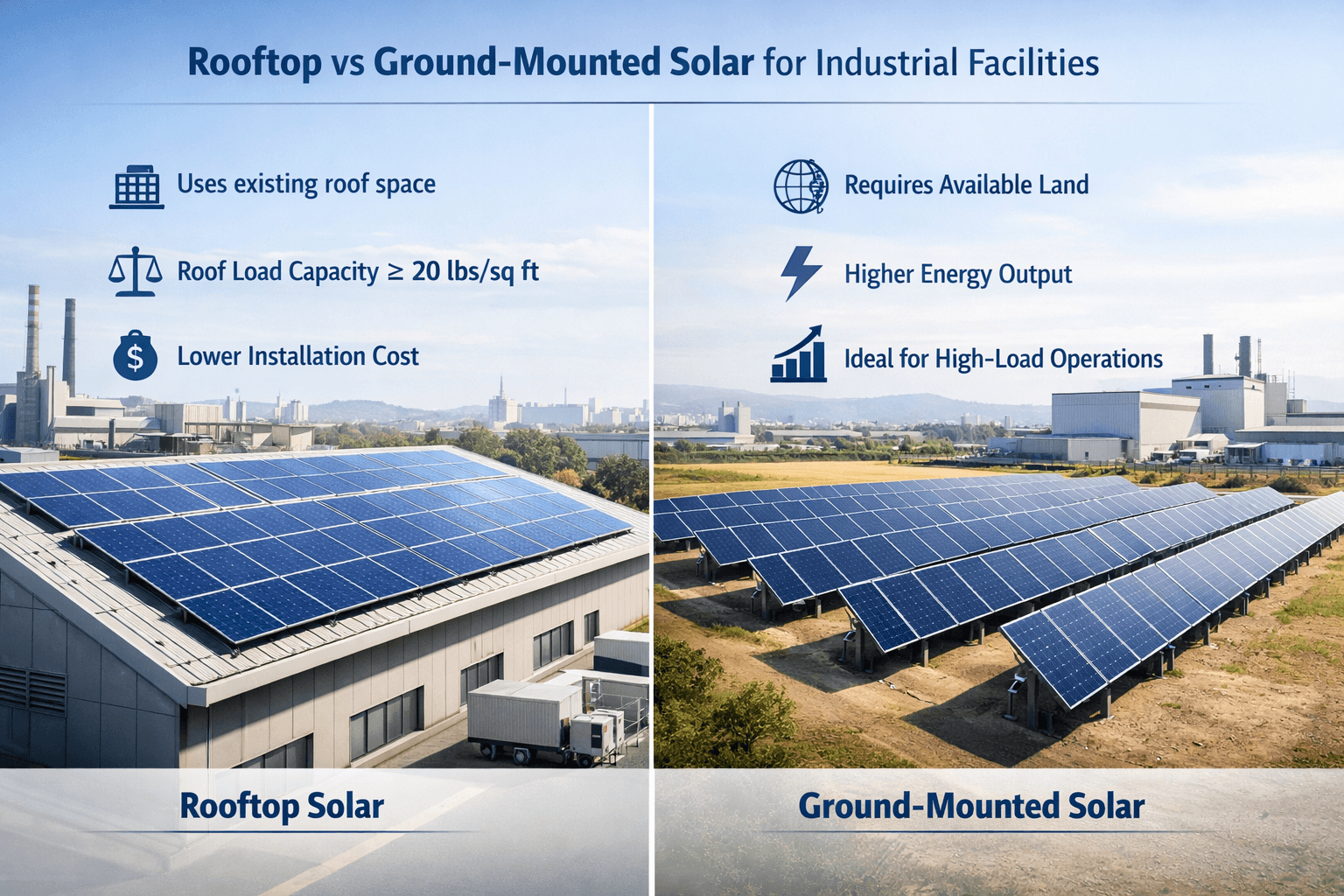
Industrial facilities choosing between rooftop and ground-mounted solar systems should base their decision on available space, roof load capacity, energy requirements, and budget.
Rooftop systems work best when roof structures are strong and unobstructed, while ground-mounted installations suit facilities with available land and high-capacity energy needs.
Rooftop solar utilizes existing building structures without requiring additional land, making it cost-effective for facilities with strong roofs
Ground-mounted systems offer higher energy output through optimal panel orientation and tracking capabilities, ideal for high-load operations
Industrial solar installations typically achieve payback
within 3 to 6 years
with annual ROI between
18% and 30%
Roof load capacity must meet
minimum 20 pounds per square foot
plus panel weight requirements
Professional site assessment determines which system delivers maximum operational efficiency for your specific facility conditions
This comprehensive analysis draws from real-world industrial solar installations across manufacturing facilities, warehouses, and production plants.
The insights reflect current 2025 market data, technical specifications from operational systems ranging from 100 kW to multi-megawatt installations, and proven financial performance metrics from industrial EPC projects.
System Overview:
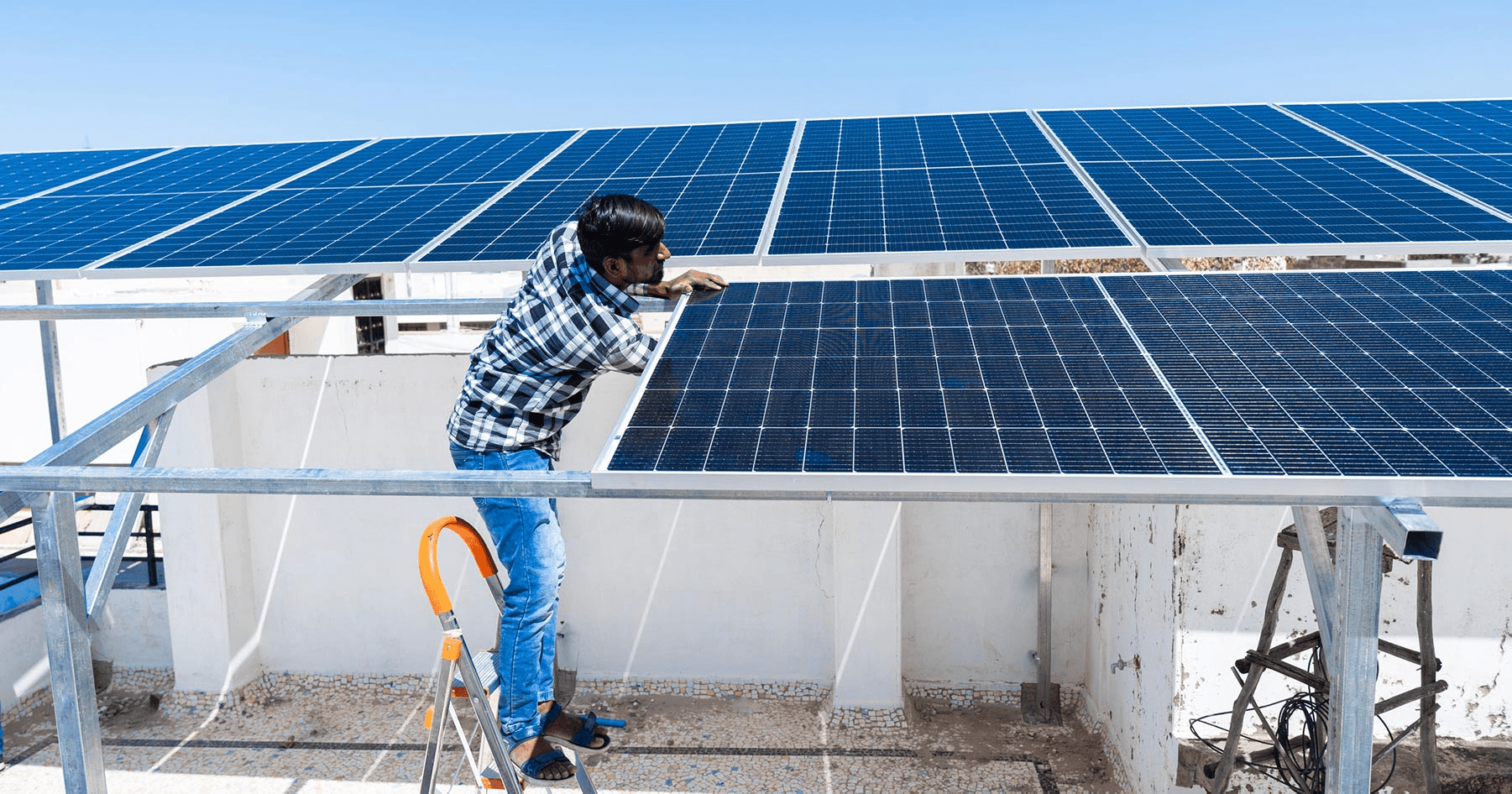
Mounts directly on factory roofs, warehouses, or
Converts sunlight to electricity without using additional ground space
Ideal for congested industrial zones with limited land availability
Capacity Range:
300 to 1500 kW typical capacity for industrial facilities
10 square meters required per kilowatt on concrete roofs
Less space needed for south-facing metal shed roofs
Suggested Visual: Diagram showing rooftop solar panel arrangement on industrial warehouse with capacity calculations
System Overview:
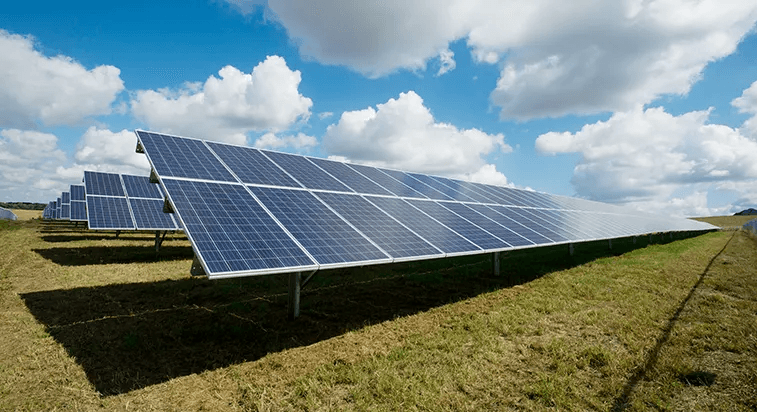
Panels fixed to metal structures embedded in land near factory
Flexible panel alignment and tilt angle for maximum sun exposure
Not limited by building structure or roof constraints
Capacity and Performance:
500 kW to multiple megawatts capacity possible
Solar tracking systems follow sun movement throughout day, Learn more about our
.
15% to 25% higher energy yield with tracking technology
10% to 20% better output than rooftop through optimal orientation
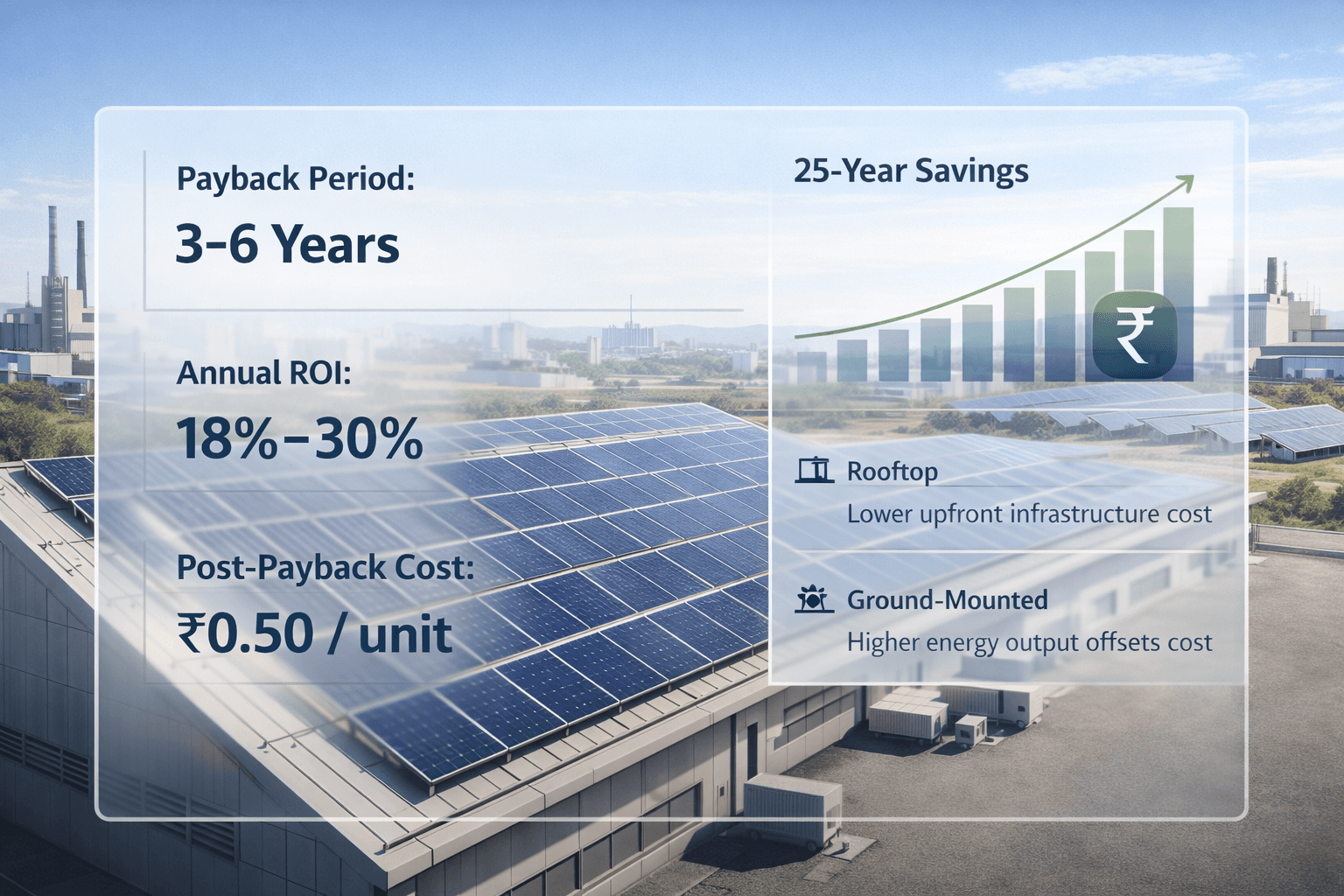
Industrial solar systems deliver strong financial returns regardless of installation type.
The investment analysis focuses on three core metrics that matter to finance teams:
Payback period
: “3 to 6 years” for both rooftop and ground-mounted systems
Annual ROI
: 18% to 30% depending on facility energy consumption and tariff rates
Post-payback energy costs
: Drop to maintenance-only levels under ₹0.50 per unit
A facility spending ₹50 lakhs annually on electricity recovers solar investment within 3.2 years, **See how other manufacturers achieved similar results and generates ₹15 crore in savings** over 25-year system lifetime.
Rooftop installations typically require lower upfront infrastructure investment since they utilize existing building structures.
Ground-mounted systems involve additional costs for land preparation, mounting structures, and potentially longer cable runs to grid connection points.
However, ground systems often deliver higher energy output per installed kilowatt, offsetting initial cost differences through superior generation performance.
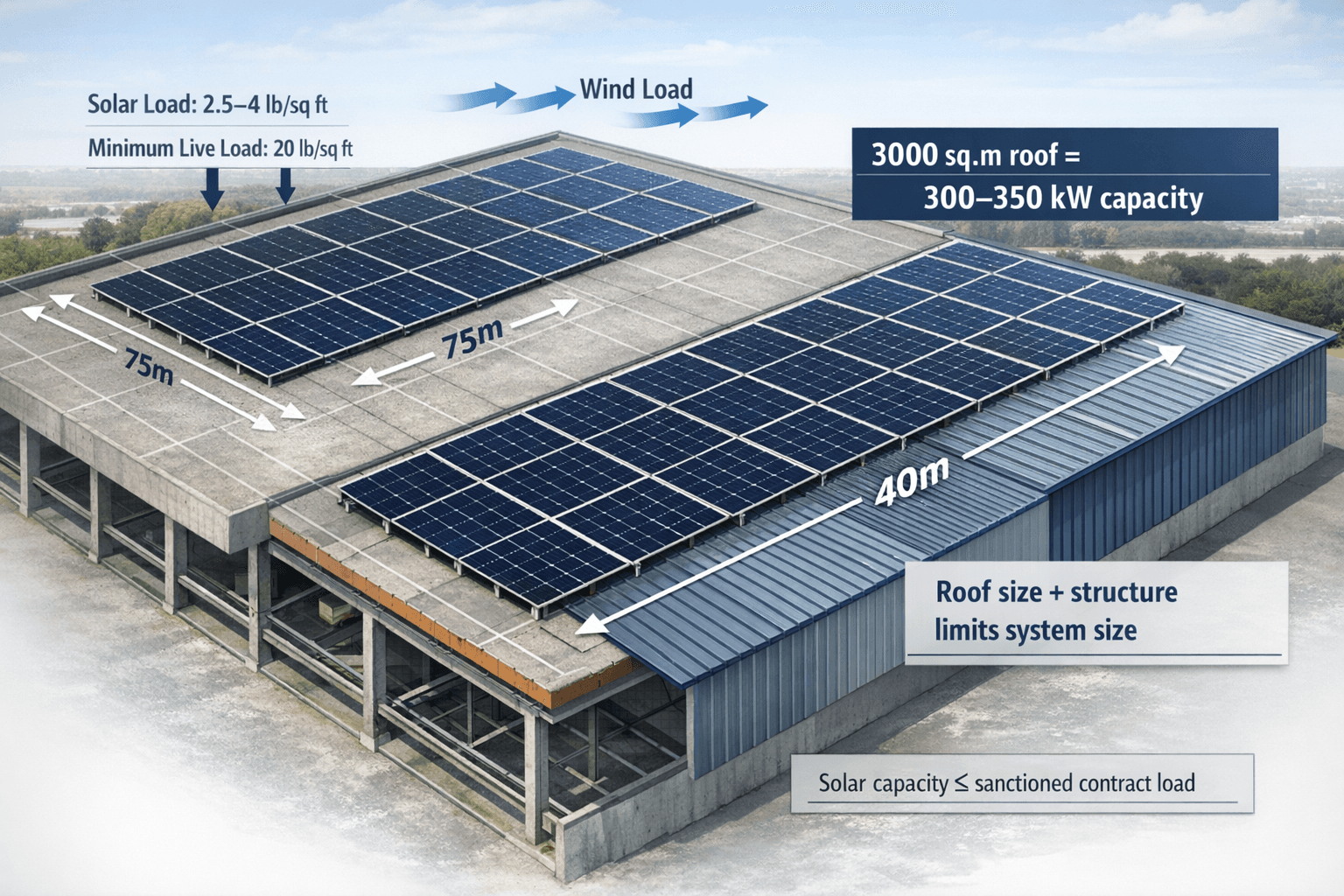
Building Code Requirements:
Minimum 20 pounds per square foot live load capacity required.
include comprehensive structural assessments.
Solar panels add 2.5 to 4 pounds per square foot
Metal shed roofs need structural assessment before installation
Capacity Calculations:
3000 square meter roof = 300 to 350 kW solar capacity
Roof size and structural strength directly limit total capacity
Wind load factors must be included in structural analysis
Regulatory Limits:
Solar capacity cannot exceed sanctioned contract load in most states
Contract load restrictions vary by state distribution company
Space Requirements:
4 to 5 acres needed per megawatt capacity
Space includes panel rows plus maintenance access paths
Spacing between rows prevents shading issues
Site Conditions:
Unused land within 500 meters of electrical infrastructure ideal
Land must be relatively flat or require grading
Optimal panel orientation depends on ground levelness
Installation Advantages:
No building structure limitations
Install exact capacity needed for energy requirements
Lower cable investment when near main infrastructure
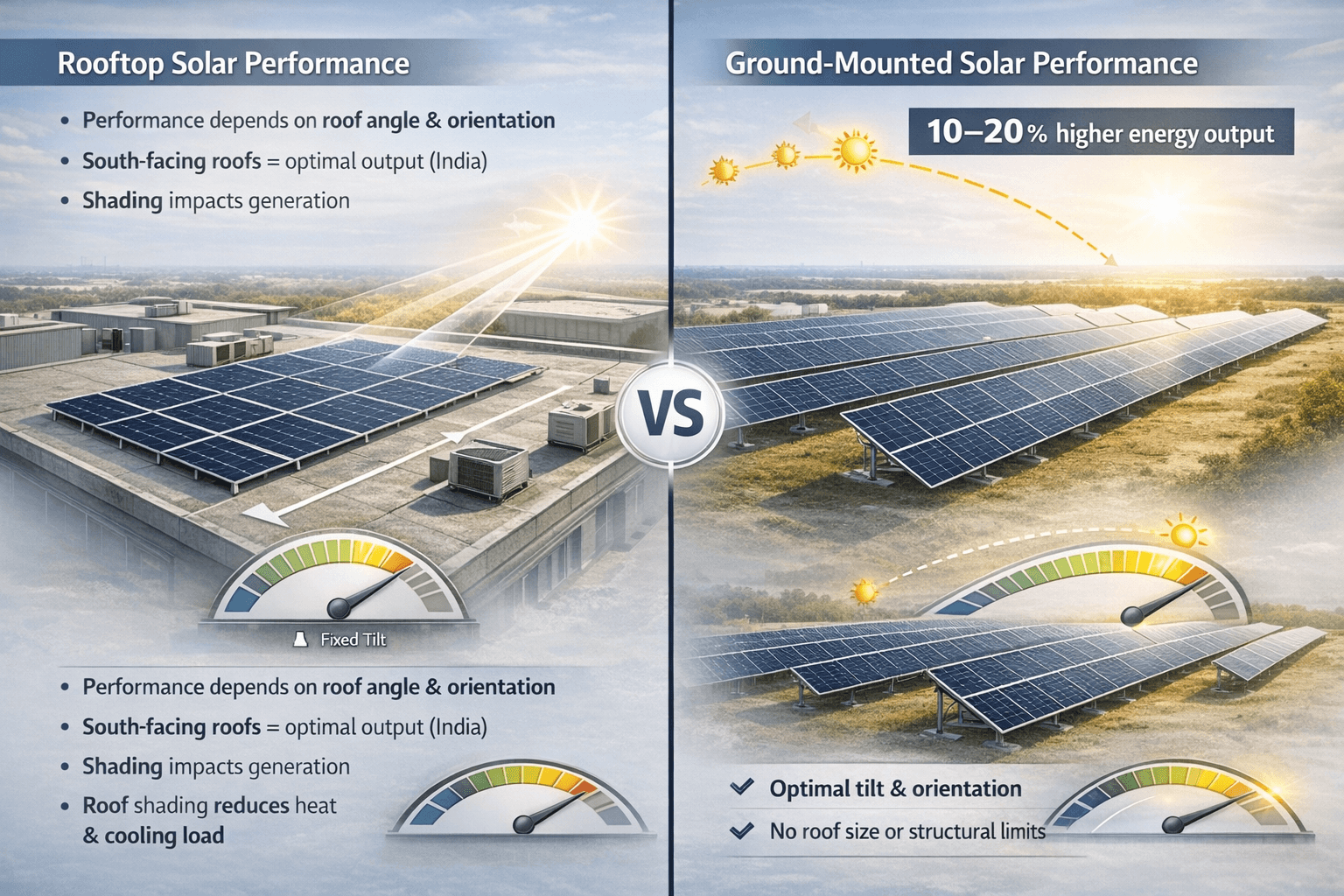
Rooftop solar performance depends on roof angle, orientation, and shading from nearby structures or equipment.
South-facing roofs in India deliver optimal generation.
Read our complete guide on solar energy savings
.
Panels installed on industrial roofs also provide thermal benefits, reducing building heat by creating shade layer that lowers cooling costs during summer months.
Ground-mounted installations achieve optimal tilt and direction alignment, leading to 10 to 20% higher energy output compared to roof-constrained systems.
These setups are not limited by roof size or structural capacity, allowing facilities to install exact capacity needed for energy requirements.
Solar tracking systems available only for ground installations can boost generation by following sun path from sunrise to sunset. This technology proves most valuable for manufacturing plants requiring consistent power throughout production shifts.
Rooftop installations require specialized safety equipment and measures for workers operating at height.
Complex roof designs with multiple levels, skylights, or HVAC equipment create installation complications that increase project timeline.
However, rooftop projects typically complete faster once started since mounting structures bolt directly to existing roof framework.
Ground systems are easier to install, clean, and maintain due to open access at working height.
Maintenance teams can reach all panels without safety harnesses or specialized equipment, reducing ongoing service costs.
Panels remain accessible for quarterly cleaning that maintains optimal efficiency, particularly important in dusty industrial environments.
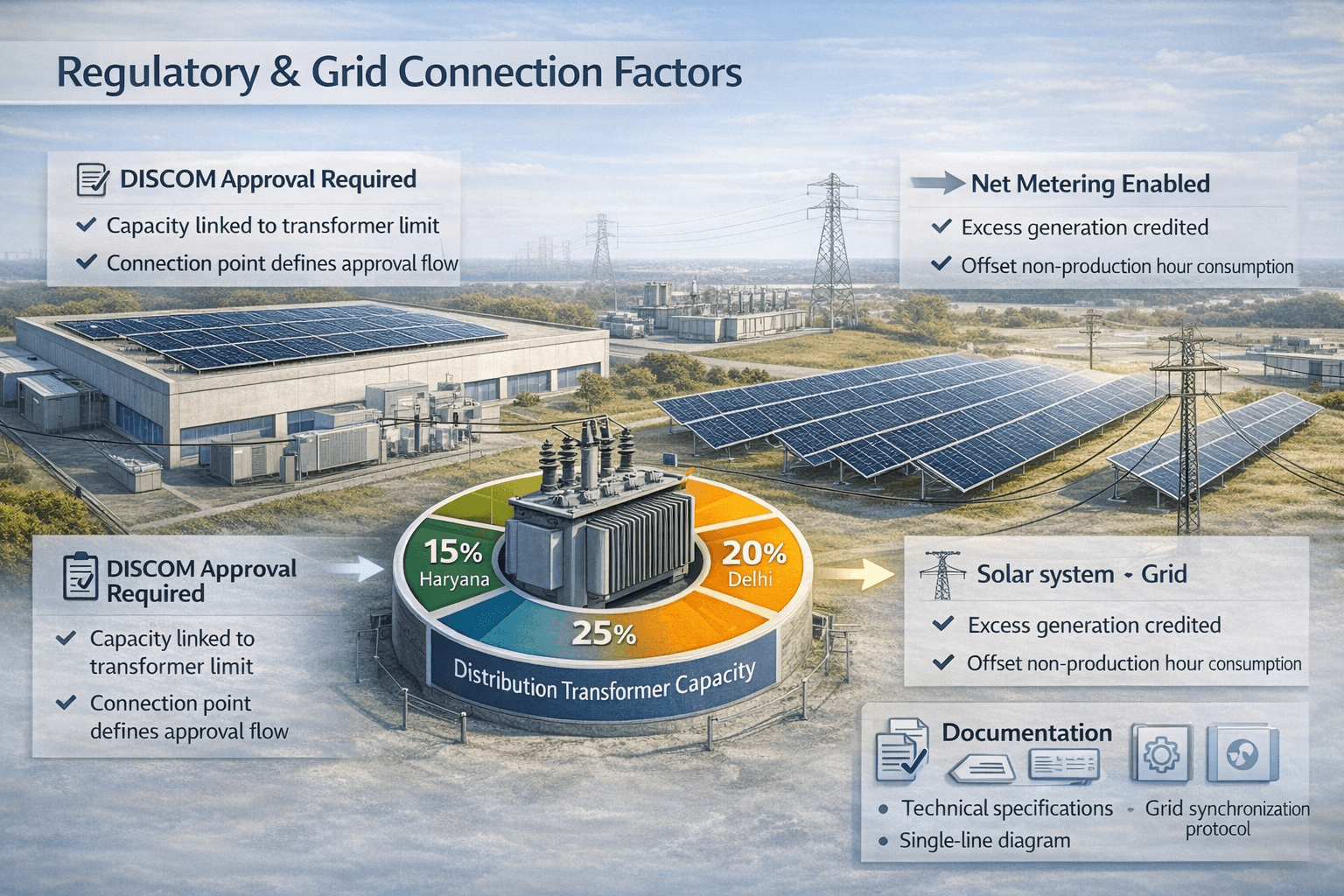
Both system types require distribution company approvals, but processes differ based on capacity and connection point.
State regulations limit solar capacity to 15% to 25% of distribution transformer capacity depending on location.
Haryana allows 15% of transformer capacity for solar connections, while Delhi permits 20% and Uttar Pradesh allows 25%.
Industrial facilities benefit from net metering that credits excess solar generation against grid consumption during non-production hours.
Both rooftop and ground systems qualify for net metering under current regulations.
Documentation requirements include technical specifications, single-line diagrams, and grid synchronization protocols handled by experienced EPC providers.
Choose rooftop installation when your facility has:
Strong roof structure capable of supporting additional load
2000+ square meters of unobstructed south-facing roof space
Limited or no available land for ground mounting
Existing roof requiring minimal reinforcement
Operations in congested industrial zones with high land costs
Select ground-mounted solar when your facility offers:
Available land within 500 meters of electrical infrastructure
Energy requirements exceeding roof capacity limitations
Roof structures requiring expensive reinforcement
Need for maximum energy output through tracking systems
Plans for future capacity expansion as production grows
Some industrial facilities implement both
and
to maximize total solar capacity to maximize total solar capacity.
This hybrid approach utilizes all available space while delivering combined energy output that significantly reduces grid dependence.
Facilities spending ₹2 crore annually on power can save ₹60 lakhs to ₹1.4 crore per year through properly sized hybrid installations.
conduct comprehensive site assessments evaluating roof loading capacity, electrical infrastructure, consumption patterns, and land suitability, So
for a detailed evaluation.
This technical analysis determines optimal system type, capacity, and configuration for maximum ROI.
Detailed engineering studies
include structural calculations, shadow analysis, electrical load profiling, and 25-year financial modeling for board approval.
Experienced solar EPC companies handle all documentation, utility coordination, environmental clearances, and grid connection requirements.
They manage phased installation during planned shutdowns to minimize operational disruption.
Request a professional site assessment to determine whether rooftop, ground-mounted, or hybrid solar delivers optimal returns for your industrial facility. for your industrial facility.
Certified EPC providers offer detailed technical and financial analysis showing exact payback period, annual savings, and 25-year ROI projections specific to your operations.
Schedule your consultation today to start reducing energy costs while building long-term operational resilience and sustainability credentials that strengthen your market position.
Industrial solar systems typically achieve payback within 3 to 6 years, after which facilities enjoy virtually free electricity for the remaining 20+ year system lifespan. Annual ROI ranges from 18% to 30% depending on energy consumption and local tariff rates.
A 500 kW rooftop system requires approximately 5000 square meters of usable roof area on concrete roofs. South-facing metal sheds can accommodate the same capacity in less space. Learn more about commercial solar solutions.
Ground-mounted systems typically generate 10% to 20% more energy per installed kilowatt through optimal panel orientation and tilt angles. Systems with solar tracking technology can increase generation by an additional 15% to 25% compared to fixed rooftop arrays.
Building codes require minimum live load capacity of 20 pounds per square foot, with solar installations adding 2.5 to 4 pounds per square foot including panels and mounting structures. Professional structural assessment confirms existing capacity before installation begins.
State DISCOMs limit solar capacity based on distribution transformer capacity and sanctioned contract load. Most states allow 15% to 25% of transformer capacity for solar connections, which may restrict maximum installable capacity regardless of available roof or land space
FAQS
Can't find the answer you're looking for? Our team is here to help.
SUBSCRIBE NEWSLETTER
Switching to solar is easier than you think. Let us guide you to cleaner, more affordable energy.
