Solar EPC Supply Chain
Solar EPC Supply Chain Delays: How Earthwave Avoids Them
2026-06-14T00:00:00.000Z•9

Solar EPC supply chain delays in India happen because 60% of projects depend on imported cells, ALMM-listed modules, and multi-vendor procurement that runs in sequence instead of parallel.
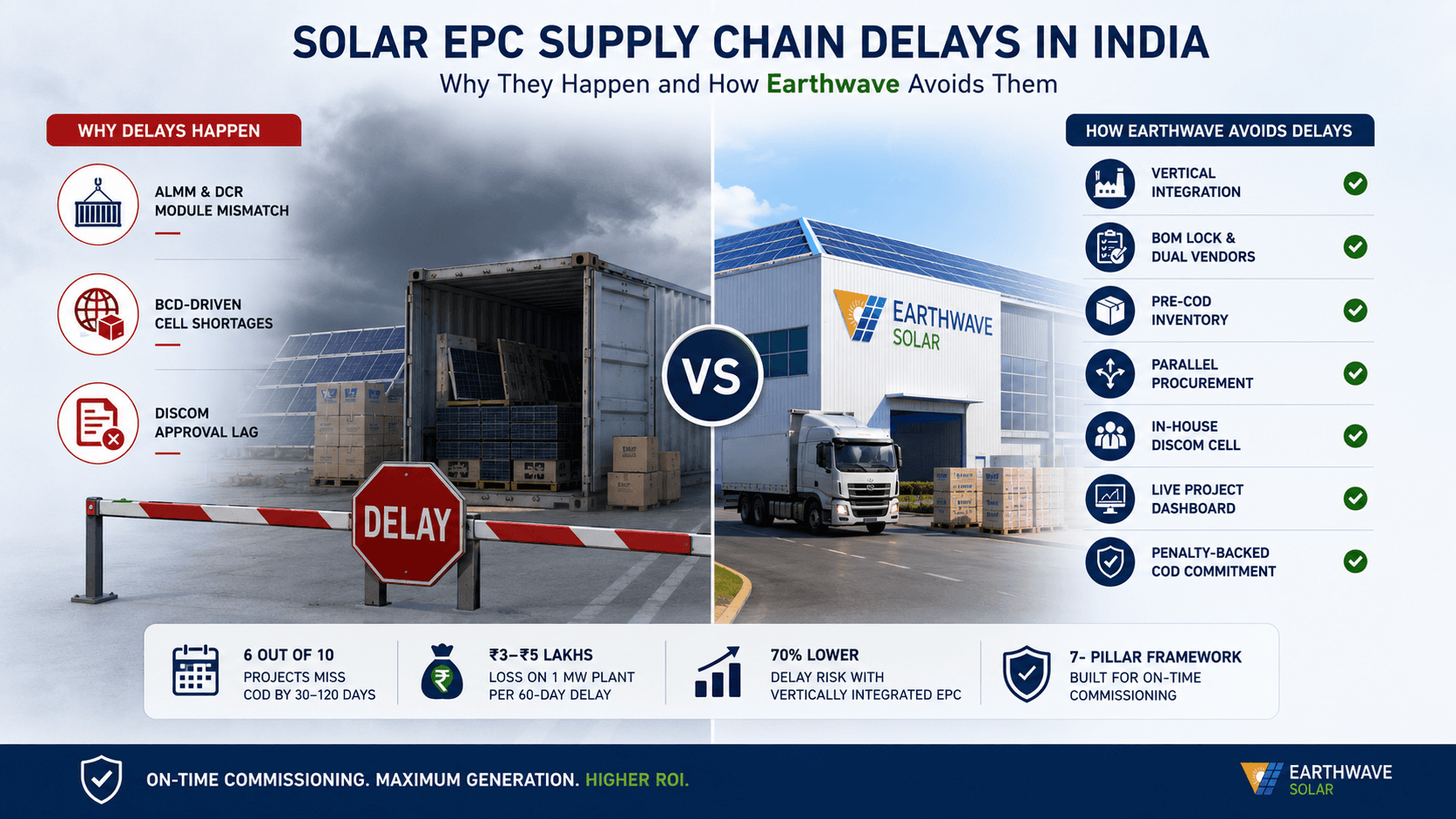
Earthwave Solar avoids them by combining in-house Wave inverter manufacturing, in-house solar module manufacturing from 2025, dual-vendor BOM locks, and a dedicated DISCOM cell.
For the full execution workflow, read our guide on the solar EPC process in Gujarat.
6 out of 10 Indian solar EPC projects miss their committed COD by 30 to 120 days.
Top 3 reasons: ALMM and DCR module mismatch, BCD-driven cell shortages, and DISCOM approval lag.
A 60-day delay on a 1 MW C&I plant costs ₹3 to ₹5 lakhs in lost generation plus diesel and demand charges.
Vertically integrated EPCs cut delay risk by 70% versus traditional multi-vendor EPCs.
Earthwave Solar uses a 7-pillar framework (vertical integration, BOM lock, pre-COD inventory, parallel procurement, in-house DISCOM cell, live dashboard, penalty-backed COD).
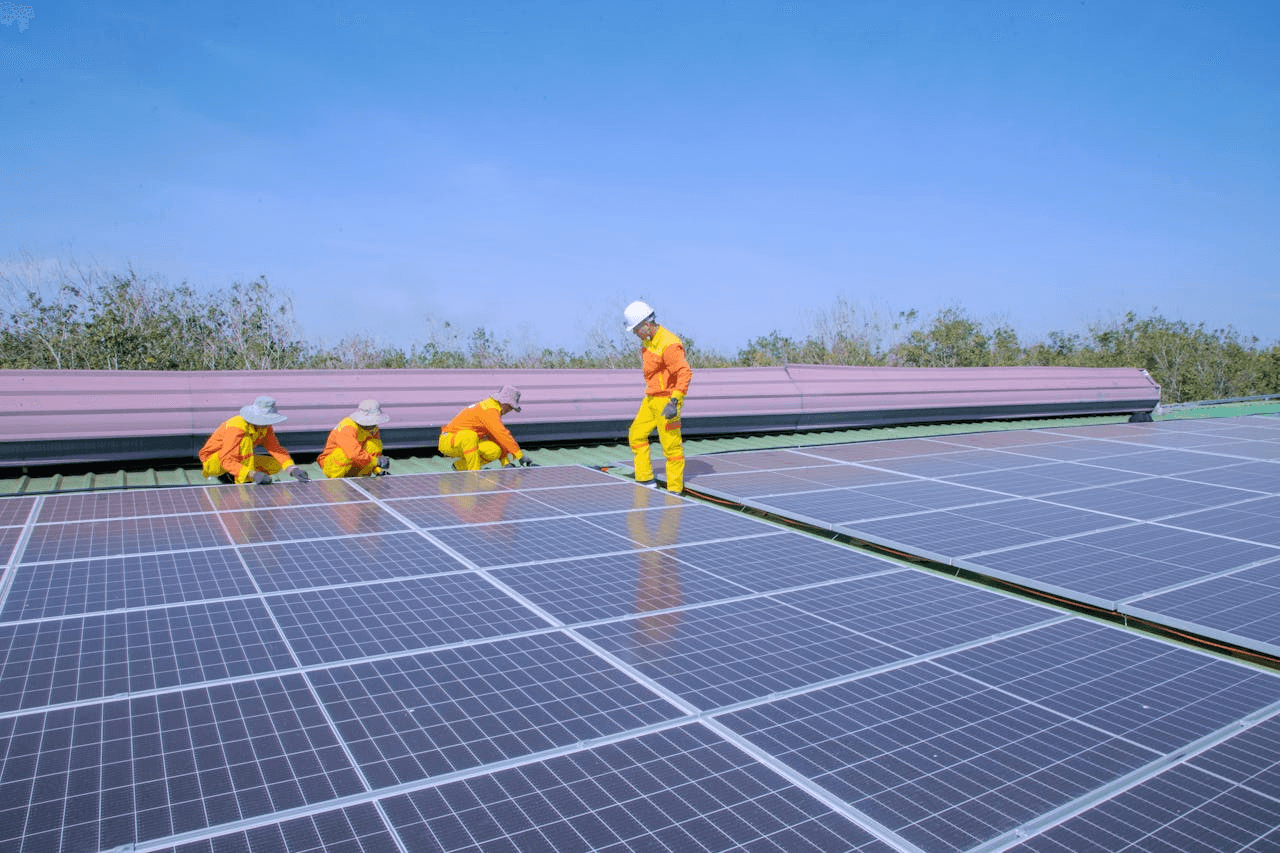
The Indian solar EPC delay problem is structural, not occasional. The market grew faster than the supply chain matured.
Residential rooftop (3 to 20 kW):
15 to 30 days delay on average.
C&I rooftop (50 kW to 1 MW):
30 to 60 days delay.
Large industrial and ground-mount (1 MW to 50 MW):
60 to 120 days delay.
A 1 MW C&I rooftop generating 1,500 units per day at ₹7 per unit loses ₹6.3 lakhs in 60 days. Add diesel backup, demand charges, and lost accelerated depreciation tax benefits, and the real damage crosses ₹10 lakhs per MW.
C&I and IPP projects depend on a fixed Commercial Operation Date tied to power purchase agreements, lender drawdowns, and ESG reporting. A 60-day slip cascades into 6 months of revenue and tariff loss.
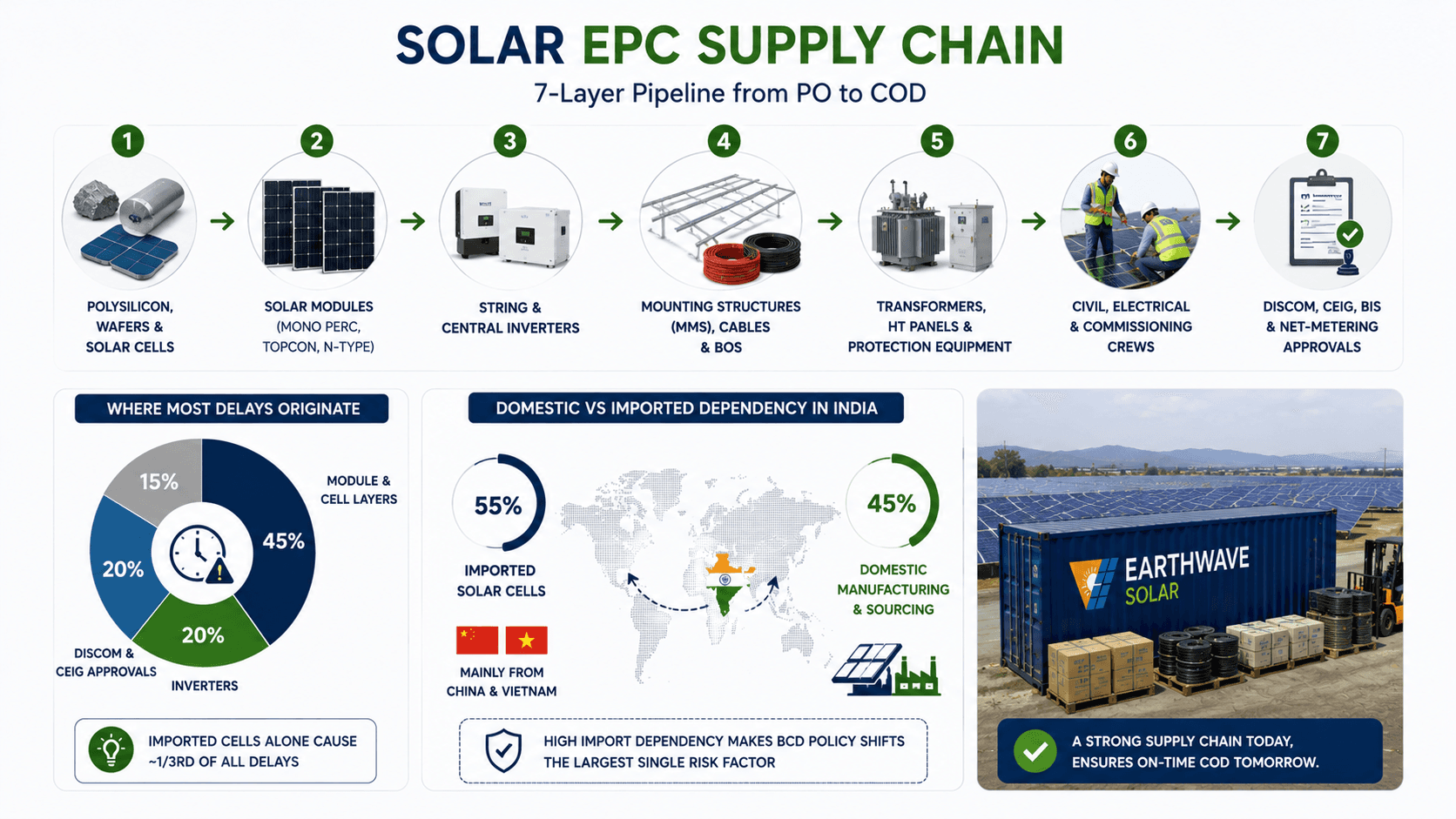
The solar EPC supply chain is a 7-layer pipeline that moves a project from PO to COD. A break in any single layer delays the entire project.
Polysilicon, wafers, and solar cells
Solar modules (mono PERC, TOPCon, N-type)
String and central inverters
Mounting structures (MMS), cables, and BOS
Transformers, HT panels, and protection equipment
Civil, electrical, and commissioning crews
DISCOM, CEIG, BIS, and net-metering approvals
Industry pattern data shows roughly 45% of delays come from module and cell layers, 20% from inverters, 20% from DISCOM and CEIG approvals, and 15% from civil and execution. Imported cells alone trigger close to one third of all delays.
India still imports nearly 55% of solar cells, primarily from China and Vietnam, while module manufacturing has localised.
This single dependency makes BCD policy shifts the largest single risk factor.
Solar EPC supply chain delays in India happen because 10 structural pressure points stack inside a single project timeline. Most EPCs control only 2 or 3 of them.
ALMM-listed and DCR modules are oversubscribed during scheme-driven demand surges. Lead times stretch from 4 to 12 weeks during PM Surya Ghar and KUSUM peaks.
Basic Customs Duty of 25% on imported cells pushed EPCs to domestic sourcing, but Indian cell capacity is still ramping. Price volatility of 8% to 15% per quarter is now normal.
String inverters depend on imported semiconductors, IGBTs, and DSP chips. Even a 6-week chip shortage at the vendor's factory can push a 1 MW plant by 30 days.
BIS certification renewals and CEIG approvals for HT-connected plants regularly take 4 to 8 weeks. Most EPCs file too late in the project cycle.
Container delays at Mundra, Nhava Sheva, and Chennai ports add 7 to 21 days per shipment. Container freight cost spikes have crossed 3 times their pre-2020 baseline in stress periods.
DISCOMs in many states take 30 to 90 days to clear net-metering, feasibility, and synchronisation. Read net-metering solar income in Gujarat to see how Earthwave handles this in its home state.
EPCs sitting on blocked GST refunds delay vendor payments. Vendors then delay dispatch. The cycle pushes COD by 15 to 45 days.
Many EPCs use a single vendor per BOM line. One factory shutdown derails the whole project.
Monsoon halts civil work for 6 to 10 weeks in Gujarat, Maharashtra, and the South. Trained solar technicians remain scarce nationally.
PM Surya Ghar, KUSUM, and RTS Phase II create sudden demand peaks. Modules, inverters, and mounting structures get diverted to subsidy projects, starving C&I orders.
For more on these dynamics, see solar EPC red flags in Gujarat.
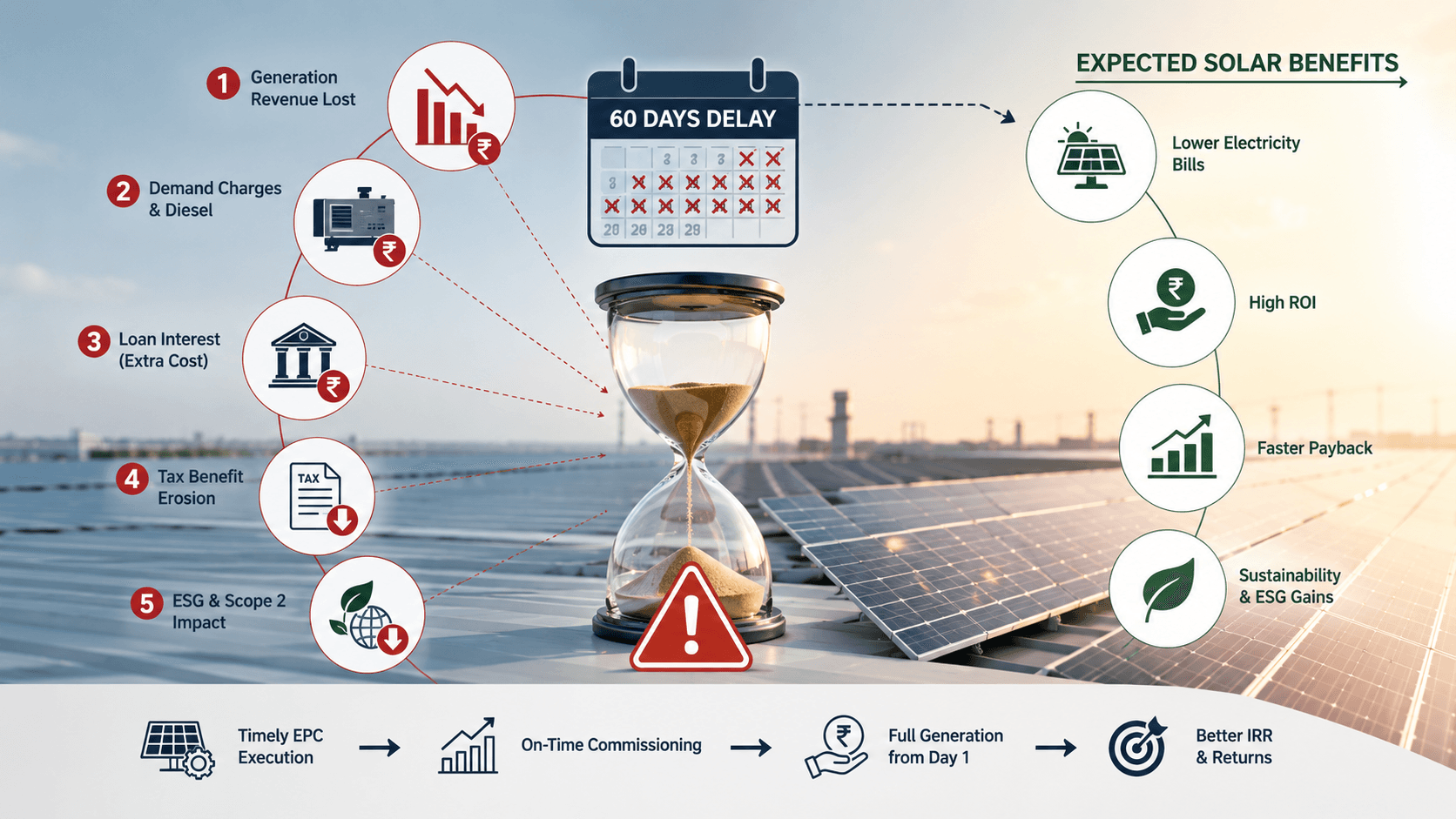
A 60-day EPC delay is not a calendar issue. It is a balance-sheet event for the project owner.
Generation revenue lost:
₹3 to ₹6 lakhs per MW per month at ₹6 to ₹8 per unit tariff.
Demand charges and diesel:
₹1 to ₹3 lakhs per MW per month for factories on backup.
Loan interest:
Moratorium extensions cost 0.5% to 1% extra IRR on the project.
Tax benefit erosion:
Missing a financial year reduces the AD benefit window by 12 months.
ESG and Scope 2 impact:
Corporate sustainability and CSR targets slip, affecting BRSR reporting.
Benchmark these losses against expected solar energy savings in India and the solar payback period India 2026.
A solar EPC headed for delay leaves clear early signals. Catch them in the first 30 days, not the last 30.
Vague PO acknowledgement without dispatch dates.
No weekly procurement and dispatch tracker.
BOM revisions after PO without client sign-off.
Repeated "module ETA shifted" emails.
Net-metering paperwork not filed within 15 days of PO.
Civil mobilisation pushed without monsoon plan.
Single vendor named for every BOM line.
"Module shortage" usually means no dual sourcing.
"Container delay" usually means no buffer inventory.
"DISCOM is slow" usually means paperwork was filed late.
If you see 3 or more of these signs, use our solar EPC company checklist for India to re-evaluate the vendor.
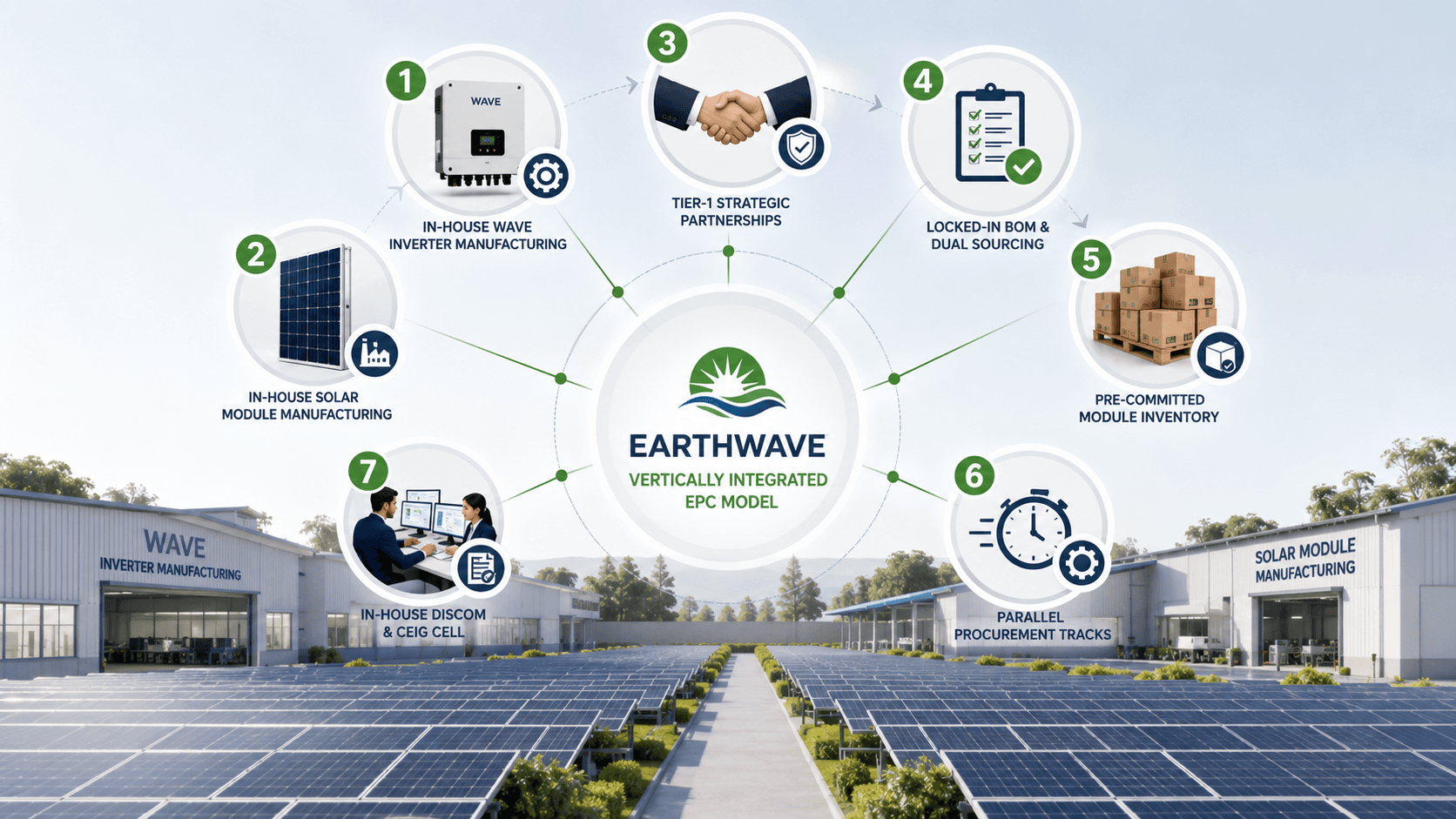
Earthwave Solar avoids supply chain delays by owning the layers that other EPCs rent. Vertical integration moves risk from the vendor to the EPC's own factories and processes.
Earthwave manufactures Wave inverters from 2.5 kW to 125 kW in-house since 2024. Project teams pull from internal stock, not from third-party OEMs.
Read more on the Wave on-grid inverter for India.
Module manufacturing started in 2025 with multi-state expansion. This removes the single biggest delay source, ALMM-listed third-party module availability.
Long-standing relationships with Goldi Solar, Mahindra Susten, Torrent Power, GUVNL, Solnce, Deon Energy, True Colors, and Rajesh Power Services give Earthwave priority allocation during scheme peaks.
Every BOM line has a primary and a backup vendor pre-approved at PO stage. No single-vendor exposure goes into a contract.
Modules are blocked at the factory before client PO, not after. This compresses lead time by 4 to 6 weeks.
Modules, inverters, MMS, cables, transformers, and approvals move on parallel timelines, not in sequence. This alone cuts 20 to 30 days from a standard project.
A dedicated approval team files net-metering, CEIG, and DISCOM paperwork in week 1, not week 6. Pair this with Gujarat solar subsidy 2026 for the full approval map.
Earthwave's project history shows on-time delivery across rooftop, ground-mount, and utility-scale categories.
80 MW Mahindra Susten ground-mount (2021):
Delivered with full procurement and civil discipline despite COVID-era supply chain stress.
170 kW Pari Textile rooftop, Diamond Nagar:
Mixed-zone roof, dual-vendor module supply, on-time commissioning. See
solar for textile units in Surat
.
2 MW True Colors industrial rooftop, Palsana:
Parallel procurement track delivered the plant within the client's financial year for AD claim.
4 MW Zudvadli ground-mount (in execution):
Active drone survey, locked BOM, and pre-COD inventory model.
Browse the full Earthwave project portfolio for more.
Project owners win the timeline game in the contract, not on the site. Five clauses and checkpoints make the biggest difference.
Define COD, scope, and exclusions clearly.
Vague scope creates legitimate delay claims.
Add liquidated damages of 0.5% per week
of contract value, capped at 10%.
Tie payments to procurement milestones
, not generic project stages. Pay against dispatched modules and inverters, not against promises.
Hire an Owner's Engineer (OE)
for any project above ₹5 Cr. An independent OE audits procurement, civil, and commissioning.
Run a BOM lock checkpoint
at week 2. Approved BOM cannot change without written sign-off.
For financing tied to these milestones, see CAPEX vs RESCO solar financing.
Use these 10 questions to separate a structurally protected EPC from a reseller.
Which BOM lines do you manufacture in-house?
Who is the backup vendor for each major BOM line?
What is your current module and inverter inventory at PO?
How many days are you ready to lose to BCD or ALMM changes without slipping COD?
What is your DISCOM approval cycle time in my state?
Do you have a CEIG cell for HT projects?
Can I see your last 5 projects with PO date, committed COD, and actual COD?
What LD percentage will you accept in the contract?
Will you share a weekly procurement and dispatch dashboard?
Who is the single point of accountability if the project slips?
Solar EPC supply chains in India are shifting toward full domestic, fully integrated, and digitally tracked execution by 2027.
ALMM Phase II and DCR push:
More projects will mandate fully domestic modules and cells.
TOPCon and N-type ramp-up:
Higher efficiency modules will dominate C&I rooftops above 250 kW.
PLI scheme impact:
Domestic cell capacity is set to cross 50 GW, closing the import gap.
Vertically integrated EPCs win:
Multi-vendor EPCs will struggle on price, lead time, and ESG reporting.
Pair this with rooftop vs ground-mounted solar for industrial sites for the right project mix.
Earthwave Solar's 7-pillar framework is the structural answer to every common cause of project delay.
Vertical integration:
In-house Wave inverter and solar module manufacturing.
Dual-vendor BOM lock:
Two pre-approved vendors per BOM line.
Pre-COD inventory commitment:
Modules and inverters blocked before PO.
Parallel procurement tracks:
All BOM lines and approvals move in parallel.
In-house DISCOM and CEIG cell:
Approval filings in week 1.
Real-time project dashboard:
Clients see PO, dispatch, civil, and commissioning live.
Penalty-backed COD commitment:
Contractual LD clauses with capped exposure.
This framework powers Earthwave's full service stack across rooftop, residential, commercial, ground-mount, and Wave hybrid projects.
Earthwave Solar is a vertically integrated EPC headquartered in Surat with operations across Gujarat, Madhya Pradesh, and multiple Indian states.
The company started in 2018, scaled to 80 MW execution by 2021, launched Wave inverter manufacturing in 2024, and added solar module manufacturing in 2025.
Vertically integrated EPC with in-house inverter and module manufacturing.
Track record across 30 kW residential to 80 MW utility-scale.
Trusted by Goldi Solar, Mahindra Susten, GUVNL, Torrent Power.
Dedicated DISCOM, CEIG, and net-metering cell.
Transparent 5-step process from consultation to handover.
Meet the Earthwave leadership team driving this model.
They are delayed because supply chains depend on imported cells, ALMM-listed modules, and DISCOM approvals that run in sequence. Few EPCs control more than 2 of these layers.
Residential plants need 30 to 60 days, C&I rooftops need 75 to 120 days, and ground-mount plants need 120 to 240 days when supply chain and approvals run on parallel tracks.
Yes, if your contract has liquidated damages, typically 0.5% per week of contract value capped at 10%. CFOs should insist on this clause at the term-sheet stage.
Through its 7-pillar framework that combines in-house Wave inverter and module manufacturing, dual-vendor BOM lock, pre-COD inventory, parallel procurement, and an in-house DISCOM cell.
In most cases yes, because they remove 2 to 3 vendor handoffs from the timeline. The real differentiator is whether the integration covers both modules and inverters, not just one.
Lock your COD before you sign the contract, not after the first delay email. Book a free Supply Chain Risk Review with Earthwave Solar at www.earthwavetech.in or visit our contact page.
You walk away with a clear procurement plan, a dual-vendor BOM, a DISCOM filing roadmap, and a penalty-backed COD commitment.
For more practitioner guides, explore the Earthwave Solar blog library.
FAQS
Can't find the answer you're looking for? Our team is here to help.
SUBSCRIBE NEWSLETTER
Switching to solar is easier than you think. Let us guide you to cleaner, more affordable energy.
