Solar O&M Contracts
Solar O&M Contracts: What Should Be Included
2026-06-26T00:00:00.000Z•8
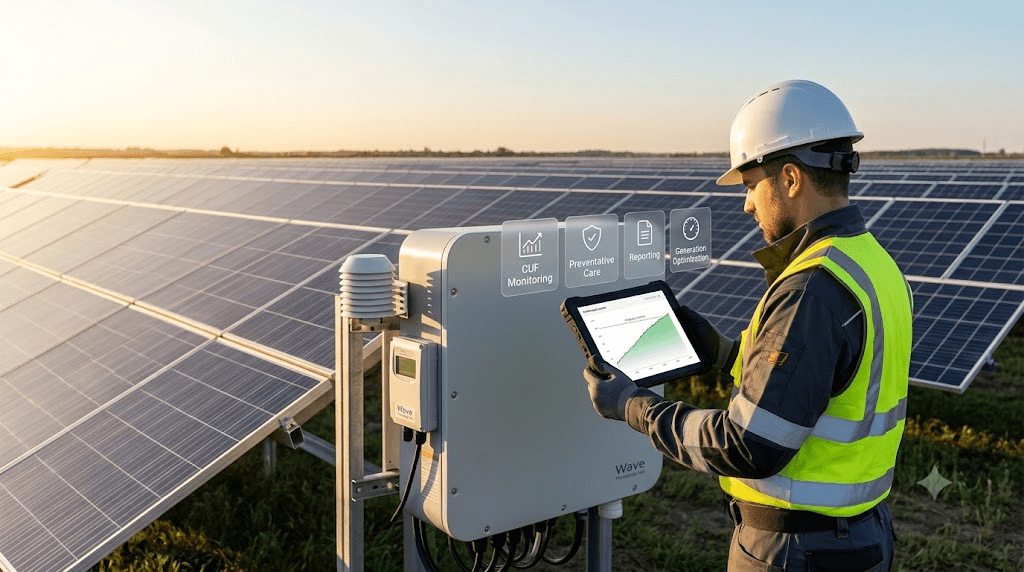
A strong solar O&M contract must lock in a written PR or CUF generation guarantee, defined response and resolution SLAs, preventive and corrective maintenance scope, module cleaning frequency, spare parts coverage, SCADA monitoring, DISCOM and CEIG compliance, insurance support, and penalty-backed performance clauses.
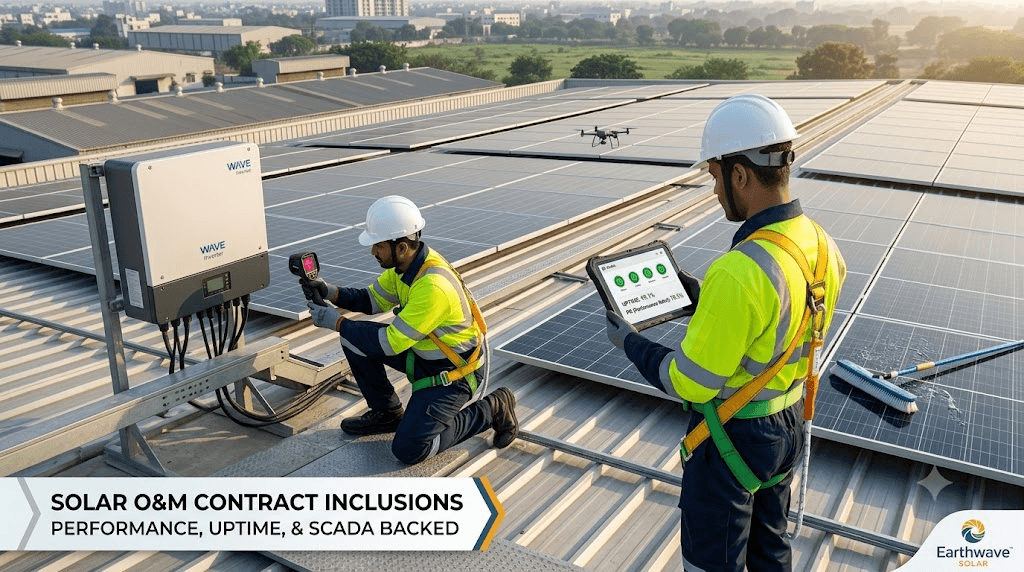
Anything missing in these 10 areas leaves the asset owner exposed to silent generation loss and unbudgeted repair cost.
For the broader maintenance backbone, read our solar plant maintenance checklist.
10 non-negotiable inclusions, led by PR or CUF generation guarantee.
Response time of 4 to 24 hours and resolution of 24 to 72 hours.
Uptime guarantee above 98%, PR guarantee between 75% and 80%.
Realistic O&M cost: ₹1.0 to ₹1.6 lakhs per MW per year for ground-mount, ₹1.5 to ₹2.2 lakhs per MW for rooftop.
Earthwave Solar offers SCADA-backed, SLA-driven, penalty-locked O&M across India.
A solar O&M contract is the legal and operational backbone that protects 25 years of plant generation, not a glorified cleaning agreement.
Operations:
Daily monitoring, SCADA review, generation reporting, DISCOM compliance.
Maintenance:
Preventive checks, corrective repairs, cleaning, spare replacement.
A weak O&M contract can erode 8% to 15% of total lifetime generation. On a 1 MW plant, that is ₹35 to ₹60 lakhs in lost revenue across 25 years.
Warranty:
Manufacturer covers defective equipment only.
AMC:
Annual maintenance, usually labour-focused.
O&M:
End-to-end operations, maintenance, generation guarantee, and reporting.
For inverter warranty context, read our Wave on-grid inverter guide for India.
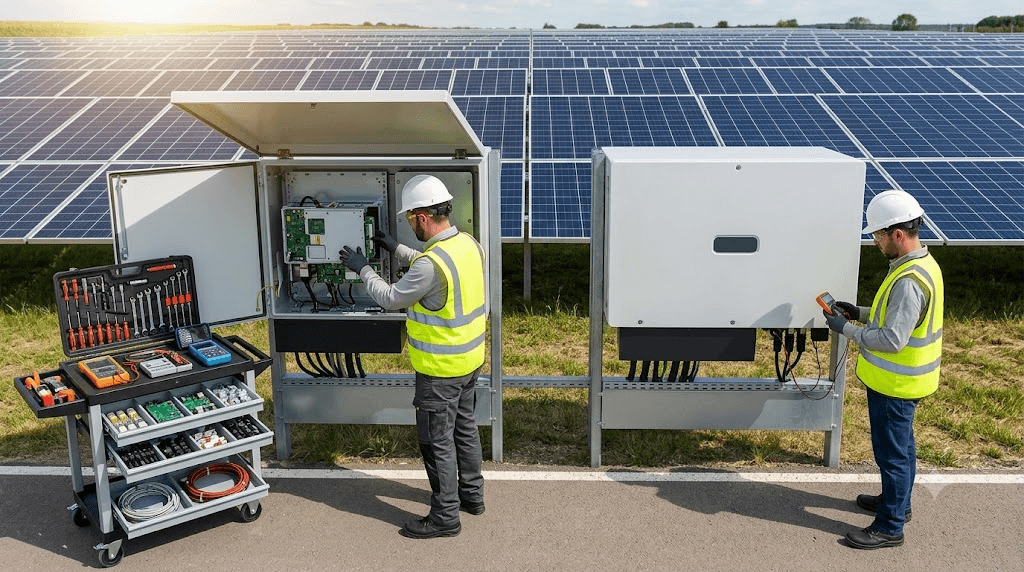
A comprehensive O&M contract includes spares, labour, and replacements, while a non-comprehensive contract covers labour only. For plants above 100 kW, comprehensive almost always wins on total cost of ownership.
All preventive and corrective maintenance labour.
Replacement of consumables (fuses, MC4 connectors, surge arrestors).
Most spare parts within agreed limits.
Cleaning, water cost, transport, manpower.
Labour for routine tasks.
Owner pays for all spares and consumables separately.
Suitable only for plants where the owner has in-house spare inventory.
Some O&M contracts cover spares up to a cap (₹50,000 to ₹2 lakhs per MW per year), then convert to non-comprehensive. This is a fair middle path for many C&I projects.
Comprehensive:
35% to 50% costlier upfront.
Non-comprehensive:
Cheaper, but unpredictable annual spend.
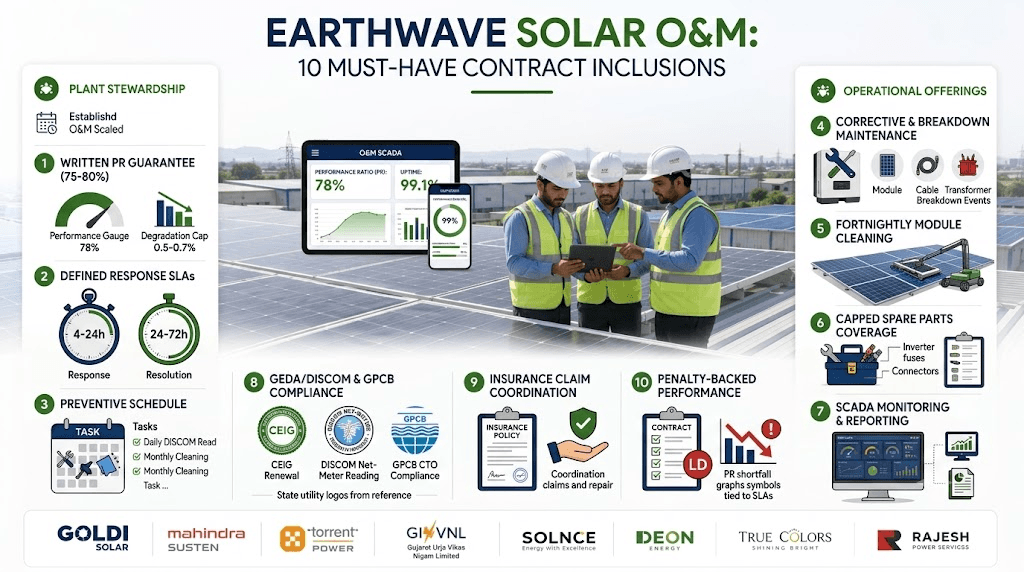
These 10 inclusions separate a serious O&M contract from a cleaning agreement dressed up in legal language.
PR and CUF generation guarantee:
Written PR of 75% to 80% with annual degradation cap of 0.5% to 0.7%.
Response and resolution SLAs:
Response in 4 to 24 hours, resolution in 24 to 72 hours.
Preventive maintenance schedule:
Daily, weekly, monthly, quarterly, half-yearly, and annual tasks listed.
Corrective and breakdown maintenance:
Inverter, module, cable, MMS, transformer, and surge events.
Module cleaning frequency:
Monthly for dusty zones, fortnightly for highly polluted or coastal sites.
Spare parts coverage:
Inventory list, lead time, and capped replacement costs.
SCADA, monitoring, and reporting:
Real-time dashboard access for the owner.
DISCOM, CEIG, and GPCB compliance:
Net-meter reading, CEIG renewal, GPCB CTO compliance.
Insurance coordination:
Vendor coordinates claims with the plant insurer.
Penalty-backed performance clauses:
LD tied to PR shortfall, downtime, and SLA misses.
Cross-reference with our solar EPC company checklist for India.
Without SLA numbers, an O&M contract is just intent. Use these benchmarks as your negotiation floor.
SLA Type | Benchmark |
Response time (fault acknowledgment) | 4 to 24 hours |
Resolution time (fault closure) | 24 to 72 hours |
Plant uptime guarantee | 98% and above |
PR (Performance Ratio) guarantee | 75% to 80% |
Module cleaning cycle | Monthly to fortnightly |
SCADA reporting cadence | Daily auto-report, monthly review |
Annual generation audit | Once a year, third-party verifiable |
For SCADA depth, read our solar monitoring system SCADA guide.
A preventive maintenance schedule is the operating system of your O&M contract. The vendor must commit to a written cadence, not "as needed."
Frequency | Tasks |
Daily | SCADA review, alarm triage, generation logging |
Weekly | Visual inspection, cleaning trigger check, inverter status |
Monthly | Thermography (IR), string-level Voc/Isc checks, junction box audit |
Quarterly | Inverter PM, earthing test, cable insulation check, MMS torque sample |
Half-yearly | IV curve test, hot-spot mapping, transformer oil check |
Annual | Insurance audit, CEIG renewal, deep electrical inspection, annual generation report |
Pair this schedule with the broader solar plant maintenance checklist.
Corrective maintenance is where weak contracts fail loudly. The O&M vendor must own end-to-end diagnosis and resolution across 6 fault categories.
Inverter and string-level faults:
Card replacements, firmware updates, fan and IGBT issues.
Module hot-spots, PID, and degradation:
Thermography-led diagnosis and replacement.
Cable and connector failures:
MC4 burn-outs, DC cable nicks, AC cable insulation breakdown.
MMS corrosion and structural issues:
Galvanising checks, bolt torque, foundation cracks.
Transformer and HT panel faults:
Oil leaks, breaker trips, relay miscoordination.
Lightning and surge events:
Arrestor replacement, earthing rework, SPD checks.
A real-world example: at our 80 MW Mota Mandvada ground-mount, thermography in month 9 caught early PID on 3 strings. Replacement under O&M saved 1.8% of annual generation across the asset life.
Solar O&M in India costs ₹1.0 to ₹2.2 lakhs per MW per year depending on plant type, scope, and location. Free first-year O&M is common but usually narrow in scope.
Plant Type | Comprehensive O&M | Non-Comprehensive O&M |
Ground-mount, 1 MW and above | ₹1.2 to ₹1.6 lakhs per MW per year | ₹0.7 to ₹1.0 lakhs per MW per year |
Industrial rooftop, 100 kW to 1 MW | ₹1.5 to ₹2.2 lakhs per MW per year | ₹0.9 to ₹1.3 lakhs per MW per year |
Residential, under 10 kW | ₹4,000 to ₹8,000 per year | ₹2,500 to ₹5,000 per year |
A healthy O&M spend is 1% to 1.5% of CAPEX per year. Below 0.8% is usually a red flag for missing scope.
Cleaning water and DI water for soiled regions.
Transport and crew mobilisation for remote sites.
Consumables (fuses, MC4, fasteners).
DG and battery support for SCADA during outages.
For ROI math, see solar payback period India 2026 and solar energy savings in India.

The right O&M model depends on plant size, location, and in-house engineering capacity. Most C&I and IPP owners are best served by EPC O&M with a vertically integrated partner.
OEM O&M:
Strong on inverter or module care, weak on civil, MMS, and DISCOM.
EPC O&M:
The company that built your plant. Strongest ownership when EPC is vertically integrated.
Third-party O&M:
Specialist asset managers. Good for IPPs and large portfolios. Adds an interface layer.
In-house O&M:
Only viable for plants above 25 MW with dedicated electrical staff.
For plant sizes between 100 kW and 5 MW, EPC O&M with an integrated EPC almost always wins. Read EPC vs non-EPC solar contractors for the contractor decision framework.
Six red flags tell you the O&M proposal in front of you is a cleaning agreement, not an asset protection contract.
No PR or CUF guarantee in writing.
Vague response time ("we will reach soon").
Spare parts silently excluded under "consumables not covered."
No SCADA or monitoring access for the owner.
Penalty clauses missing or capped at less than 1% of annual O&M fee.
Free first-year O&M with no scope document.
If 2 or more show up, renegotiate or switch vendors. Cross-check with our solar EPC red flags in Gujarat guide.

A 10-point vendor evaluation cuts through marketing language and forces real commitments on the table.
Written PR and CUF guarantee with annual degradation cap.
Defined response and resolution SLAs in hours.
SCADA dashboard access for the owner.
Spare parts inventory list and lead time.
Module cleaning frequency and water source.
Dedicated regional O&M cell.
Insurance coordination scope.
DISCOM, CEIG, and GPCB compliance scope.
Penalty clauses tied to PR and uptime.
Audit rights for third-party verification.
Payment milestones tied to performance:
Last 10% to 15% payable on annual PR achievement.
Exit clauses:
Owner exit on 2 consecutive PR misses or 3 SLA misses in a year.
Contract duration:
3 to 5 years preferred over 1-year rolling.
Audit rights:
Owner or third party can audit logs and SCADA data anytime.
Stories beat theory. Here are 4 real-pattern scenarios that recur across Indian solar plants.
A textile rooftop plant skipped monthly cleaning during peak dust season. PR dropped from 78% to 68% over 5 months. Loss: ₹4.2 lakhs in a single year.
A central inverter failed. The non-comprehensive O&M vendor had no spare. Replacement took 9 days. Loss: ₹2.7 lakhs in generation plus demand charge spike.
A comprehensive O&M contract with monthly thermography caught early PID on 3 strings. Replacement under contract saved 1.8% of annual generation, worth crores across asset life.
An IPP tried to refinance a 5 MW plant. The lender's technical advisor rejected the deal because the O&M contract had no PR guarantee and no SCADA. The owner had to re-sign with a SLA-backed O&M before refinancing went through.
Earthwave Solar runs a 5-pillar O&M model designed for bankable solar assets across India.
SCADA monitoring and remote diagnostics:
24x7 dashboard with alarm escalation.
Dedicated O&M cell across Gujarat and Madhya Pradesh:
Surat and Bhopal teams with regional response under 24 hours.
Wave inverter in-house service advantage:
Same-day spare access for Earthwave-installed Wave inverters.
Penalty-backed PR and uptime guarantee:
LD tied to PR shortfall and SLA misses.
Track record:
Active O&M on the 80 MW Mahindra Susten ground-mount, 2 MW Goldi Solar Amod, 4 MW Zudvadli, 170 kW Pari Textile, 2 MW True Colors Palsana, and 120 kW Sahaj Textile Sachin.
Explore the project portfolio and the full Earthwave service stack.
Switching O&M vendors does not have to be painful. A clean 5-step transition closes the gap in 30 days.
Run a generation and PR audit
for the last 12 months.
Pull SCADA data
and inverter logs to identify trends.
Review your current contract
against the 10-point inclusions checklist.
Get a new SLA-backed proposal
from a vetted O&M vendor.
Plan a 30-day handover window
covering spare inventory, SCADA credentials, and on-site walkthrough.
Earthwave Solar is a Surat-based vertically integrated solar EPC with operations in Bhopal and project delivery across India. Established in 2018, the company executes rooftop, residential, commercial, ground-mount, and hybrid solar projects, manufactures Wave inverters in-house since 2024, and added solar module manufacturing in 2025.
True end-to-end O&M scope, not labour-only AMC.
In-house Wave inverter service shortens inverter downtime.
SCADA-backed, SLA-driven, penalty-locked contracts.
Trusted by Goldi Solar, Mahindra Susten, GUVNL, Torrent Power, Solnce, Deon Energy, True Colors, Rajesh Power Services.
Dedicated O&M cells across Gujarat and Madhya Pradesh.
Meet the Earthwave leadership team shaping each O&M contract.
A solar O&M contract must include a PR or CUF guarantee, response and resolution SLAs, preventive and corrective maintenance, cleaning frequency, spare parts coverage, SCADA monitoring, DISCOM and CEIG compliance, insurance support, and penalty clauses.
Ground-mount O&M costs ₹1.0 to ₹1.6 lakhs per MW per year. Industrial rooftop costs ₹1.5 to ₹2.2 lakhs per MW per year. Comprehensive contracts cost 35% to 50% more than non-comprehensive ones.
Monthly cleaning is standard for most Indian sites. Dusty, coastal, or industrial zones need fortnightly cleaning. The cleaning cycle must be written into the O&M contract with water quality and source specified.
OEM O&M is strong on the OEM's own equipment but weak on civil, MMS, DISCOM, and full-plant performance. For plants between 100 kW and 5 MW, EPC O&M with a vertically integrated EPC usually outperforms OEM O&M.
Yes. Earthwave Solar offers takeover O&M for plants originally built by other EPCs across rooftop, ground-mount, and hybrid systems, with a 30-day handover process including SCADA integration, spare audit, and SLA reset.
FAQS
Can't find the answer you're looking for? Our team is here to help.
SUBSCRIBE NEWSLETTER
Switching to solar is easier than you think. Let us guide you to cleaner, more affordable energy.
