PM Surya Ghar Subsidy
Solar Panel Cost After PM Surya Ghar Subsidy 2026
2026-06-08T00:00:00.000Z•9
A 1kW solar system costs roughly ₹40,000 to ₹55,000 after subsidy, a 3kW system costs roughly ₹87,000 to ₹1,47,000 after subsidy, and a 5kW system costs roughly ₹2,02,000 to ₹3,02,000 after subsidy.
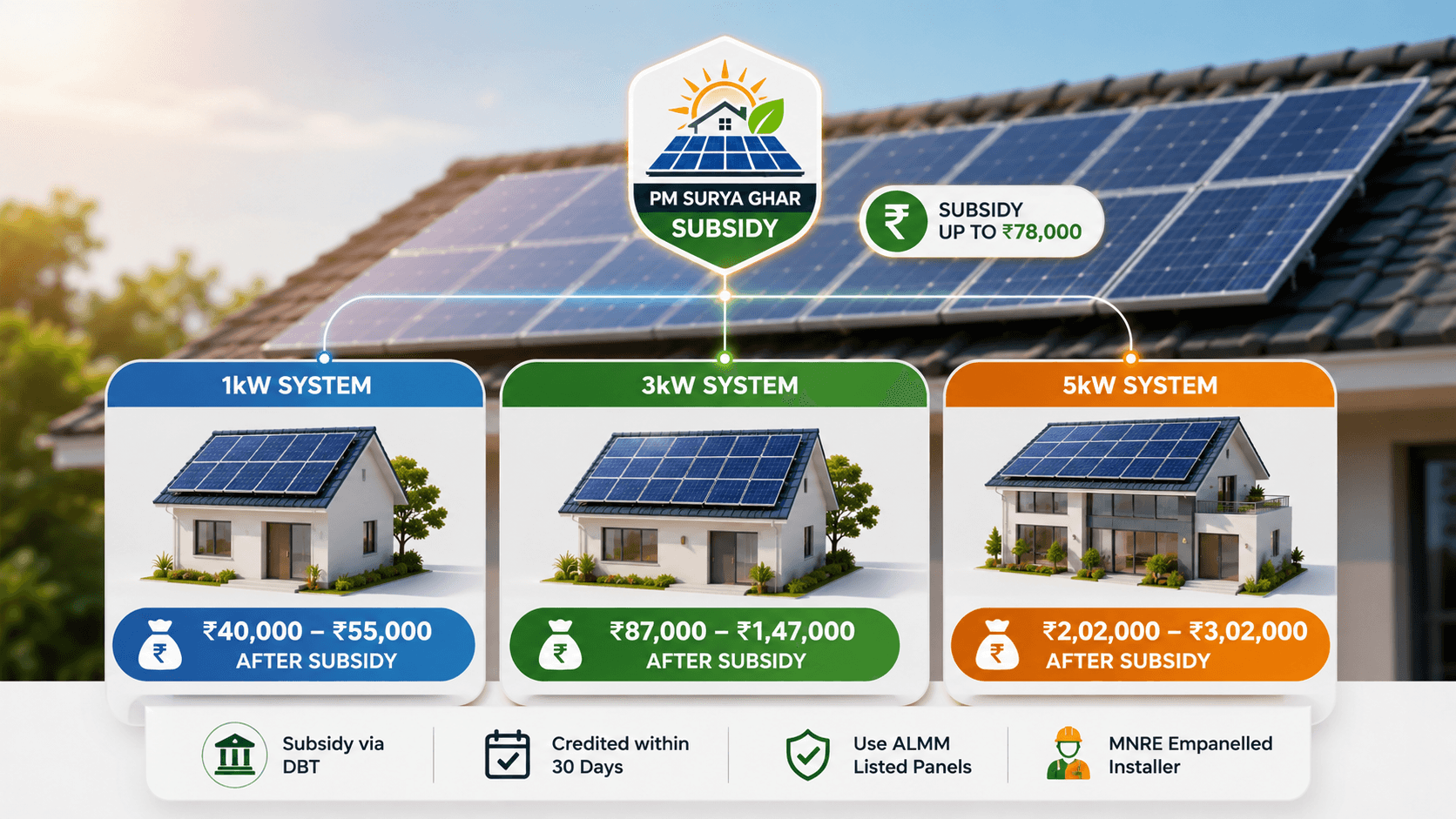
The **PM Surya Ghar subsidy caps at ₹78,000,** and it applies the same way regardless of city, as long as you use ALMM-listed panels and an MNRE-empanelled installer.
System Size | Net Cost After Subsidy ( Approx. ) |
1 kW | ₹40,000 to ₹55,000 |
3 kW | ₹87,000 to ₹1,47,000 |
5 kW | ₹2,02,000 to ₹3,02,000 |
These are real post-subsidy numbers, not base prices. Here is exactly how they break down for each system size.
PM Surya Ghar gives ₹30,000 for 1kW, ₹60,000 for 2kW, and a capped ₹78,000 for 3kW and above.
A 3kW system is the most subsidy-efficient choice for most Indian homes.
Net cost after subsidy: 1kW around ₹40,000 to ₹55,000, 3kW around ₹87,000 to ₹1,47,000, 5kW around ₹2,02,000 to ₹3,02,000.
Payback period typically falls between 3.5 and 6 years, depending on your electricity bill.
Subsidy is credited via DBT to your bank account within 30 days of DISCOM commissioning.
The cost after subsidy is your total installation price minus the central government's direct subsidy, which ranges from ₹30,000 to ₹78,000 depending on system size.
This is the number that actually matters when you are deciding whether to go solar.
PM Surya Ghar Muft Bijli Yojana is the central government's residential rooftop solar scheme, active since February 2024 and funded under a ₹75,021 crore outlay.
Covers on-grid, grid-tied residential rooftop systems only.
Off-grid and pure battery-backup systems do not qualify.
Requires ALMM-listed (Approved List of Models and Manufacturers) panels.
Requires installation through an MNRE-empanelled vendor. Use our
solar EPC company checklist for India
to verify a vendor before signing.
Base cost is what an installer quotes before subsidy. Final cost is what you actually pay after the subsidy lands in your bank account.
Base cost for a 3kW system: roughly ₹1,65,000 to ₹2,25,000.
Subsidy applied: ₹78,000.
Final cost: roughly ₹87,000 to ₹1,47,000.
Many quotes only show the base price. Always ask your installer to show you the post-subsidy number in writing.
See our full solar panel price guide for India for a broader cost breakdown by panel type.
This guide is for homeowners comparing 1kW, 3kW, and 5kW systems and who want exact numbers before contacting an installer.
1 BHK to 2 BHK homeowners with modest electricity bills.
2 BHK to 4 BHK families checking if 3kW fits their consumption.
Larger homes or those with high AC load considering 5kW.
If you have not started planning yet, our guide on how to plan rooftop solar for your home is a good starting point.
The subsidy works on a slab structure: ₹30,000 per kW for the first 2kW, then ₹18,000 for the next 1kW, capped at ₹78,000 total for any system 3kW or larger.
System Size | Subsidy Amount |
1 kW | ₹30,000 |
2 kW | ₹60,000 |
3 kW (and above) | ₹78,000 (capped) |
A 5kW system still gets the same ₹78,000 cap. The subsidy does not increase beyond 3kW under the central scheme.
The cap exists because the scheme is designed to support typical household consumption, not large or commercial-scale systems. Most Indian homes use 200 to 400 units per month, which a 2kW to 3kW system comfortably covers.
A 3kW system is the subsidy "sweet spot," getting maximum support for moderate household load.
Going beyond 3kW means paying full price per kW for the extra capacity, with no added subsidy.
If you are in Gujarat, check our dedicated breakdown of the solar subsidy in Gujarat for 2026 for any state-level top-ups that apply on top of this central amount.
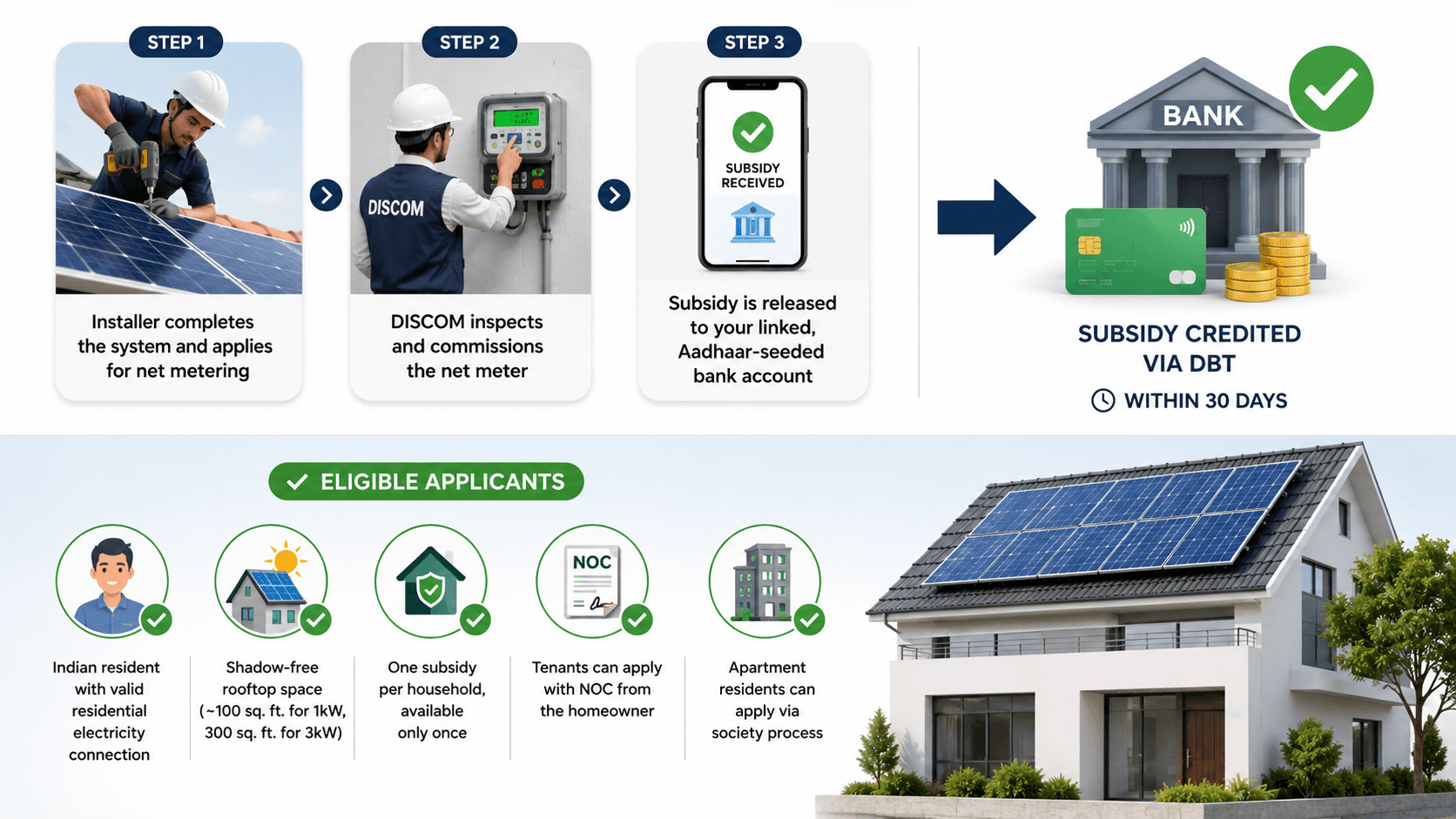
The subsidy is credited via Direct Benefit Transfer (DBT), straight to your bank account, within 30 days of DISCOM commissioning and net meter installation.
Step 1:
Installer completes the system and applies for net metering.
Step 2:
DISCOM inspects and commissions the net meter.
Step 3
: Subsidy is released to your linked, Aadhaar-seeded bank account.
Pro tip: Make sure your bank account is NPCI DBT-linked before applying. An inactive DBT link is one of the most common reasons subsidy payments get delayed.
Most residential electricity connection holders with a suitable rooftop qualify, with a few exceptions.
Must be an Indian resident with a valid residential electricity connection.
Must have shadow-free rooftop space (roughly 100 sq. ft. for 1kW, 300 sq. ft. for 3kW).
One subsidy per household, available only once.
Tenants can apply with a No Objection Certificate (NOC) from the homeowner.
If you live in a flat, our
apartment solar installation guide
covers society-level approvals in more detail.
The net cost scales with system size, but not in a straight line, because the subsidy share shrinks as a percentage once you cross 3kW. Here is the real math for each size.
Item | Amount |
Base installation cost | ₹70,000 to ₹1,10,000 |
Subsidy | ₹30,000 |
Net cost after subsidy | ₹40,000 to ₹80,000 |
A 1kW system generates roughly 4 to 5 units per day, enough for a small home with basic lighting, fans, and a refrigerator.
Item | Amount |
Base installation cost | ₹1,65,000 to ₹2,25,000 |
Subsidy | ₹78,000 |
Net cost after subsidy | ₹87,000 to ₹1,47,000 |
A 3kW system generates roughly 12 to 14 units per day, enough to run a 1.5-ton AC plus regular household appliances.
Item | Amount |
Base installation cost | ₹2,75,000 to ₹3,75,000 |
Subsidy | ₹78,000 |
Net cost after subsidy | ₹2,02,000 to ₹3,02,000 |
A 5kW system generates roughly 18 to 22 units per day, suited for larger homes or multiple AC units.
1kW
: Small 1 BHK homes, light consumption, minimal AC usage.
3kW
: Standard 2 BHK to 3 BHK homes with one AC and regular appliance load.
5kW
: Larger 3 BHK to 4 BHK homes, multiple ACs, or homes planning higher future consumption.
See our picks for the best solar panels for home in India to compare panel options across these system sizes.
Every solar quote should break down into four numbers: base cost, subsidy, net cost, and payback period. If your installer cannot show you all four clearly, ask again.
System Size | Base Cost Range |
1 kW | ₹70,000 to ₹1,10,000 |
3 kW | ₹1,65,000 to ₹2,25,000 |
5 kW | ₹2,75,000 to ₹3,75,000 |
System Size | Subsidy |
1 kW | ₹30,000 |
3 kW | ₹78,000 |
5 kW | ₹78,000 |
System Size | Net Cost |
1 kW | ₹40,000 to ₹80,000 |
3 kW | ₹87,000 to ₹1,47,000 |
5 kW | ₹2,02,000 to ₹3,02,000 |
System Size | Daily Generation | Approx. Monthly Bill Offset |
1 kW | 4 to 5 units | ₹600 to ₹900 |
3 kW | 12 to 14 units | ₹2,000 to ₹2,800 |
5 kW | 18 to 22 units | ₹3,000 to ₹4,200 |
Actual savings depend on your local electricity tariff and how much of your generated power you self-consume versus export.
Most residential systems pay back their net cost within 3.5 to 6 years, after which electricity generation is effectively free for the remaining system life.
Higher electricity bills shorten payback time.
Systems closer to actual consumption (rather than oversized) pay back faster.
After payback, the system continues generating for 20+ more years. Read our full guide on the
for a size-by-size comparison.
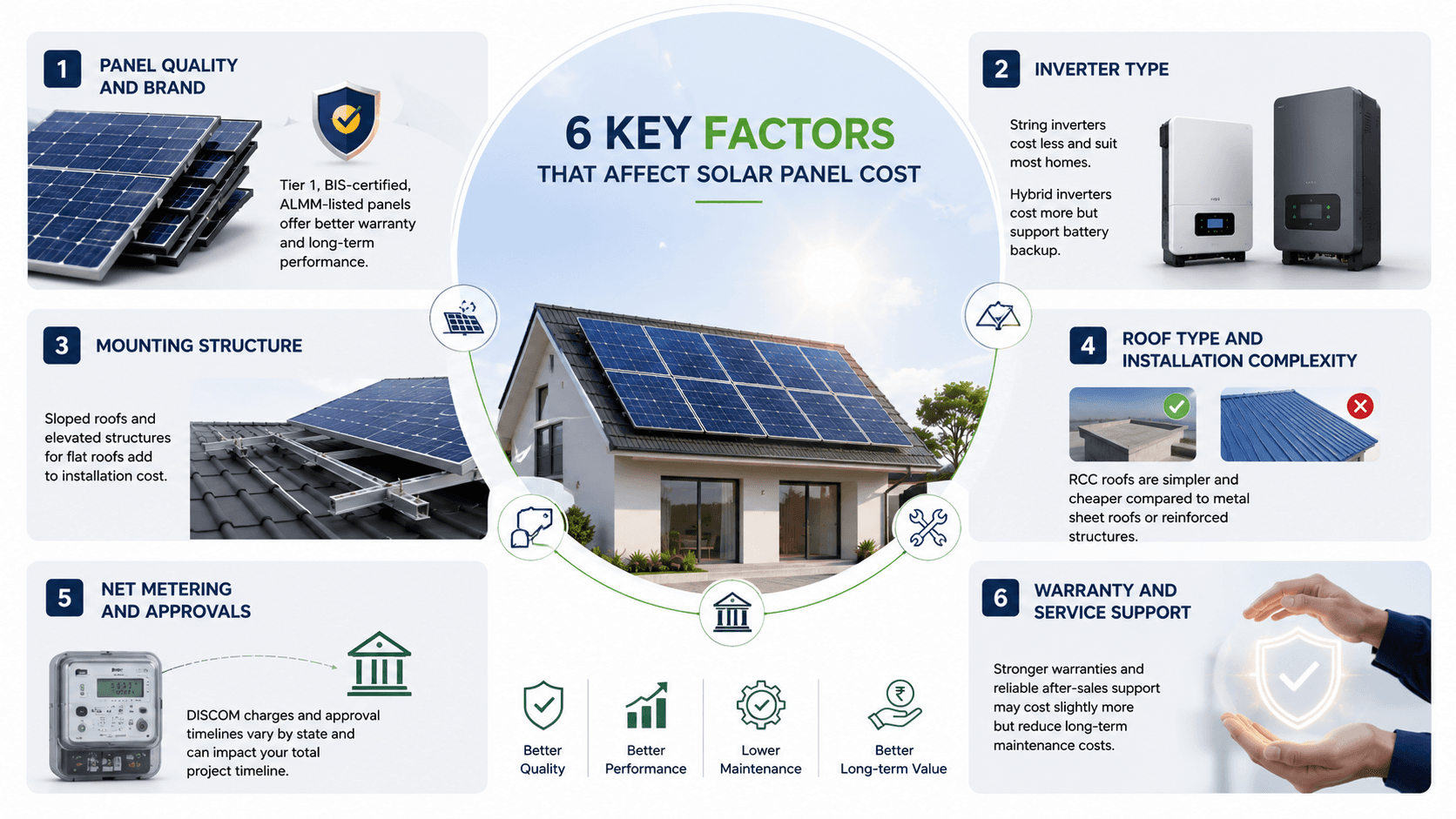
System size sets the baseline, but six other factors decide where your final quote lands within the typical price range.
Tier 1, BIS-certified, ALMM-listed panels cost more upfront but carry longer warranties and more stable output over 25 years.
String inverters cost less and suit most homes, while hybrid inverters cost more but support battery backup integration. See our solar inverter guide for India for a full comparison.
Sloped roofs and elevated structures for flat roofs add to installation cost compared to simple flat-roof mounting.
RCC roofs are generally simpler and cheaper to work with than metal sheet roofs or roofs needing structural reinforcement.
DISCOM net metering charges and approval timelines vary by state and can add to your total project timeline, though typically not to the equipment cost itself. Learn more in our guide on net metering and solar income in Gujarat.
Installers offering longer service visits and stronger after-sales support may quote slightly higher, but this often reduces long-term maintenance costs.
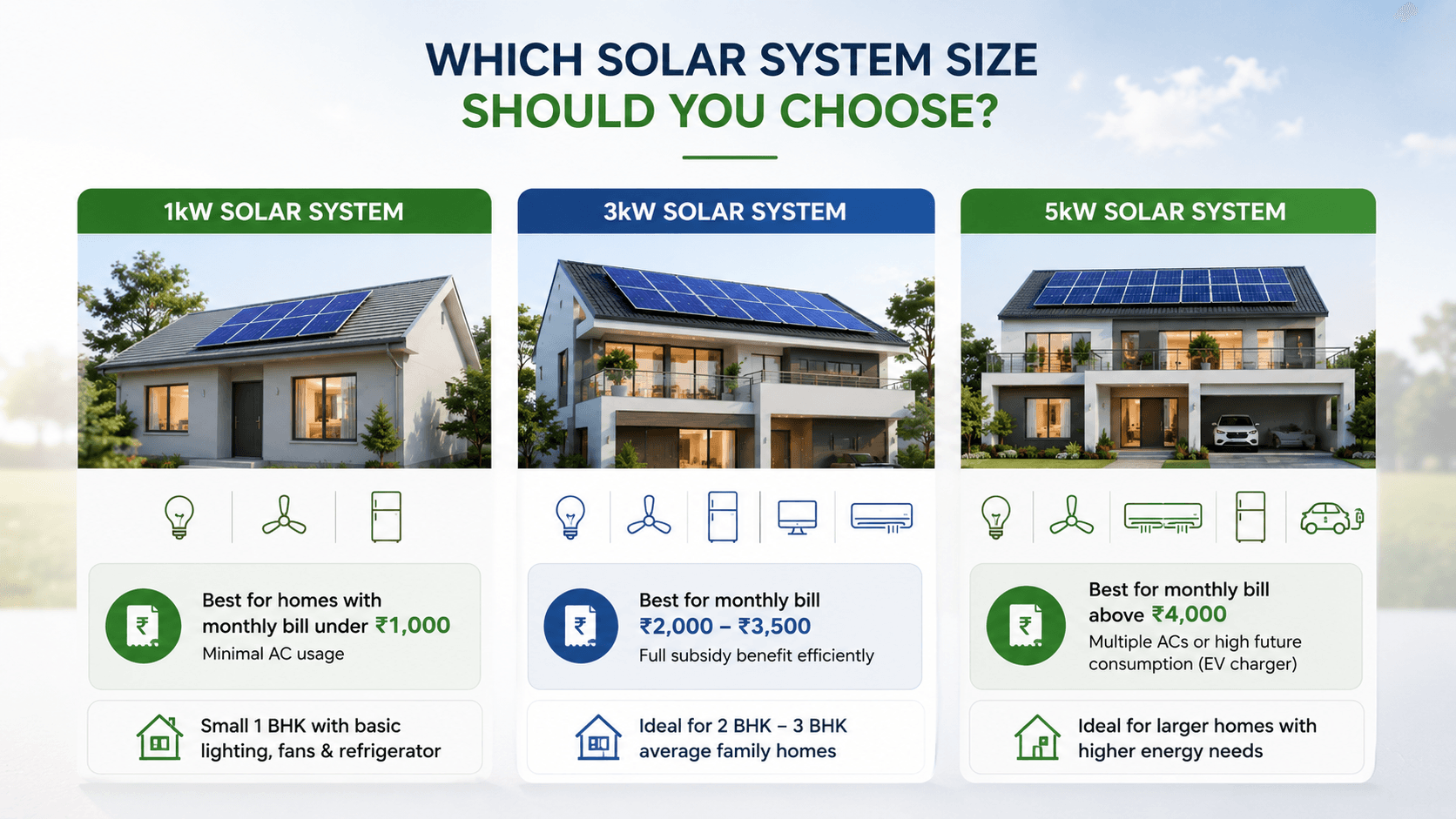
The right system size matches your average monthly electricity bill, not your roof's full available space. Oversizing wastes subsidy efficiency, and undersizing limits your savings.
Best for homes with a monthly bill under ₹1,000 and minimal AC usage.
A small 1 BHK with basic lighting, fans, and a refrigerator fits this size well.
Best for most 2 BHK to 3 BHK homes with a monthly bill between ₹2,000 and ₹3,500. This is the size that gets the full subsidy benefit most efficiently.
Best for homes with a monthly bill above ₹4,000, multiple AC units, or higher future consumption plans, such as an EV charger.
Check your last 6 months of electricity bills and find your average monthly consumption in units.
Match that consumption against the daily generation table above.
Confirm your rooftop has enough shadow-free area for your chosen system size.
For a deeper look at the savings side, see how solar can reduce your electricity bill in Gujarat.
Pro tip: If your bill sits between two system sizes, lean toward the smaller size first. You can always expand later, but oversizing upfront means paying full price for capacity you may not use.
It depends on system size. A 1kW system costs ₹40,000 to ₹80,000, a 3kW system costs ₹87,000 to ₹1,47,000, and a 5kW system costs ₹2,02,000 to ₹3,02,000 after subsidy.
Most homes choose a 3kW system, which costs ₹87,000 to ₹1,47,000 after the ₹78,000 central subsidy is applied.
A 1kW system suits only very small homes with light electricity use. Most family homes with even one AC unit need at least 3kW.
Yes, for typical 2 BHK to 3 BHK homes. It captures the full ₹78,000 subsidy cap while matching average Indian household consumption.
Yes, if your monthly bill already exceeds ₹4,000 or you plan to add appliances, an EV charger, or more AC units in the near future.
Savings range from ₹600 to ₹900 monthly for 1kW, ₹2,000 to ₹2,800 for 3kW, and ₹3,000 to ₹4,200 for 5kW, depending on your tariff and consumption pattern.
Most subsidy delays and rejections come from preventable paperwork errors, not actual ineligibility.
Any Indian resident with a valid residential electricity connection and suitable rooftop space, applying for the first time for that household.
Latest electricity bill with current DISCOM consumer number.
Aadhaar card.
Bank passbook, with the account Aadhaar-seeded for DBT.
House tax receipt (required in some states).
Using non-ALMM-listed panels.
Applying through a non-MNRE-empanelled vendor.
Mismatched name or address between electricity bill and bank account.
Using an outdated DISCOM consumer number from an old bill.
Inactive or non-Aadhaar-seeded bank account for DBT.
Skipping net meter installation before claiming subsidy completion.
The application runs through four stages, from registration to subsidy receipt, typically taking 45 to 90 days end to end.
Visit pmsuryaghar.gov.in, select the consumer option, and register using your mobile number and electricity bill details.
Select an MNRE-empanelled installer from the list shown on the portal for your DISCOM area.
The installer completes the system using ALMM-listed panels, then the DISCOM inspects the site and installs the net meter.
Once DISCOM commissioning is confirmed on the portal, the subsidy is credited via DBT within 30 days.
The subsidy changes solar from a long-payback investment into a short-payback one, which is why most homeowners should never skip applying for it.
Without subsidy, a 3kW system payback can stretch to 6 to 8 years.
With the ₹78,000 subsidy applied, payback typically drops to 3.5 to 5 years.
If your consumption already justifies 5kW, the subsidy cap means you are paying full price for the additional 2kW beyond the 3kW mark, but the long-term savings on a higher bill usually still justify it.
Always compare net cost after subsidy, not base price alone.
Check that the quote already factors in the correct subsidy slab for your system size.
Ask for the subsidy timeline and DBT process the installer follows.
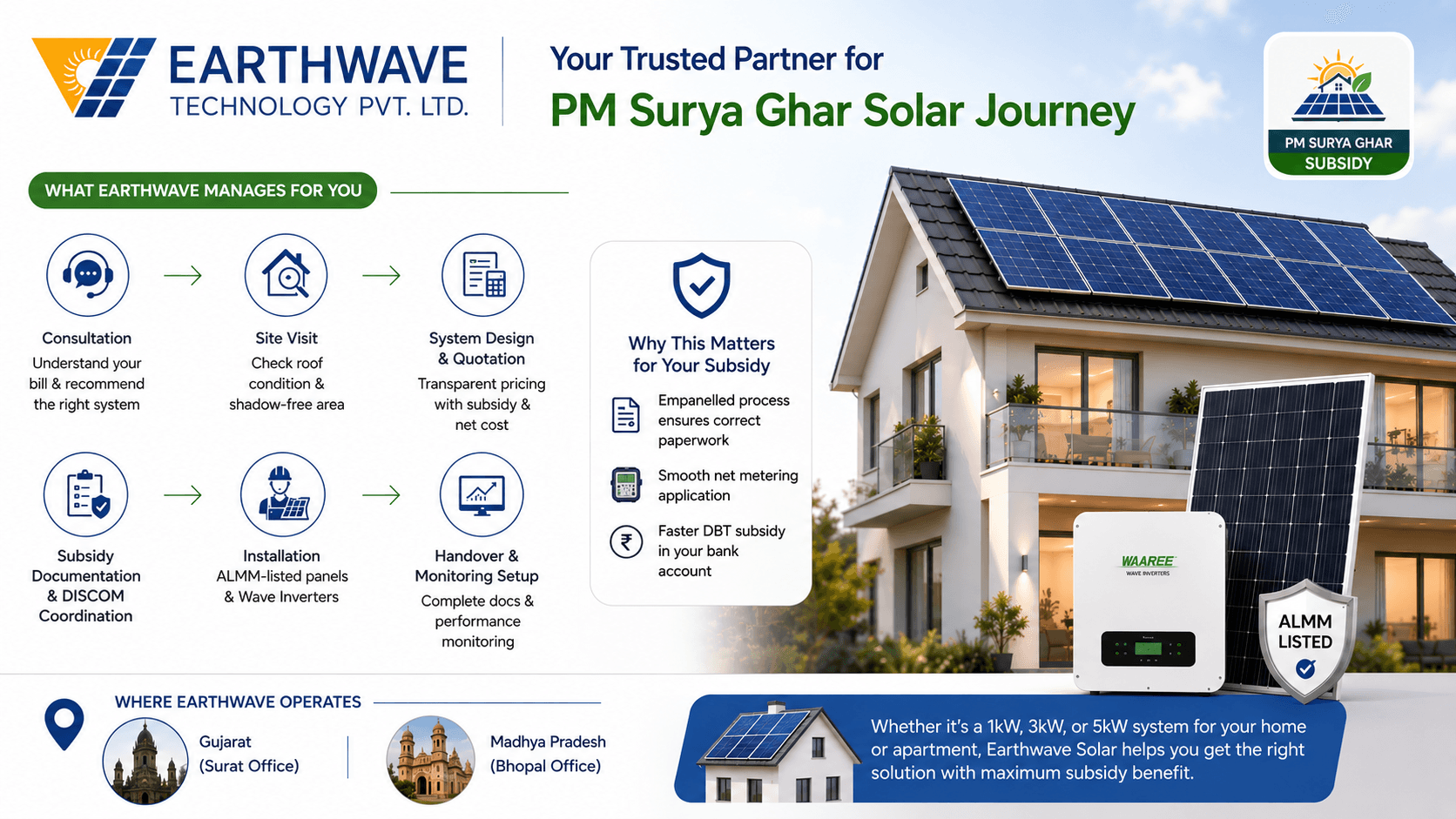
Earthwave Solar is an EPC company that handles your entire PM Surya Ghar journey, from site visit to subsidy documentation to final installation, across residential rooftop solar projects.
Initial consultation to assess your electricity bill and recommend the right system size
Site visit to check roof condition and shadow-free area
System design and transparent quotation showing base cost, subsidy, and net cost
Subsidy documentation and DISCOM coordination
Installation using ALMM-listed panels and
Final handover with complete documentation and monitoring setup
Earthwave's empanelled process means your paperwork, net metering application, and DBT subsidy claim are handled correctly the first time, reducing the common delays homeowners face when applying independently.
Madhya Pradesh (Bhopal office)
If you are considering a 1kW, 3kW, or 5kW rooftop system for your home or apartment, Earthwave Solar can walk you through the exact subsidy numbers for your specific consumption and roof size.
Get in touch:
Website:
for a personalized quote
Surat office: +91 90336 07212
Solar panel installation in India costs roughly ₹55,000 to ₹85,000 per kW before subsidy in 2026, depending on panel quality, inverter type, and roof complexity.
Total cost after subsidy ranges from ₹40,000 for a 1kW system to ₹3,02,000 for a 5kW system, depending on the system size and the applicable subsidy slab.
For most homes choosing a 3kW system, the cost after the ₹78,000 central subsidy comes to roughly ₹87,000 to ₹1,47,000.
The subsidy for a 3kW system is capped at ₹78,000 under the central scheme. This same cap applies to any system 3kW or larger.
The central subsidy amount stays the same nationwide, but several states, including Uttar Pradesh, Delhi, and Gujarat, offer additional state-level top-up subsidies on top of the central amount.
The full process from application to subsidy credit typically takes 45 to 90 days, with the subsidy itself credited within 30 days of DISCOM commissioning.
FAQS
Can't find the answer you're looking for? Our team is here to help.
SUBSCRIBE NEWSLETTER
Switching to solar is easier than you think. Let us guide you to cleaner, more affordable energy.
