Solar Payback Period
Solar Payback Period India 2026: City Calculator
2026-02-27T00:00:00.000Z•9
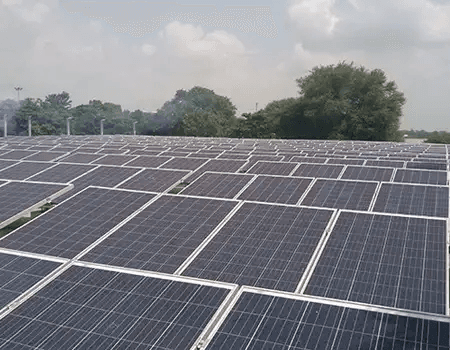
In most Indian cities, a rooftop solar system pays back its investment in 3 to 5 years depending on your city's electricity tariff, available sunlight, and system size.
Cities like Mumbai and Surat with higher tariffs see faster payback than cities with lower per-unit rates.
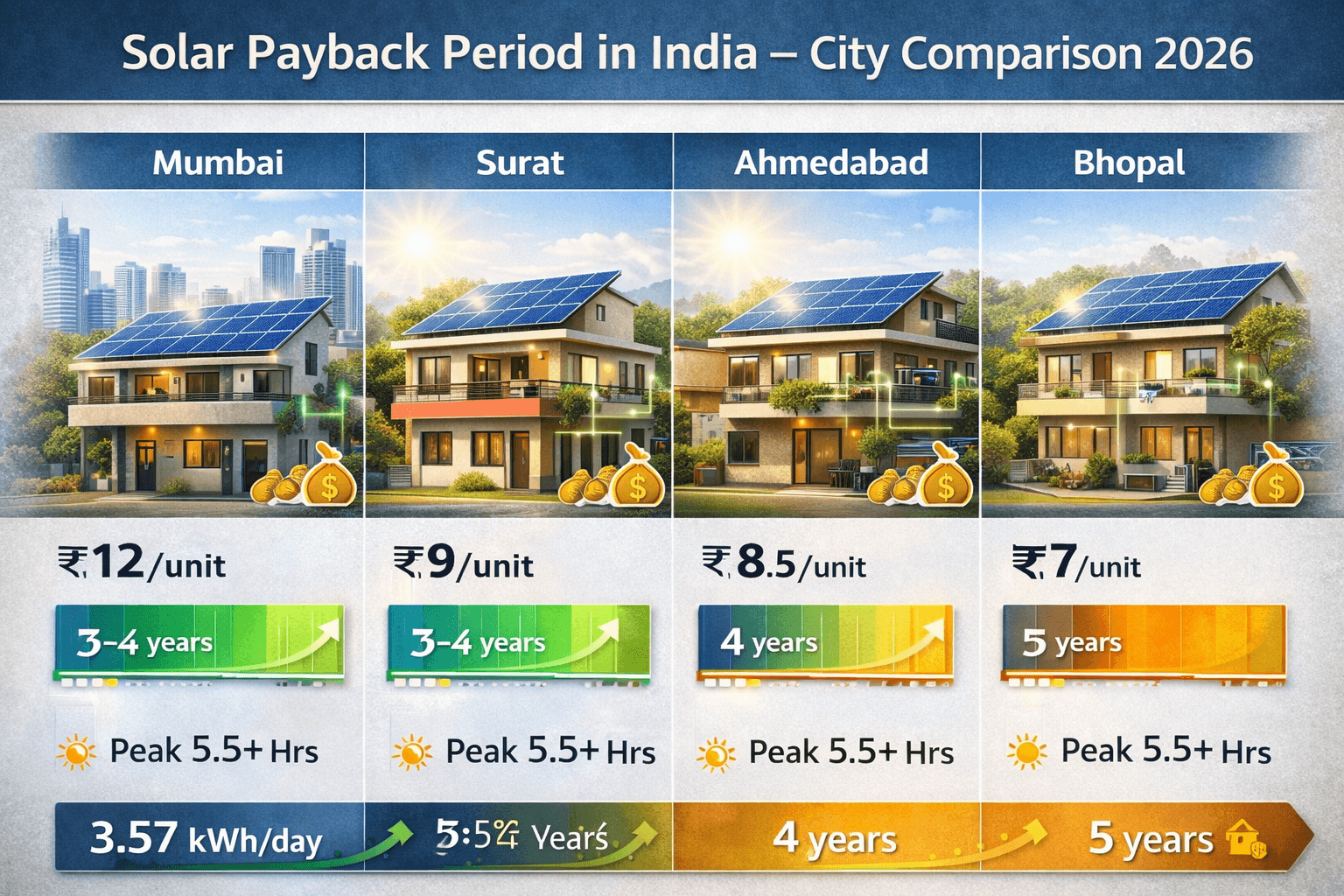
Solar payback period in India ranges from 3 to 5 years for most homeowners in 2026.
Mumbai residents pay some of the highest electricity rates in India, making solar ROI fastest there.
Surat and Ahmedabad benefit from 5.5+ peak sun hours daily, boosting annual generation.
Bhopal has good sunlight but lower tariffs, resulting in a slightly longer payback window.
Getting your exact payback calculated requires your actual bill, roof size, and system design.
Three factors control how fast solar pays back in your specific location:
Electricity tariff
- Higher per-unit rate means more money saved per unit generated.
Peak sun hours
- More sunlight means more units generated per kW of installed capacity.
System cost after subsidy
- PM Surya Ghar Yojana subsidy reduces upfront investment significantly.
All three vary across Surat, Ahmedabad, Mumbai, and Bhopal. That is why a generic "3-4 year ROI" answer is incomplete.
Before city-level breakdown, here is a realistic national average:
System Size | Typical Cost (Post Subsidy) | Annual Savings | Payback Period |
3kW | Rs. 1.2 to 1.5 lakh | Rs. 30,000 to 45,000 | 3 to 4.5 years |
5kW | Rs. 2 to 2.8 lakh | Rs. 55,000 to 80,000 | 3 to 4 years |
8kW | Rs. 3.5 to 4.5 lakh | Rs. 85,000 to 1.2 lakh | 3.5 to 5 years |
These are estimates. City-level tariffs change the savings figure significantly.
Peak Sun Hours: 5.5 hours/day (one of India's highest)
Electricity Tariff (DGVCL/UGVCL 2025-26):
251 to 500 units/month: Rs. 6.30 per unit
501 to 600 units/month: Rs. 8.40 per unit
601 to 800 units/month: Rs. 9.45 per unit
High bill homeowners in Surat consuming 500 to 800 units monthly effectively pay Rs. 8 to 9.45 per unit on their upper slab units.
Parameter | Value |
System cost (before subsidy) | Rs. 3.2 to 3.5 lakh |
PM Surya Ghar subsidy (3kW portion) | Rs. 78,000 |
Net cost after subsidy | Rs. 2.4 to 2.7 lakh |
Daily generation (5.5 sun hours x 5kW) | 27.5 units/day |
Annual generation | 10,000 units approx. |
Avg saving per unit (slab-based) | Rs. 8 to 9 per unit |
Annual savings | Rs. 80,000 to 90,000 |
Payback period | 2.8 to 3.2 years |
Surat is one of the most solar-favorable cities in India due to high sun hours combined with steep upper-slab tariffs.
Peak Sun Hours:
5.5 hours/day
101 to 250 units: Rs. 4.15 per unit
Above 250 units: Rs. 5.20 per unit
Note: Gujarat's slab tariffs are structured. Most high-consumption homeowners in Ahmedabad (400 to 700 units/month) end up with a blended effective rate of Rs. 5 to 6 per unit.
Parameter | Value |
Net cost after subsidy | Rs. 2.4 to 2.7 lakh |
Annual generation | 10,000 units approx. |
Avg saving per unit | Rs. 5 to 6 per unit |
Annual savings | Rs. 50,000 to 60,000 |
Payback period | 4 to 5 years |
Ahmedabad has excellent sunlight but lower effective tariff rates compared to Mumbai. Payback is still strong for homeowners with bills above Rs. 8,000 per month.
Peak Sun Hours: 5.0 hours/day
101 to 300 units/month: Rs. 12.57 per unit
301 to 500 units/month: Rs. 16.35 per unit (reducing to this over 5 years)
Above 500 units/month: Rs. 19.15 per unit
Mumbai has the highest residential electricity tariff in India. This makes solar financially very compelling for homeowners consuming above 300 units per month.
Parameter | Value |
Net cost after subsidy | Rs. 2.4 to 2.8 lakh |
Annual generation (5.0 sun hrs x 5kW) | 9,000 to 9,500 units |
Avg saving per unit (upper slab) | Rs. 13 to 16 per unit |
Annual savings | Rs. 1.17 to 1.52 lakh |
Payback period | 1.8 to 2.4 years |
Mumbai delivers the fastest solar payback of any metro in India due to steep electricity tariffs. If your bill is above Rs. 15,000 per month in Mumbai, solar is not just beneficial, it is financially urgent.
Peak Sun Hours:
5.2 hours/day
101 to 200 units/month: Rs. 5.90 per unit
201 to 300 units/month: Rs. 6.85 per unit
Above 300 units/month: Rs. 7.25 to 7.90 per unit
Bhopal gets strong sunlight throughout the year, but tariffs are moderate compared to Mumbai. Payback is still achievable within 4 to 5 years for average homeowners.
Parameter | Value |
Net cost after subsidy | Rs. 2.4 to 2.7 lakh |
Annual generation (5.2 sun hrs x 5kW) | 9,500 units approx. |
Avg saving per unit | Rs. 6.50 to 7.50 per unit |
Annual savings | Rs. 62,000 to 71,000 |
Payback period | 3.5 to 4.5 years |
Bhopal's advantage is strong year-round sunlight (lower seasonal variation vs coastal cities). Solar makes strong financial sense here, especially for homes with bills above Rs. 6,000 per month.
City | Avg Tariff (Upper Slab) | Annual Generation (5kW) | Annual Savings | Payback Period |
Mumbai | Rs. 13 to 19/unit | 9,000 to 9,500 units | Rs. 1.2 to 1.5 lakh | 1.8 to 2.4 years |
Surat | Rs. 8 to 9.45/unit | 9,800 to 10,000 units | Rs. 80,000 to 90,000 | 2.8 to 3.2 years |
Bhopal | Rs. 6.50 to 7.90/unit | 9,200 to 9,800 units | Rs. 62,000 to 71,000 | 3.5 to 4.5 years |
Ahmedabad | Rs. 5 to 6/unit | 9,800 to 10,000 units | Rs. 50,000 to 60,000 | 4 to 5 years |
These are directional estimates. Actual payback depends on your exact consumption, self-consumption ratio, and net metering credits.
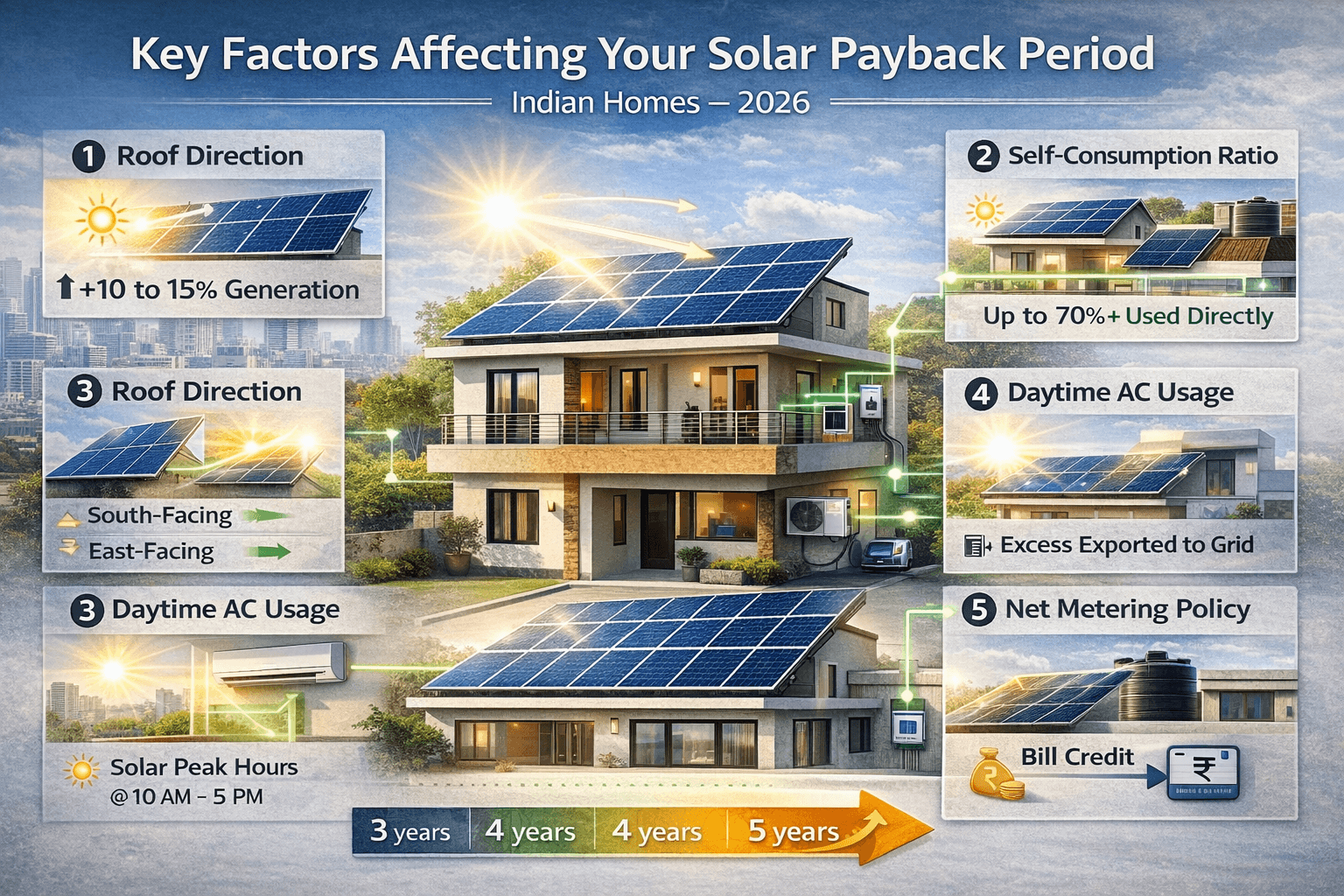
Even within the same city, these factors shift your payback timeline:
Roof direction:
South or west-facing roofs generate 10 to 15% more than east-facing ones.
Self-consumption ratio:
Using 70%+ of generated solar directly gives better returns than exporting most of it at net metering credit rates.
AC usage pattern:
Daytime AC usage aligns perfectly with solar peak generation hours, improving self-consumption.
Shading:
Even partial shading from a water tank or neighboring building can reduce output by 15 to 20%.
Net metering policy:
Gujarat and Maharashtra both have active net metering, so exported units earn bill credits.
Your payback will be on the shorter end of the range if:
Your monthly electricity bill is above Rs. 10,000
You run 1 or more ACs during daytime (10 AM to 5 PM)
You own an independent house or villa with good roof access
Your roof faces south or west with minimal shading
You apply for PM Surya Ghar subsidy (reduces capital cost by Rs. 30,000 to 78,000)
Earthwave is a full-service Solar EPC company based in Surat, Gujarat, serving homeowners across Gujarat and Madhya Pradesh since 2018.
They do not give you a generic "3-4 year ROI" claim.
Their engineers conduct a free site visit, assess your actual roof conditions, measure sun exposure, and calculate your exact generation forecast.
They use Wave Series on-grid inverters with up to 98.6% efficiency, which directly improves annual generation and savings accuracy.
They handle all PM Surya Ghar subsidy paperwork, DISCOM approvals, and net metering connection so your net investment is reduced from day one.
River Penta Sky: 30kW residential
Casa Amorina: 30kW residential
Shivdhara Skylight: 80kW
Pari Textile, Surat: 170kW commercial
These are real installations with real performance data, not estimates.
Generic payback calculators online give you a rough number. Your actual payback depends on your specific bill, roof, and location.
Pull out your last 3 electricity bills and note total monthly units consumed.
Check which tariff slab you fall into using your DISCOM name (DGVCL, UGVCL, MSEDCL, or MPEZ).
Contact Earthwave for a free site assessment and personalized payback calculation.
Gujarat: +91 90336 07212
Madhya Pradesh: +91 90336 02156
Email:
Website:
At Rs. 5,000 per month, solar is marginally viable with a payback of 5 to 7 years for a 3kW system. It makes stronger financial sense once your bill crosses Rs. 8,000 per month consistently, especially in cities like Surat and Mumbai where upper slab tariffs are steep.
Yes, significantly. With net metering, the units you export to the grid reduce your future bills. In Gujarat, net metering is well-established under GERC regulations. This means even if you consume only 60% of your solar output directly, the remaining 40% still earns you bill credits, improving your effective savings.
MERC has approved gradual tariff reductions through 2029-30. However, current tariffs remain among India's highest and even at reduced future rates, the payback period stays under 3 to 4 years for high-consumption Mumbai households. Solar locks in your savings at today's high tariff before reductions fully take effect.
Under PM Surya Ghar Muft Bijli Yojana, you receive Rs. 30,000 for a 1kW system, Rs. 60,000 for 2kW, and Rs. 78,000 for 3kW and above. For larger systems (5kW to 10kW), the subsidy is capped at the 3kW amount of Rs. 78,000 but still meaningfully reduces your net investment.
Online calculators give directional estimates only. They do not account for your actual tariff slab, roof angle, local shading, self-consumption ratio, or DISCOM-specific net metering credits. A proper payback calculation requires a site assessment by a qualified EPC company that factors in all these variables specific to your home.
FAQS
Can't find the answer you're looking for? Our team is here to help.
SUBSCRIBE NEWSLETTER
Switching to solar is easier than you think. Let us guide you to cleaner, more affordable energy.
