Solar Site Survey
How a Solar Site Survey Works Before EPC Begins
2026-06-12T00:00:00.000Z•9

A solar site survey is the on-ground engineering audit your EPC partner runs before any contract, design, or panel order, to verify shadow patterns, structural strength, electrical capacity, and generation potential of your site.
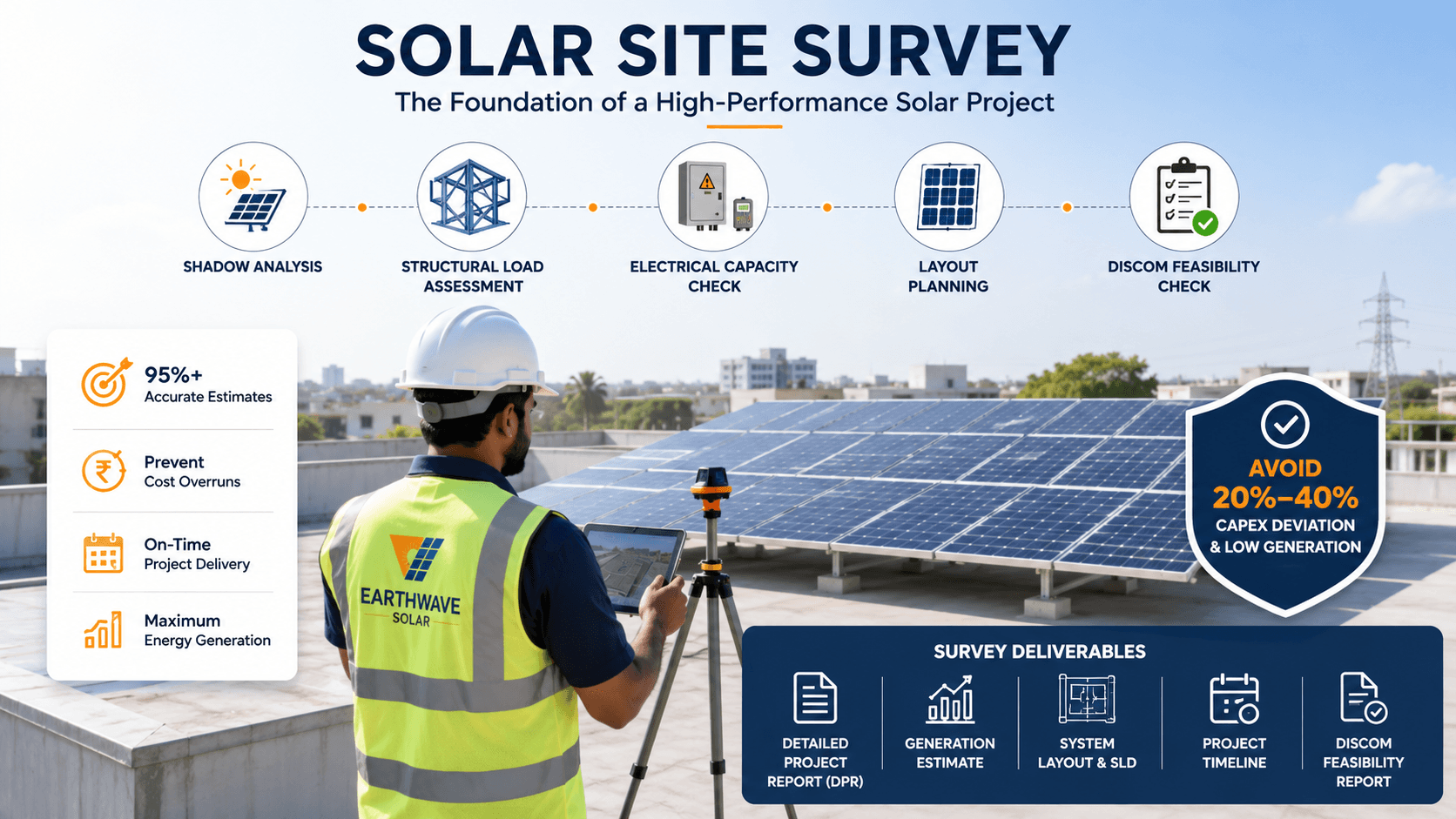
Done right, it locks your CAPEX, generation estimate, and timeline with 95%+ accuracy and prevents the cost overruns that kill 1 in 3 poorly-planned solar projects.
If you are new to the broader workflow, start with our guide on the solar EPC process in Gujarat before reading this article.
A solar site survey is a physical, engineering-grade audit of your roof or land before the EPC contract is signed.
It covers shadow analysis, structural load, electrical infrastructure, layout planning, and DISCOM feasibility.
A proper survey takes 1 to 5 days and produces a Detailed Project Report (DPR) plus a generation estimate.
Skipping or shortcutting the survey causes 20% to 40% CAPEX deviations, low generation, and DISCOM delays.
A serious EPC like
bundles this audit into Step 2 of its process before any quotation is locked.
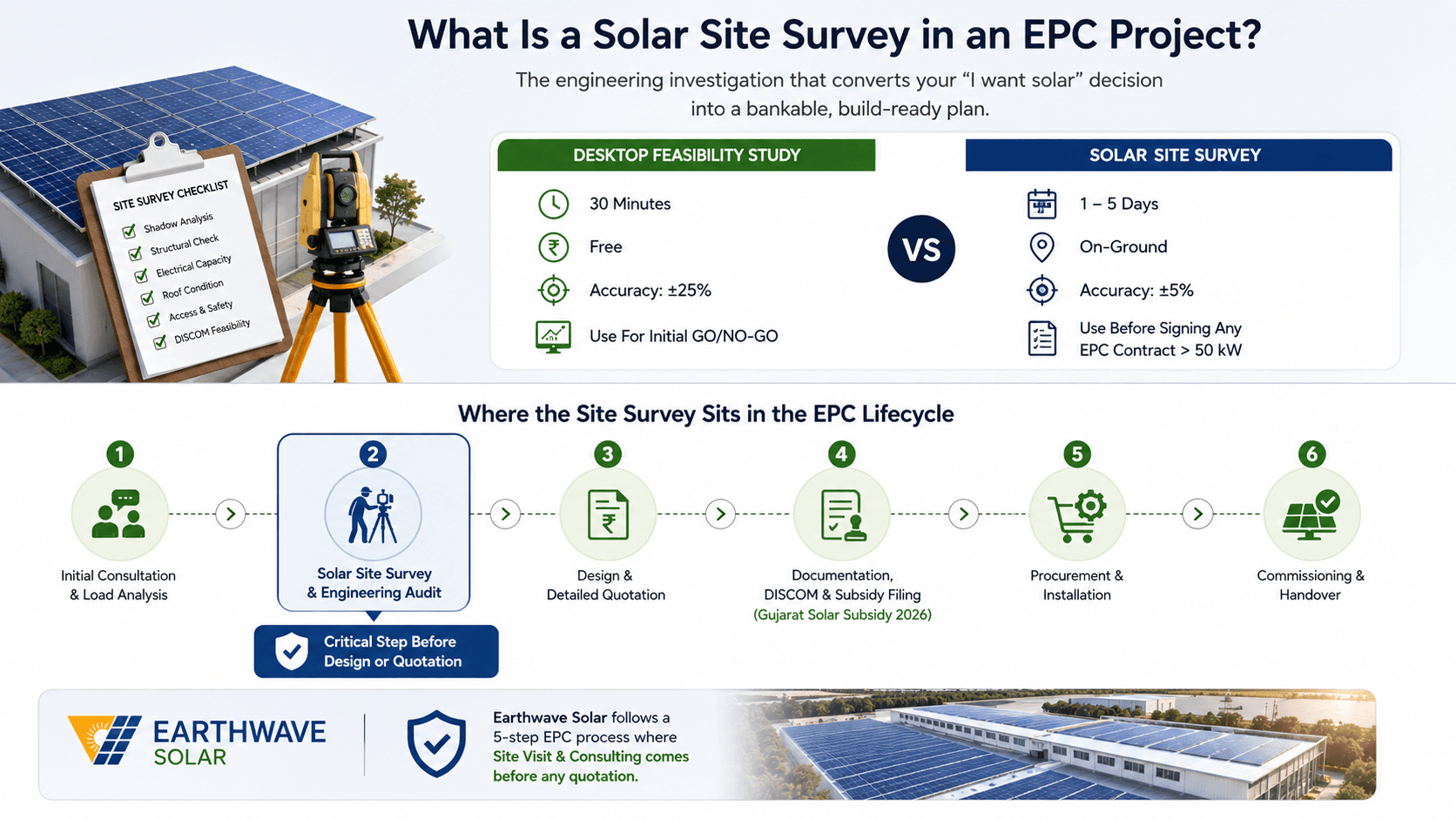
A solar site survey is the engineering investigation that converts your "I want solar" decision into a bankable, build-ready plan. It is the bridge between intent and execution in the EPC workflow.
A site survey is physical and project-grade. A desktop feasibility study is a quick screening done on Google Earth and satellite irradiance data.
Desktop feasibility study:
30 minutes, free, accuracy of plus or minus 25%.
Solar site survey:
1 to 5 days, on-ground, accuracy of plus or minus 5%.
Use case:
Use desktop for initial GO/NO-GO. Use the site survey before signing any EPC contract above 50 kW.
The site survey is Step 2 in a clean EPC workflow, right after the initial consultation and before design, quotation, or BOM.
Initial consultation and load analysis
Solar site survey and engineering audit
Design and detailed quotation
Documentation, DISCOM, and subsidy filing (see
Procurement and installation
Commissioning and handover
This is exactly how Earthwave Solar structures its 5-step process, with Site Visit & Consulting placed before any quotation goes out.
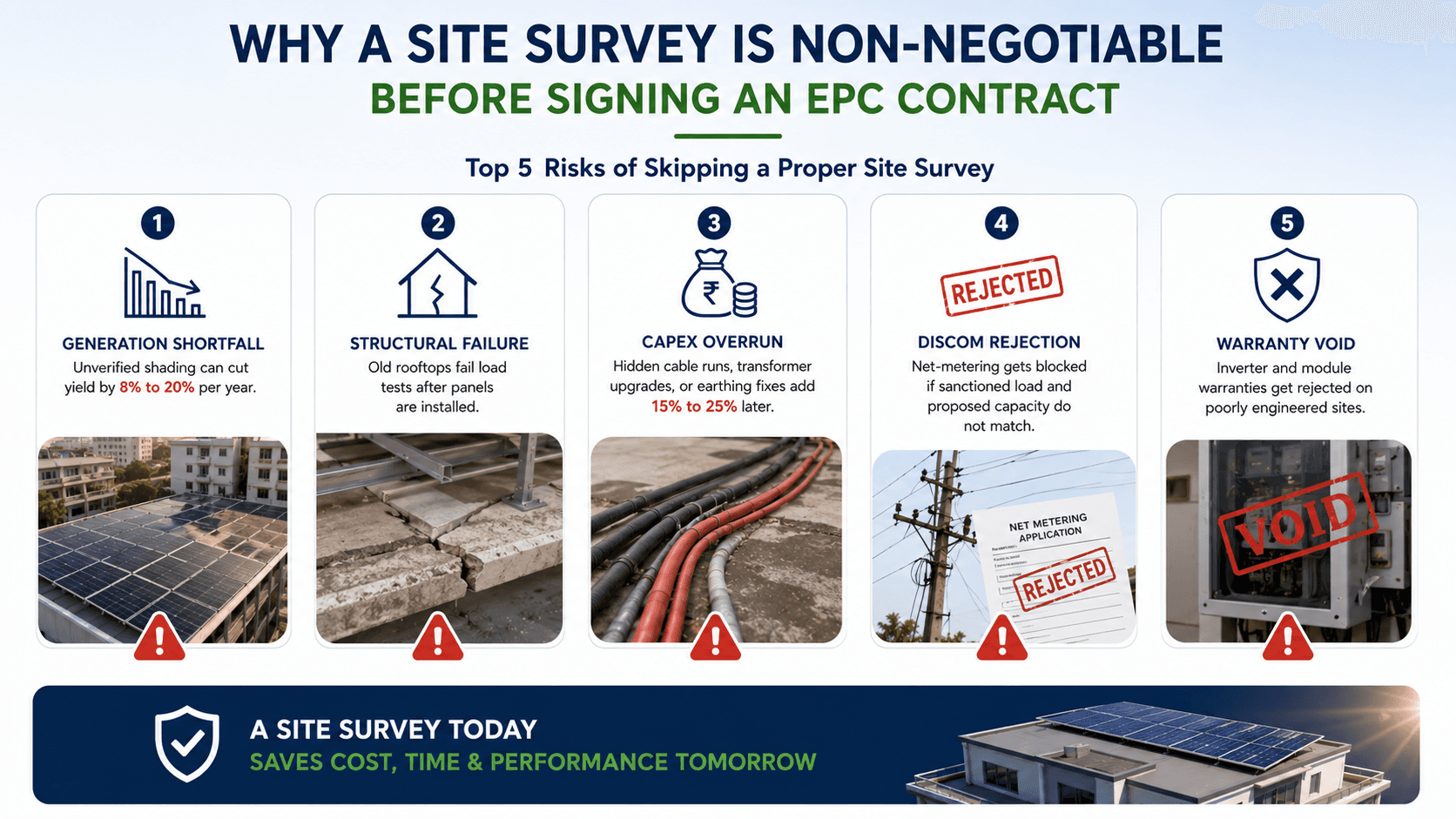
Skipping the pre-EPC site survey is the single biggest reason solar projects under-perform or blow their budget. The survey is your only objective evidence that the proposal in front of you is real. For a deeper buyer-protection lens, read our breakdown of solar EPC red flags in Gujarat.
Generation shortfall:
Unverified shading can cut yield by 8% to 20% per year.
Structural failure:
Old rooftops fail load tests after panels are installed.
CAPEX overrun:
Hidden cable runs, transformer upgrades, or earthing fixes add 15% to 25% later. See our
solar EPC cost guide for Gujarat factories
.
DISCOM rejection:
gets blocked if sanctioned load and proposed capacity do not match.
Warranty void:
Inverter and module warranties get rejected on poorly engineered sites.
A precise survey tightens your CAPEX band from "plus or minus 25%" to "plus or minus 5%". For a 500 kW plant at roughly ₹3.5 Cr, that single audit protects ₹50 to ₹70 lakhs of investment risk and locks a 5 to 7 year payback.
A 170 kW textile rooftop project at Pari Textile, Diamond Nagar required a proper pre-installation audit because of mixed roof zones. A skipped survey would have placed 20% of the modules in shadow zones during winter mornings. The on-site shadow analysis re-routed those strings and protected nearly ₹4 lakhs of annual generation revenue. For more textile sector insights, read solar for textile units in Surat.
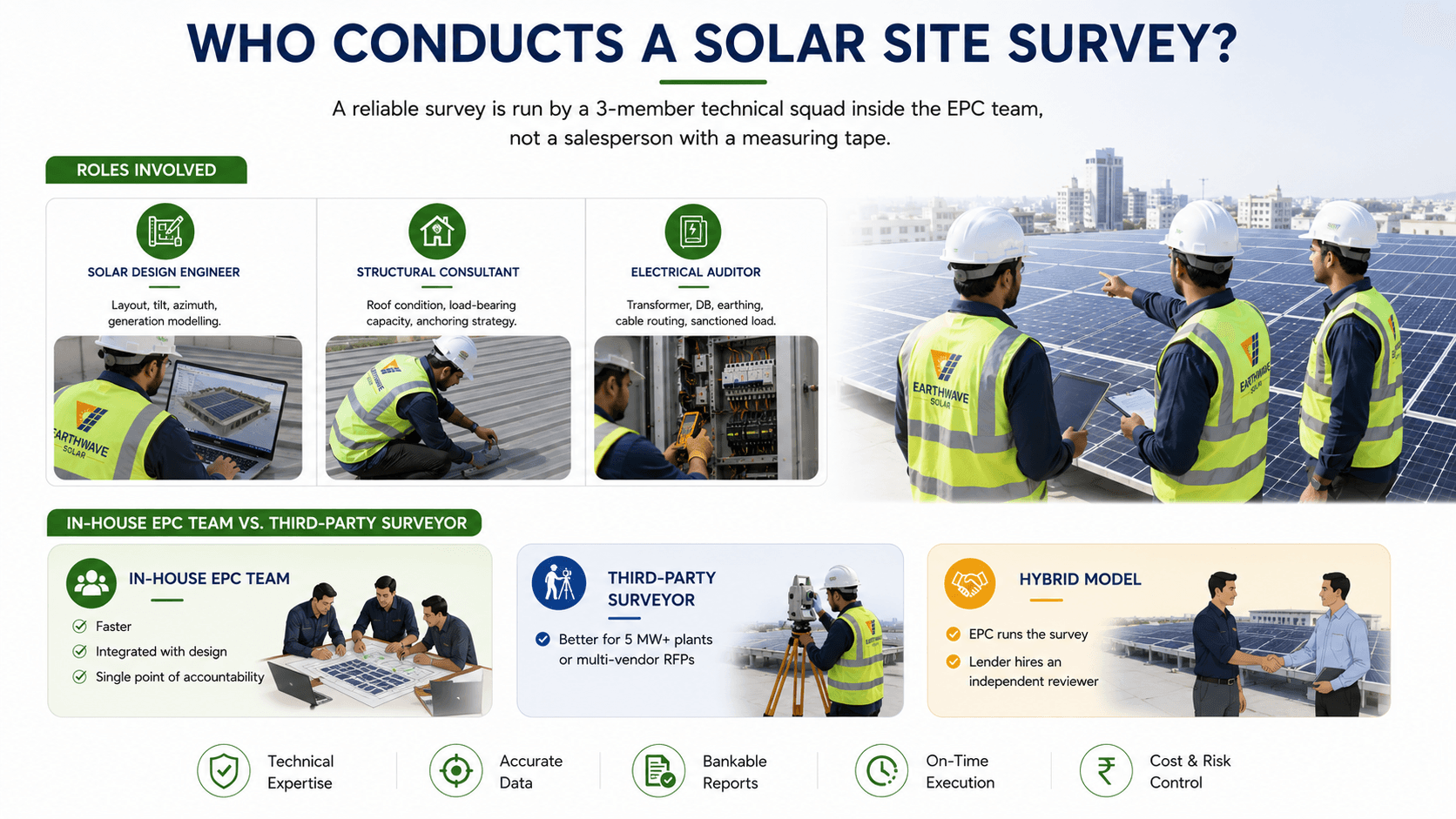
A reliable solar site survey is run by a 3-member technical squad inside the EPC team, not a salesperson with a measuring tape. Meet our engineering and leadership team to see how this works in practice.
Solar design engineer:
Layout, tilt, azimuth, generation modelling.
Structural consultant:
Roof condition, load-bearing capacity, anchoring strategy.
Electrical auditor:
Transformer, DB, earthing, cable routing, sanctioned load.
Choose an in-house EPC survey team for accountability, third-party only for very large or sensitive sites. Use our solar EPC company checklist to vet either option.
In-house EPC team:
Faster, integrated with design, single point of accountability.
Third-party surveyor:
Better for 5 MW plus plants or multi-vendor RFPs.
Hybrid model:
EPC runs the survey, lender hires an independent reviewer.
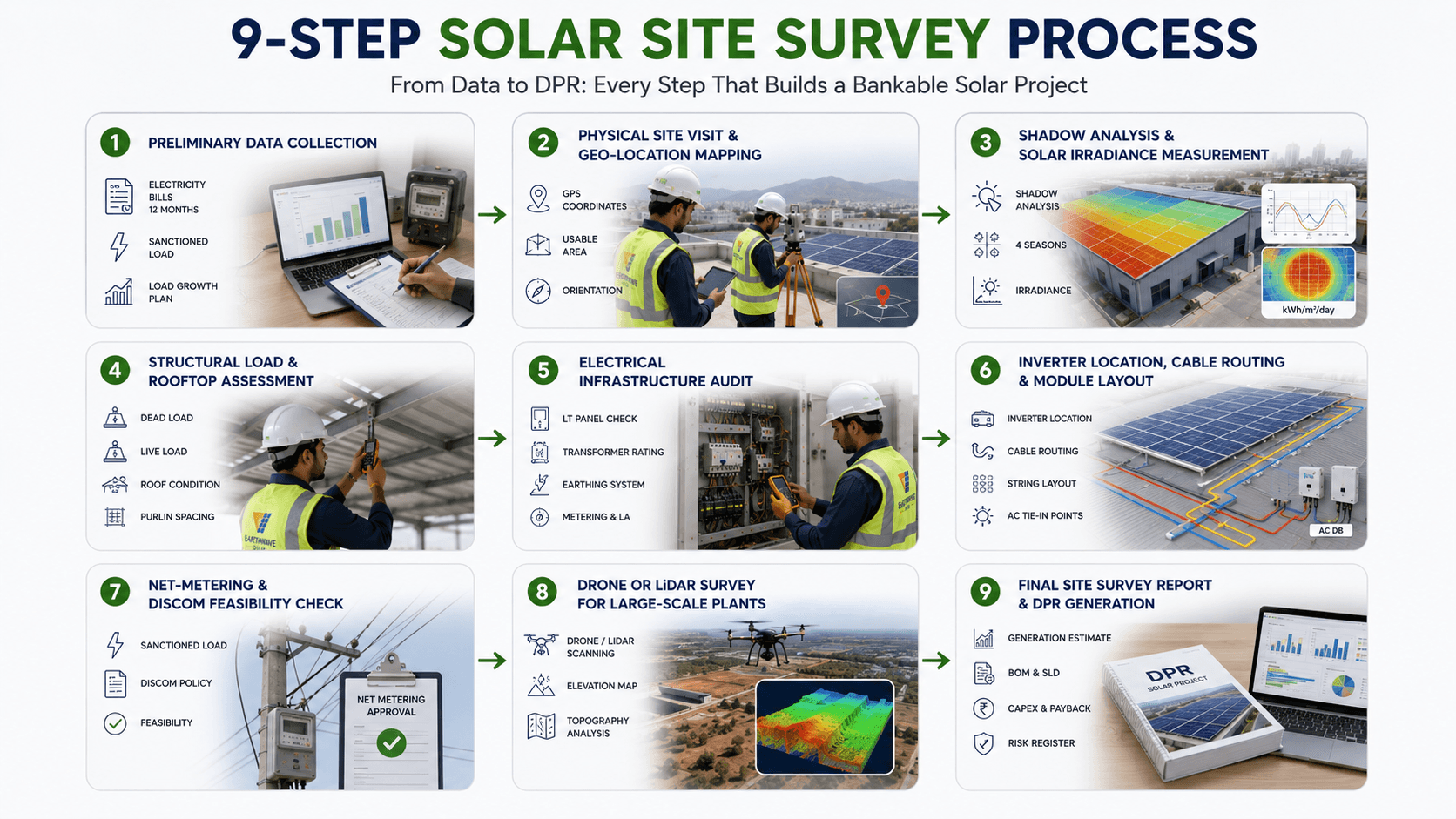
A professional pre-EPC solar site survey follows a fixed 9-step process. Each step produces a specific data point that feeds the final DPR.
The survey starts with documents, not a site visit. The EPC collects 12 months of electricity bills, sanctioned load, contract demand, and the load growth plan.
Engineers visit the site, capture GPS coordinates, measure usable area, and confirm orientation. For ground-mount projects like Earthwave Solar's 80 MW Mota Mandvada plant, drone-based geo-mapping replaces manual measurement. See more in our ground-mounted solar plant India guide.
Engineers run shadow simulations across all 4 seasons using solar pathfinder readings and PVsyst or Helioscope models. The output is a year-round shading map and a site-specific irradiance value, not a city average. For cloudy region readers, also see do solar panels work on cloudy days in India.
A structural engineer checks dead load, live load, beam spacing, and roof age. Industrial sheet roofs are tested for purlin spacing. RCC roofs are checked for waterproofing and core strength. Pair this with our guide on choosing the right solar mounting structure and the land and civil engineering checklist for ground-mounted projects in Gujarat.
The electrical auditor inspects the LT panel, transformer rating, earthing pits, lightning arrestor, and metering. The goal is to confirm the grid can absorb the proposed kW without upgrades, or to budget the upgrade upfront.
The team finalises inverter rooms, DC cable lengths, AC tie-in points, and string layout. Cable losses above 2% are flagged and re-routed at this stage, not after installation. Refer to our solar inverter guide for India and how to integrate Wave on-grid inverters.
The EPC verifies whether your sanctioned load supports the proposed kW under your state DISCOM policy. For Gujarat readers, see Gujarat rooftop solar policy 2026 and net-metering solar income in Gujarat.
For ground-mount or rooftop sites above 500 kW, drone and LiDAR scans produce centimetre-accurate elevation maps. This avoids costly civil rework on uneven terrain. See pricing context in ground-mounted solar plant cost in India.
The audit closes with a Detailed Project Report covering generation estimate, BOM, SLD, CAPEX, payback, and risk register. This DPR is what the CFO signs off on, not the brochure. Cross-check the numbers using our solar installation cost in India benchmarks.

A credible pre-EPC solar feasibility assessment uses calibrated instruments, not eyeballing. The equipment list reveals whether your EPC is serious or shortcutting.
Pyranometer:
Measures direct irradiance in W per sq.m.
Solar pathfinder:
Maps sun path and shadow obstructions.
Anemometer:
Captures wind speed for structural load calculation.
Lux meter and IR thermometer:
Surface temperature and reflectivity checks.
PVsyst and Helioscope:
Generation modelling and shading loss analysis.
AutoCAD and SketchUp:
Layout and 3D modelling.
DJI drones with LiDAR payloads:
Land contour and obstacle mapping.
Post-commissioning, this data plugs into a solar SCADA monitoring system for live performance tracking.
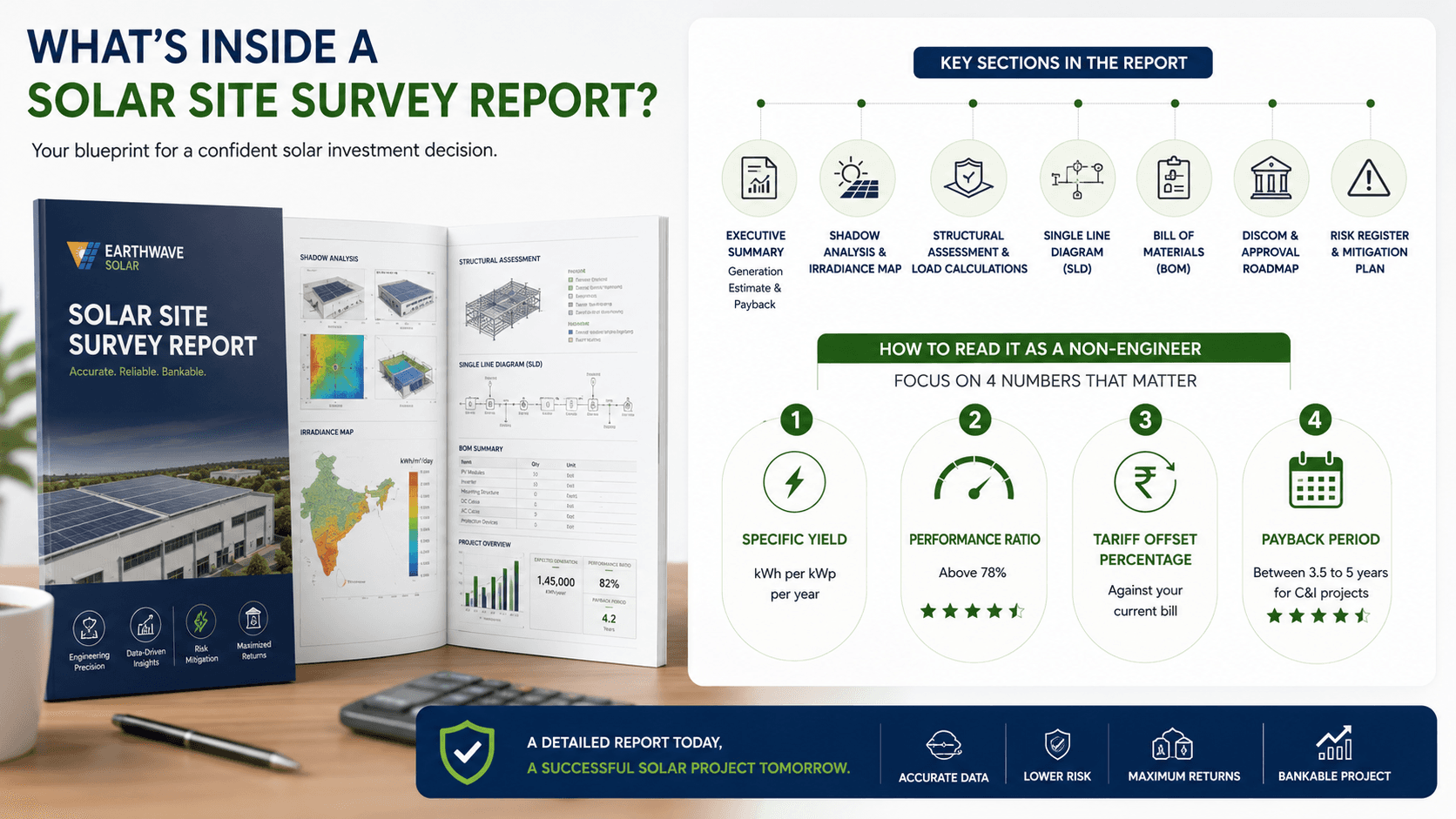
A complete solar site survey report runs 25 to 60 pages and gives you everything needed to sign or reject the EPC contract with confidence. For technical depth, refer to our datasheets library.
Executive summary with generation estimate and payback
Shadow analysis and irradiance map
Structural assessment and load calculations
Single Line Diagram (SLD)
Bill of Materials (BOM)
DISCOM and approval roadmap
Risk register and mitigation plan
Focus on 4 numbers as a CFO or facility head:
Specific yield
in kWh per kWp per year
Performance Ratio (PR)
above 78%
Tariff offset percentage
against your current bill (see commercial solar electricity cost savings)
Payback period
between 3.5 and 5 years for C&I, factoring in
A pre-EPC solar site survey takes 1 to 5 days on site and 5 to 10 working days for the final report. Most reputable EPCs absorb the cost when the contract is signed.
Residential rooftop (up to 30 kW):
4 to 8 hours on site, 3 days for report. See
how to plan rooftop solar for homes
.
C&I rooftop (50 kW to 1 MW):
1 to 2 days on site, 5 to 7 days for report. See
.
Ground-mount (1 MW plus):
3 to 5 days on site, 10 to 14 days for report.
Free survey:
Standard for projects above 50 kW, refunded against advance.
Paid survey:
₹15,000 to ₹1.5 lakhs for large ground-mount, adjustable in contract value.
Red flag:
Any EPC that quotes pricing
without
a site visit. Detailed warning signs are in our
guide.
For financing structures, compare CAPEX vs RESCO solar financing.
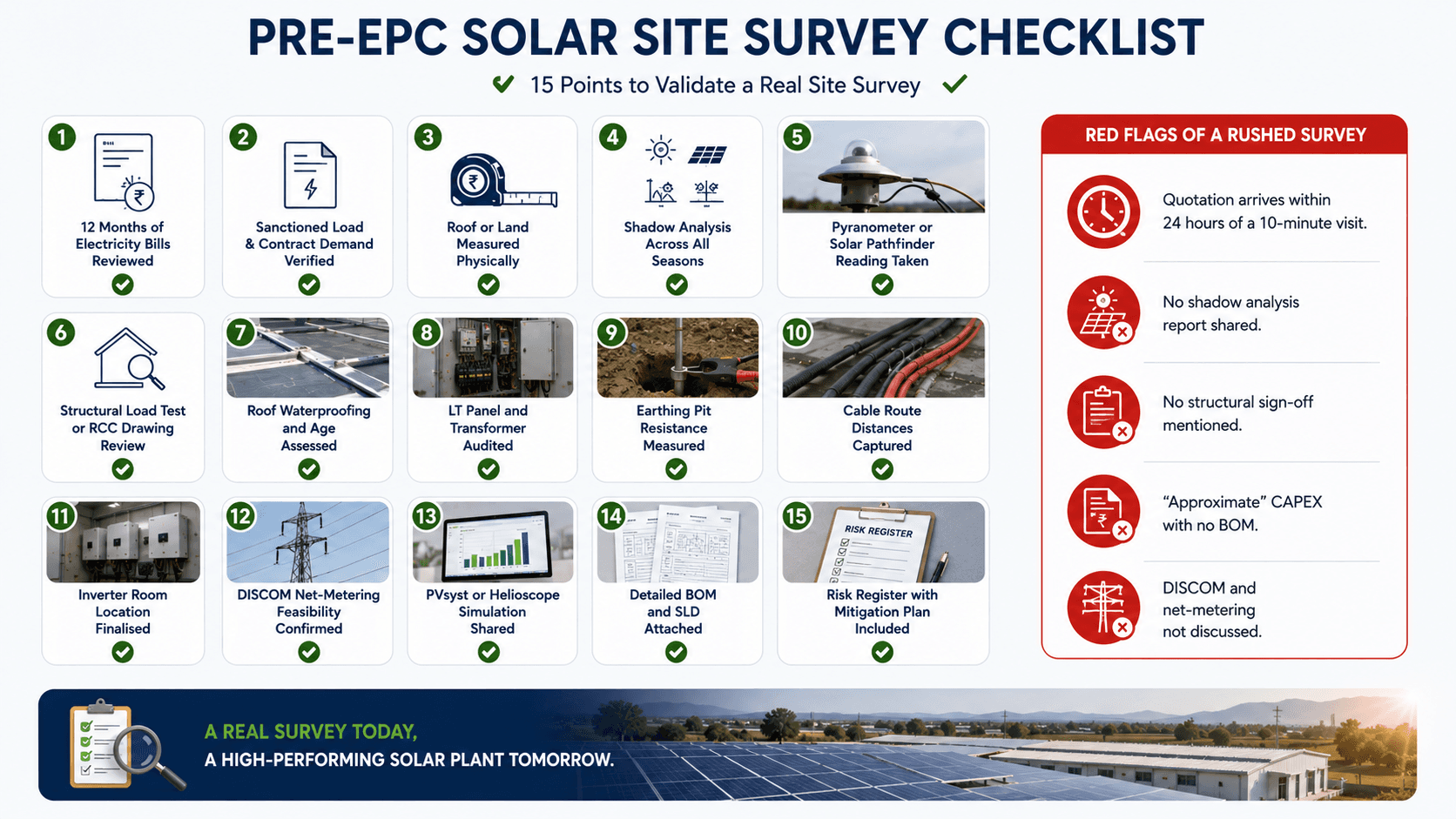
Use this 15-point checklist to validate whether your EPC ran a real survey or a desktop exercise. Combine it with our broader solar EPC company checklist for India.
12 months of electricity bills reviewed
Sanctioned load and contract demand verified
Roof or land measured physically
Shadow analysis across all seasons
Pyranometer or solar pathfinder reading taken
Structural load test or RCC drawing review
Roof waterproofing and age assessed
LT panel and transformer audited
Earthing pit resistance measured
Cable route distances captured
Inverter room location finalised
DISCOM net-metering feasibility confirmed
PVsyst or Helioscope simulation shared
Detailed BOM and SLD attached
Risk register with mitigation plan included
Quotation arrives within 24 hours of a 10-minute visit.
No shadow analysis report shared.
No structural sign-off mentioned.
"Approximate" CAPEX with no BOM.
DISCOM and net-metering not discussed.
Use these questions to separate a real EPC from a reseller before and after the survey.
Who from your team will visit and what are their qualifications?
Which software do you use for shadow and generation analysis?
Will the survey include a structural sign-off?
Do you check
DISCOM and net-metering feasibility
on site?
What is the Performance Ratio you have modelled?
What are the top 3 risks in my site and how will you mitigate them?
Can I see the BOM, SLD, and DPR before payment?
What generation guarantee will you back contractually?
Most CAPEX surprises come from the client side, not the EPC side. Avoid these 3 mistakes.
Hiding load data:
Sharing partial bills leads to under-sized systems.
Skipping facility team involvement:
Maintenance teams know the roof leaks, beams, and downtime windows. They are also key to long-term
.
Accepting verbal estimates:
If it is not in a signed DPR, it does not exist.
A serious solar site survey is the single highest-ROI activity in the entire EPC lifecycle. It directly moves three numbers that decide the project's success.
Generation:
5% to 12% higher annual yield through precise tilt, azimuth, and shading.
CAPEX:
8% to 15% lower because cable runs, structures, and BOM are right-sized. Benchmark against
.
Payback:
Compresses by 6 to 12 months on a typical 500 kW plant. See
solar payback period India 2026
.
This is why a strong EPC partner treats the survey as engineering, not sales.
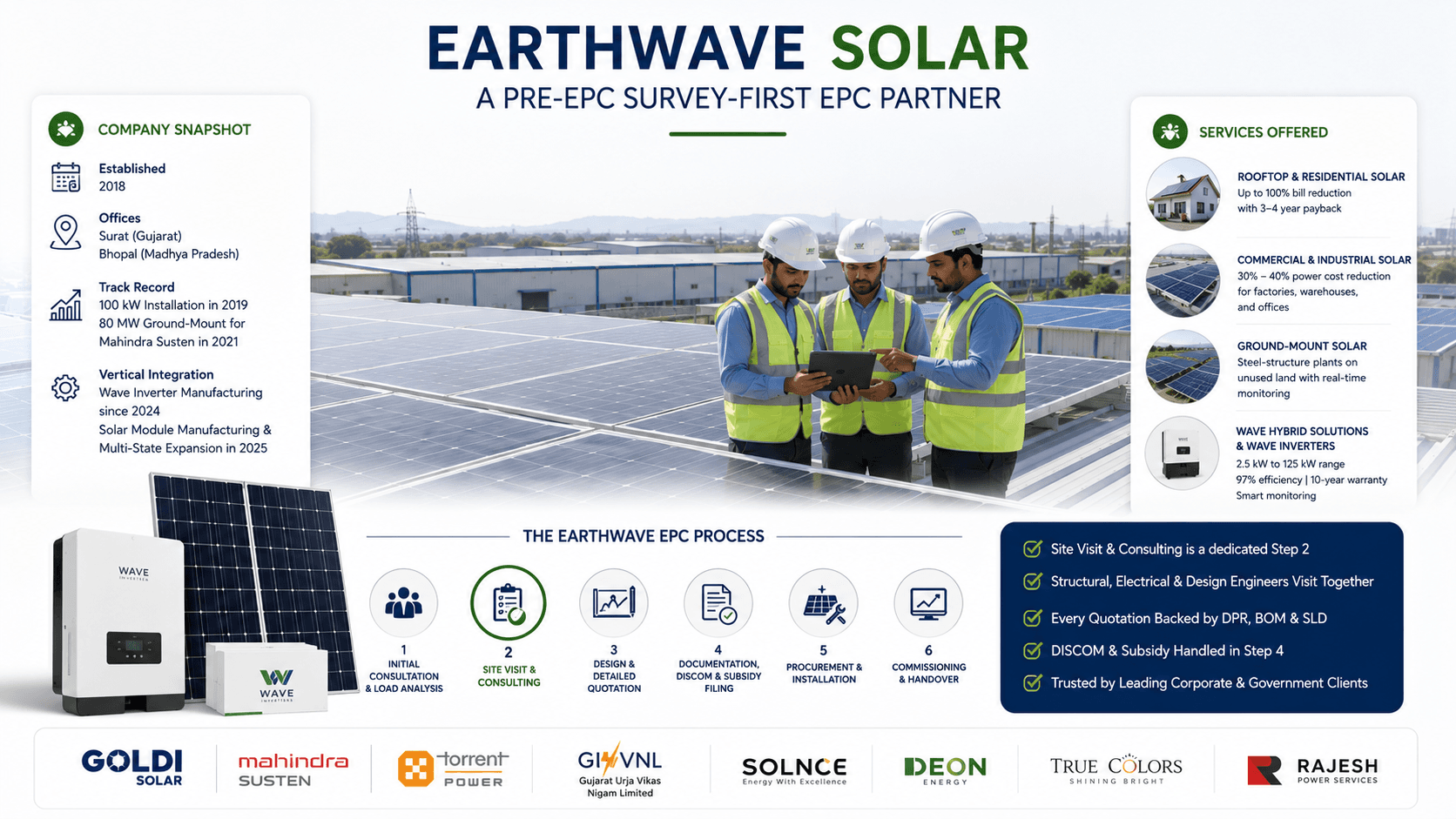
Earthwave Solar is a complete EPC solutions company that built its reputation by running engineering-grade site surveys before quoting a single rupee.
Established:
2018, with offices in Surat (Gujarat) and Bhopal (Madhya Pradesh).
Track record:
First 100 kW installation in 2019, 80 MW ground-mount executed for Mahindra Susten in 2021. Browse our full
.
Vertical integration:
In-house
since 2024, solar module manufacturing and multi-state expansion in 2025.
and
:** Up to 100% bill reduction with 3 to 4 year payback.
*Commercial and industrial solar
:** 30% to 40% power cost reduction for factories, warehouses, and offices.
:** Steel-structure plants on unused land with real-time monitoring.
and Wave Inverters:** 2.5 kW to 125 kW range, 97% efficiency, 10-year warranty, smart monitoring.
Site Visit and Consulting is a dedicated Step 2 in the Earthwave process, not a sales call.
Structural, electrical, and design engineers visit together.
Every quotation is backed by a written DPR, BOM, and SLD.
DISCOM and subsidy paperwork are handled in Step 4, after the survey locks the design.
Trusted by Goldi Solar, Mahindra Susten, Torrent Power, GUVNL, Solnce, Deon Energy, True Colors, and Rajesh Power Services.
A professionally conducted site survey is 90% to 95% accurate in predicting annual generation. The remaining variance comes from weather and grid uptime, both outside the EPC's control.
Remote-only surveys work for preliminary feasibility up to 10 kW. For anything above 50 kW, a physical visit is mandatory because structural and electrical risks cannot be verified on satellite images.
For projects below 500 kW, most EPCs including Earthwave Solar offer the survey free. For large ground-mount plants, a refundable engineering fee of ₹15,000 to ₹1.5 lakhs is standard.
The EPC proposes alternatives such as elevated structures, ground-mount on adjacent land, or a phased rollout. See rooftop vs ground-mounted solar for industrial sites for that decision tree.
A feasibility study is a quick desktop check to confirm if solar makes sense. A site survey is the on-ground engineering audit that locks the design, BOM, generation, and CAPEX before the contract is signed.
If you are evaluating a rooftop, ground-mount, or carport solar project above 50 kW, the next right step is a proper engineering audit, not another sales quotation.
Book a free pre-EPC site survey with Earthwave Solar at www.earthwavetech.in or visit our contact page. For more guides, explore the full Earthwave Solar blog library.
You walk away with a written DPR, generation estimate, BOM, and CAPEX, even if you decide not to sign. That is what a survey-first EPC partner looks like.
FAQS
Can't find the answer you're looking for? Our team is here to help.
SUBSCRIBE NEWSLETTER
Switching to solar is easier than you think. Let us guide you to cleaner, more affordable energy.
